Markets
How Are Prices Set In a Market?
Quick answer
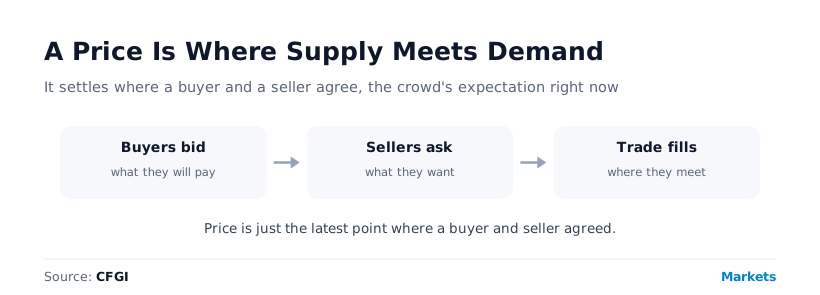
A price is set where a buyer and a seller agree. Across the whole market, it settles where supply meets demand, discovered continuously through an order book of bids and offers: when more money wants in than out, price rises until enough sellers appear, and the reverse when fear takes hold. So a price is not a fixed fact, it is the crowd’s collective expectation at that moment, which is why it can detach from value. This is education, not financial advice.
CFGI data
A price is the crowd’s expectation, and expectation is emotional. CFGI reads the buying and selling pressure behind prices, including order-book pressure and exchange flows, as part of a 0 to 100 Fear and Greed score, tracked across hundreds of assets every 15 minutes since March 2022.
Source: CFGI methodology and dataset, March 2022 to June 2026.
Key takeaways
- A price is the point where a buyer and seller agree.
- The market discovers price through an order book of bids and offers.
- Expectations move price, and price then changes expectations.
- A price is the crowd’s collective mood, not a fixed fact.
- Price can detach from underlying value at extremes.
Supply and Demand Set the Price
At its simplest, price is set by supply and demand. When more money wants to buy than to sell, buyers compete and price rises until enough sellers are tempted in. When more want to sell, price falls until buyers appear. The price is wherever those two pressures balance, and it updates with every trade. No committee or authority sets it; it emerges, moment to moment, from the collective decisions of everyone willing to buy or sell.
How the Market Discovers a Price
The mechanism by which this happens is called price discovery, and on a modern market it runs through an "order book". At any instant, would-be buyers post the prices they are willing to pay (bids) and would-be sellers post the prices they will accept (asks). The gap between the highest bid and the lowest ask is the "bid-ask spread", and a trade happens whenever a buyer and seller meet in the middle, the price of that last trade becomes "the price". It is a continuous, real-time auction: as orders pour in and get filled, the balance shifts and the price ticks up or down. This is why a price can change in a fraction of a second, and why a large order can move it noticeably, it consumes the available bids or asks and forces the next trade to happen at a different level.
Why Expectations Matter So Much
Buyers and sellers are not just reacting to today; they are betting on tomorrow. Each one is acting on what they expect to happen, and crucially, on what they think everyone else will do next, an idea the economist John Maynard Keynes likened to a "beauty contest" where you try to guess not the best choice but the choice the crowd will make. That makes markets reflexive: a rising price makes people more optimistic, which fuels more buying, which lifts the price further, until it does not. Because the price is built on collective expectation rather than fact, it moves on shifts in mood and belief just as much as on hard news, sometimes more.
Price Is a Mood, Not a Fact
Two people can look at the same asset and disagree on its worth. The price is simply where the crowd currently agrees, which is why it moves on sentiment as much as on news.
Price, Value and the Gap Between Them
A price is the market’s best collective guess at an asset’s worth, and much of the time it is a remarkably good one, instantly digesting news and information into a single number. But "the crowd’s current estimate" and "true value" are not the same thing, and the gap between them is where the most important market behaviour lives. Driven by emotion, prices routinely overshoot: in a bubble, greed pushes price far above any reasonable value, and in a panic, fear drags it far below. This is the difference between price and value that underpins all contrarian thinking, the belief that at extremes the crowd’s agreed price has drifted away from what the asset is really worth, creating opportunity for those willing to bet against the mood. A price tells you what the crowd thinks today, not what something is ultimately worth.
Price Is Not the Same As Value
The market price is the crowd’s current estimate, and emotion makes it overshoot, soaring above value in bubbles and sinking below it in panics. The gap between price and value is where opportunity hides.
How Does CFGI Read the Pressure Behind Price?
Because price reflects buying and selling pressure, CFGI reads that pressure directly: order-book depth, exchange flows and volume are among the 10 indicators behind its Fear and Greed Index. The result is a single 0 to 100 read on the market’s mood. In effect, where a price tells you the single number the crowd has agreed on, the Fear and Greed Index tells you about the emotion driving that agreement, whether the buying pressure lifting a price is calm and broad-based or a frenzy of greed, and whether the selling is orderly or a panic. Reading both, the price and the mood behind it, gives a fuller picture than the price alone, which is just the visible tip of all that underlying pressure.
Frequently asked questions
Who decides the price of an asset?
No one decides it; the market discovers it. A price is where a buyer and seller agree, and across the whole market it settles where supply and demand balance, through a continuous order-book auction of bids and offers.
How does price discovery work?
Buyers post bids and sellers post asks in an order book; a trade happens when they meet, and that last trade becomes "the price". It is a continuous real-time auction, which is why a large order can move the price by consuming the available bids or asks.
Is a market price the "true" value?
No. It is the crowd’s current estimate, not a fixed truth. Driven by emotion, prices overshoot, soaring above value in bubbles and below it in panics. The gap between price and value is exactly why sentiment is worth measuring.
Why do prices change so often?
Because expectations change constantly. Every piece of news, and every shift in mood, changes how much buyers and sellers are willing to pay, so the balance point in the order book moves, sometimes many times a second. This is education, not financial advice.
CFGI.io, Market sentiment research
The CFGI research team builds and maintains the CFGI Fear and Greed Index: a 0 to 100 sentiment score from 10 sub-indicators across hundreds of crypto assets and the equity market, refreshed every 15 minutes. We have tracked market emotion through multiple full crypto and equity cycles.
Think we missed something?
Spotted a gap, disagree with a take, or think we should cover a new topic? Message us and we'll act on your input.
Message us on TelegramKeep reading
This article is educational and is not financial advice. Crypto and equities are volatile and you can lose money. See our disclaimer.