Stocks
What Is a Margin Call?
Quick answer
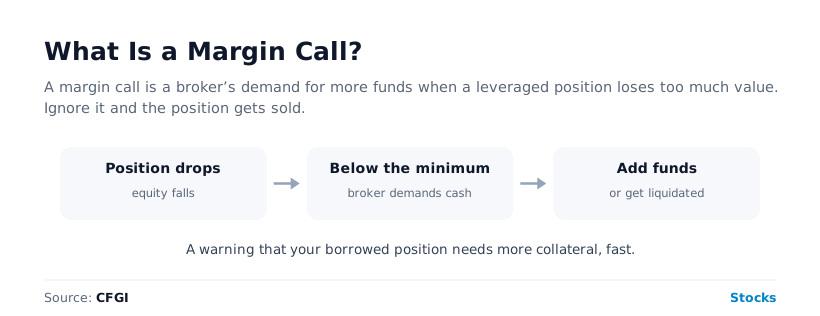
A margin call is a demand from your broker to add more money or collateral when a position bought with borrowed funds has lost enough value to fall below the required minimum equity. If you do not meet the call, the broker can sell your holdings to repay the loan, often automatically and at the worst possible time. Margin calls are the mechanism by which leverage turns an ordinary drop into forced selling, and they can be brutal.
CFGI data
Margin calls are a fear accelerant. They cluster in sharp sell-offs, forcing leveraged investors to sell into falling prices, which deepens the drop. That feedback loop is part of why markets can reach Extreme Fear, below 20 on CFGI’s 0 to 100 scale, so quickly once the selling starts.
Source: CFGI dataset, 2021 to June 2026.
Key takeaways
- A margin call demands more funds on a losing leveraged position.
- It triggers when account equity falls below the maintenance minimum, often 25%.
- Unmet, the broker can sell your holdings without warning to repay the loan.
- Margin calls turn drops into forced selling and can cascade.
- The cure is to use less leverage and keep a cushion.
When Borrowed Money Runs Short
Buying on margin means borrowing from your broker to buy more than your own cash allows. In exchange for the loan, the broker requires you to keep a minimum amount of your own equity in the account at all times. If your positions fall far enough that your equity drops below that line, you get a margin call: add funds or collateral promptly, or the broker will close positions to protect the money it lent you.
The Margin Rules: Initial and Maintenance
Two thresholds govern a margin account. The "initial margin", set in the US by the Federal Reserve’s Regulation T, lets a broker lend you up to 50% of a purchase, so to buy 10,000 dollars of stock you must put up at least 5,000 of your own. The "maintenance margin", set by industry rules at a minimum of 25% (brokers often demand more), is the floor your equity must not drop below afterwards. The gap between the two is your breathing room: you can buy with 50% equity, but trouble starts only when losses drag you toward that 25% line.
A Worked Example
Numbers make it concrete. Say you buy 100,000 dollars of stock using 50,000 of your own cash and 50,000 borrowed on margin. The stock then falls 40%, to 60,000. Your loan is still 50,000, so your equity is now just 10,000, the 60,000 value minus the 50,000 you owe. As a share of the position, that is about 17%, well under the 25% maintenance requirement. A margin call lands: you must add money to rebuild your equity, or the broker starts selling. Notice how a 40% fall in the stock wiped out 80% of your money, that doubling of the loss is leverage working in reverse.
What Happens If You Don’t Pay
This is where margin turns dangerous. If you cannot meet the call, the broker can liquidate your holdings to recover its loan, and despite the friendly word "call", it is not legally required to phone you first. Most modern brokers run automated risk systems that fire off sell orders the instant your equity breaches the threshold, often at the very bottom of a sharp drop. You can be sold out of a position you were sure would recover, at the worst possible price, with no chance to react. The loss, paper until then, becomes permanent.
The Hard Rule
In a margin account, the broker’s priority is its loan, not your conviction. When equity hits the line, positions can be sold automatically and without warning.
Why Margin Calls Amplify Crashes
Margin calls do not just hurt individuals; they amplify whole market crashes. A falling market triggers calls across many leveraged accounts at once, the forced selling pushes prices lower, and the lower prices trigger still more calls, a self-reinforcing spiral identical in spirit to crypto liquidations. The most infamous example is the Wall Street Crash of 1929, when investors had bought stocks with as little as 10% down. As prices fell, a wave of margin calls forced mass selling that turned a downturn into a catastrophe, a lesson that shaped the margin rules we have today.
How to Avoid a Margin Call
- Use less leverage than the maximum on offer, borrowing the full 50% leaves you with no cushion.
- Know your "maintenance excess", how far your account can fall before a call hits.
- Keep spare cash available, so you can meet a call rather than be sold out.
- Avoid concentrating margin in a single volatile stock that can gap down fast.
Margin Calls and Market Sentiment
Margin calls are one of the hidden engines that turn fear into a self-feeding spiral. They cluster precisely in the sharp sell-offs that drive a Stock Fear and Greed Index toward Extreme Fear on its 0 to 100 scale, because forced selling begets more forced selling. Understanding how much leverage is in the market helps explain why some drops accelerate so violently while others fade. When sentiment is collapsing and leverage is high, the conditions for a margin-call cascade are all in place.
Frequently asked questions
What is a margin call?
A broker’s demand for more funds or collateral when a leveraged position has lost enough value to fall below the required minimum equity. If unmet, the broker can sell your holdings to repay the loan.
When does a margin call happen?
When your account equity falls below the maintenance margin, typically a minimum of 25% of the position’s value, though many brokers require more. A large enough loss on a margined position triggers it.
What happens if you can’t meet a margin call?
The broker can sell your positions, often automatically and without contacting you first, to recover the borrowed money, frequently at a bad price. You lock in the loss.
How do you avoid a margin call?
Use less than the maximum leverage, keep a cash cushion, know how far your account can fall before a call, and avoid concentrating margin in one volatile stock. This is education, not financial advice.
CFGI.io, Market sentiment research
The CFGI research team builds and maintains the CFGI Fear and Greed Index: a 0 to 100 sentiment score from 10 sub-indicators across hundreds of crypto assets and the equity market, refreshed every 15 minutes. We have tracked market emotion through multiple full crypto and equity cycles.
Think we missed something?
Spotted a gap, disagree with a take, or think we should cover a new topic? Message us and we'll act on your input.
Message us on TelegramKeep reading
This article is educational and is not financial advice. Crypto and equities are volatile and you can lose money. See our disclaimer.