Markets
What Is a Santa Claus Rally?
Quick answer
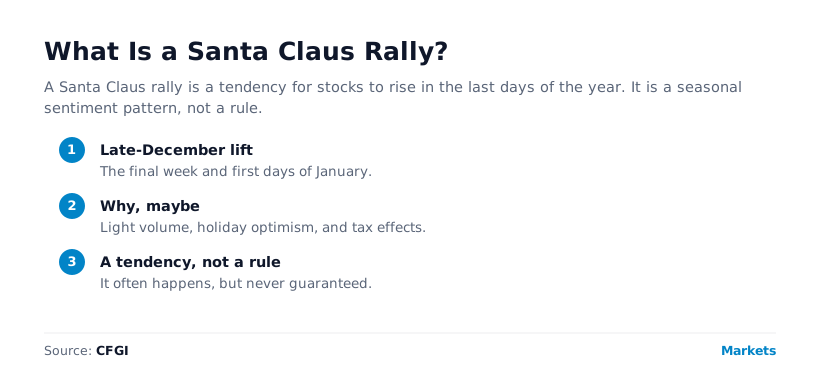
A Santa Claus rally is the market’s tendency to drift higher over the last five trading days of the year and the first two of the new one. Defined by Yale Hirsch in 1972, the S&P 500 has risen about 1.3% over this window on average since 1950, positive roughly 78% of the time. It is often attributed to holiday optimism, lighter trading and year-end positioning. Like all seasonal effects it is a historical tendency, not a guarantee, and it reflects a generally greedier, more upbeat mood into the new year. This is education, not financial advice.
CFGI data
Seasonal patterns are mild sentiment tilts, not signals. A Santa Claus rally reflects a slightly more upbeat, greedy holiday mood, but a Fear and Greed Index reads the actual current state on its 0 to 100 scale, which always matters more than the calendar. Real conditions can override any seasonal tendency.
Source: CFGI dataset and standard seasonal-market definitions, June 2026.
Key takeaways
- A Santa Claus rally is a year-end tendency for stocks to rise.
- It covers the last five and first two trading days around New Year.
- The S&P 500 has averaged ~1.3% over it, positive ~78% of the time.
- It is a seasonal tendency, not a guarantee.
- A missing one has historically hinted at a weaker year ahead.
A Festive Tendency
The term, coined by Yale Hirsch in 1972, describes a historical tendency for stocks to post small gains in the thin trading days around the turn of the year, specifically the last five trading days of December and the first two of January. Explanations vary: holiday optimism, investors putting bonuses to work, tax-driven positioning, and lighter volume that lets buyers nudge prices up. The key word is tendency. A Santa Claus rally appears often enough to be noticed, but it does not happen every year, and leaning on it as a rule is a classic seasonal trap.
The Numbers Behind It
The pattern is real in the data, if modest. Over this seven-day window since 1950, the major US indices have posted reliably positive average returns.
| Index | Average return |
|---|---|
| S&P 500 | About 1.3% |
| Dow Jones | About 1.4% |
| Nasdaq Composite | About 1.8% |
Santa Claus rally average returns since 1950.
The S&P 500 has been positive over the window roughly 78% of the time, well above the 58% positive rate of a typical seven-day stretch. So there is a genuine, if small, seasonal edge here, stronger than random, but nowhere near a sure thing.
Why It Might Happen
No single cause is agreed, but several plausible forces point the same way. The holidays bring a wave of general optimism and festive cheer that can spill into markets. Year-end bonuses get invested, tax-loss selling has largely finished, and fund managers tidy their portfolios into the new year. Crucially, trading volume is light as institutions take time off, which leaves the market thinner and easier for the remaining, often more bullish, retail buyers to nudge higher. It may also be partly self-fulfilling: because so many people know about the Santa Claus rally, some position for it, which helps bring it about. The honest answer is that it is a blend of mood, mechanics and momentum.
The Predictive Lore
The Santa Claus rally carries an intriguing piece of market folklore: its absence has historically been a warning. The old saying goes, "if Santa Claus should fail to call, bears may come to Broad and Wall." The data gives it some support, when the rally has occurred, the year ahead has tended to be stronger, with the S&P 500 averaging double-digit gains, whereas a missing or negative rally has been followed by notably weaker returns. The idea is that the year-end mood acts as a small thermometer for sentiment heading into January. As always, this is a historical correlation, not a guarantee or a mechanism, but it is part of why analysts watch the period more closely than its tiny size alone would warrant.
If Santa Fails to Call
Wall Street lore holds that a missing year-end rally hints at a rockier year ahead. The pattern has some statistical backing, but treat it as a curiosity, not a forecast.
Seasonality and Sentiment
Seasonal patterns are best seen as mild tilts in mood, not signals to trade. A Santa Claus rally reflects a marginally greedier, more upbeat backdrop, but the actual Fear and Greed Index reading at the time always matters more than the calendar. Current conditions can easily override any seasonal lean: a year-end that arrives amid genuine fear and a deteriorating economy will not float higher simply because of the date. In the long run, markets follow fundamentals, so a holiday rally not backed by real earnings and a sound outlook tends to get given back. Read the live sentiment and the fundamentals as the substance, and the festive seasonality as nothing more than background colour.
Frequently asked questions
What is a Santa Claus rally?
The market’s tendency to rise over the last five trading days of the year and the first two of the new one, defined by Yale Hirsch in 1972 and often attributed to holiday optimism and lighter trading.
How reliable is the Santa Claus rally?
It is a historical tendency, not a guarantee. The S&P 500 has averaged about 1.3% over the window since 1950 and been positive roughly 78% of the time, a genuine but small edge that does not appear every year.
Does a missing Santa Claus rally mean trouble?
Wall Street lore says "if Santa Claus should fail to call, bears may come to Broad and Wall", and the data offers some support: a positive rally has tended to precede a stronger year, a negative one a weaker year. It is a curiosity, not a forecast.
Should I trade the Santa Claus rally?
Seasonal patterns are mild tilts, not signals. The current Fear and Greed Index reading and the fundamentals matter more than the calendar, and real conditions can override any seasonal lean. This is education, not financial advice.
CFGI.io, Market sentiment research
The CFGI research team builds and maintains the CFGI Fear and Greed Index: a 0 to 100 sentiment score from 10 sub-indicators across hundreds of crypto assets and the equity market, refreshed every 15 minutes. We have tracked market emotion through multiple full crypto and equity cycles.
Think we missed something?
Spotted a gap, disagree with a take, or think we should cover a new topic? Message us and we'll act on your input.
Message us on TelegramKeep reading
This article is educational and is not financial advice. Crypto and equities are volatile and you can lose money. See our disclaimer.