Markets
What Is a Market Rally?
Quick answer
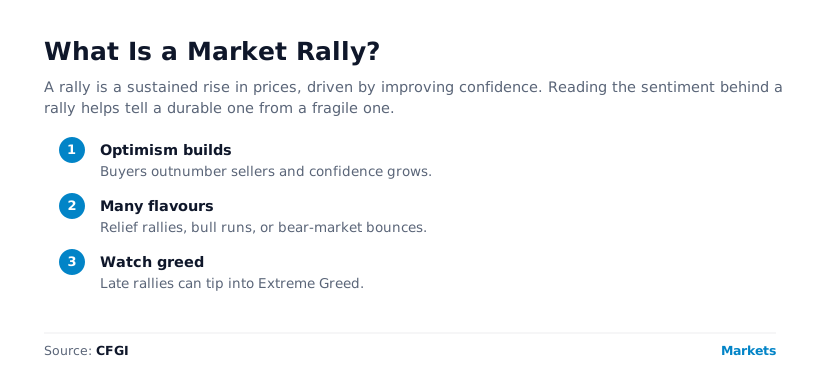
A market rally is a period of sustained rising prices, whether over hours, days or months, usually driven by improving confidence and buying demand. Rallies are the upside of the cycle, the opposite of a sell-off. Not all rallies are equal, though: a durable advance is backed by improving fundamentals and broad participation, while a fragile "bear-market rally" runs on emotion and quickly fails. Reading the breadth and the fear and greed behind a rally helps tell the two apart. This is education, not financial advice.
CFGI data
Sentiment tells you what kind of rally you are in. A rally that lifts CFGI out of fear from a low base looks healthier than one pushing an already-greedy score toward extremes on its 0 to 100 scale. The index is context for whether a rally has room or is running hot.
Source: CFGI dataset, 2021 to June 2026.
Key takeaways
- A rally is a sustained rise in prices.
- It is driven by improving confidence, demand and fundamentals.
- A bear-market rally is a fragile rally within a downtrend.
- Broad breadth signals a healthier rally than a narrow one.
- Sentiment helps tell a durable rally from a fragile one.
The Upside of the Cycle
A rally is simply a meaningful, sustained move higher. It can be short, an intraday bounce, or long, a months-long advance. What they share is rising demand: more buyers than sellers, usually fuelled by improving confidence about the future. Rallies are how bull markets are built, one advance at a time. But context matters. A rally early in a recovery, with sentiment lifting off a fearful low, is very different from a bear market rally or a late-stage surge running on greed.
What Drives a Rally
Rallies start when the balance of buyers and sellers tips decisively toward buyers, and several forces can do that. Improving fundamentals, rising earnings, a strengthening economy, a new technology, give investors real reasons to pay more. A dovish shift from the Federal Reserve, with lower rates or easier policy, makes risk assets more attractive. Fading fear after a sell-off lets prices recover as panic exhausts itself. And momentum itself draws in buyers once a move is under way, sometimes amplified by short-sellers forced to buy back. The healthiest rallies are powered mainly by the first of these, genuine fundamental improvement, while the most fragile run mostly on the last, momentum and emotion with little underneath.
Healthy Rally Versus Bear-Market Rally
The most important distinction is between a durable rally and a deceptive one. A healthy rally tends to lift off a low, fearful base, broaden out across many stocks and sectors, and rest on genuinely improving conditions, so it has room to keep climbing. A "bear-market rally", by contrast, is a sharp but short-lived bounce within an ongoing downtrend, often called a "dead cat bounce", that lures in hopeful buyers before the decline resumes. These fragile rallies can be violent and convincing, which is exactly what makes them dangerous, but they are narrow, run on relief and short-covering rather than fundamentals, and fade once the buying exhausts. Telling the two apart in real time is one of the harder, and more valuable, skills in markets.
Not Every Rally Is the Start of Something
A bear-market rally feels just like the real thing while it lasts. The difference is what is underneath: broad participation and improving fundamentals, or a narrow bounce on relief.
Reading Breadth and Sentiment
Two things help reveal a rally’s true strength. The first is "breadth", how many stocks are participating: a rally where most stocks are rising is far healthier than one carried by just a handful of giants while the rest lag, a narrow advance that often signals fragility beneath a rising index. The second is sentiment: a rally that begins while the crowd is still fearful has plenty of room as confidence rebuilds, whereas one that pushes already-greedy sentiment toward euphoria is stretched and vulnerable. Together, broad breadth plus sentiment lifting from a fearful base is the signature of a durable rally; narrow breadth plus already-extreme greed is the signature of one running on borrowed time.
Reading the Rally With Sentiment
A Fear and Greed Index helps judge a rally’s character at a glance. One that lifts the score out of fear from a low base has room to run as confidence rebuilds, the most powerful rallies often begin when the crowd is still frightened and disbelieving. One pushing an already-greedy reading toward Extreme Greed is more stretched, closer to the euphoric end where reversals lurk. The mood behind the move is as telling as the move itself: the same 5% gain means something very different starting from Extreme Fear than starting from Extreme Greed. Used this way, the gauge turns "the market is going up" into the more useful "the market is going up, and here is how much room the crowd’s mood suggests it still has."
Frequently asked questions
What is a market rally?
A period of sustained rising prices, over hours, days or months, usually driven by improving confidence and buying demand. It is the upside of the market cycle and the building block of bull markets.
What drives a rally?
A decisive tip toward buyers, driven by improving fundamentals, a dovish central bank, fading fear after a sell-off, or momentum and short-covering. The healthiest rallies rest on real fundamental improvement; the most fragile run on emotion alone.
What is a bear-market rally?
A sharp but short-lived bounce within an ongoing downtrend, also called a "dead cat bounce". It lures in hopeful buyers before the decline resumes, and is narrow and emotion-driven rather than backed by improving fundamentals.
How does sentiment help read a rally?
A Fear and Greed Index shows whether a rally has room, lifting out of fear from a low base, or is stretched, pushing an already-greedy score toward extremes. Combined with breadth, the mood is as telling as the move. This is education, not financial advice.
CFGI.io, Market sentiment research
The CFGI research team builds and maintains the CFGI Fear and Greed Index: a 0 to 100 sentiment score from 10 sub-indicators across hundreds of crypto assets and the equity market, refreshed every 15 minutes. We have tracked market emotion through multiple full crypto and equity cycles.
Think we missed something?
Spotted a gap, disagree with a take, or think we should cover a new topic? Message us and we'll act on your input.
Message us on TelegramKeep reading
This article is educational and is not financial advice. Crypto and equities are volatile and you can lose money. See our disclaimer.