Markets
What Is the January Effect?
Quick answer
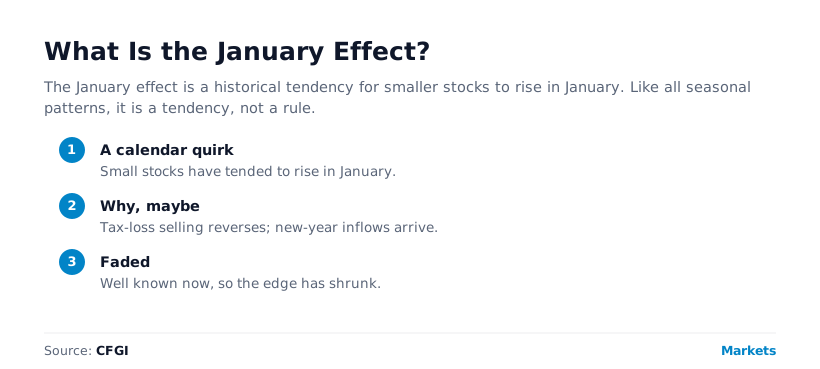
The January effect is a historical tendency for stocks, especially smaller companies, to perform well in January. It has often been linked to investors selling losers in December for tax reasons, then buying back in the new year, along with fresh optimism, fund window-dressing and the investment of year-end bonuses. Like all calendar patterns, it is a tendency that has weakened over time as it became well known, not a reliable rule, and it remains a famous puzzle for the efficient-market hypothesis. This is education, not financial advice.
CFGI data
Calendar effects are weak sentiment tilts that fade as they become known. The January effect reflects a slightly more optimistic new-year mood, but a Fear and Greed Index reads the actual conditions on its 0 to 100 scale, which matter far more than the month. Seasonal edges erode once everyone trades them.
Source: CFGI dataset and standard seasonal-market definitions, June 2026.
Key takeaways
- The January effect is a tendency for smaller stocks to rise in January.
- It is linked to year-end tax-loss selling and new-year optimism.
- Behavioural factors may matter more than tax, given the evidence.
- It has weakened over time as it became well known.
- It is a tendency, not a reliable rule, and a puzzle for efficient markets.
A New-Year Tilt
The January effect describes a pattern where stocks, particularly small caps, tend to rise in January. The leading explanation is tax-loss selling: investors dump losing positions in December to claim tax benefits, depressing those stocks, then buy back in January, lifting them. Fresh optimism and bonus money entering the market are often cited too. Importantly, the effect has faded over the decades. Once a pattern is widely known, traders front-run it, which tends to erode the very edge they are chasing, a recurring fate of seasonal anomalies.
Tax-Loss Selling: The Classic Explanation
The original and most-cited explanation is tax-loss selling. As the year ends, investors sell their losing positions to "harvest" the losses, which they can use to offset capital gains and lower their tax bill. This wave of December selling pushes those stocks down, often artificially below their worth. When the new year begins and the tax motive disappears, the selling pressure lifts and investors reinvest, so the same stocks bounce back. The effect is strongest in small-cap stocks because they tend to be the most beaten-down, the most thinly traded, and therefore the most sensitive to a swing from heavy selling to renewed buying.
The Behavioural Side
Tax is not the whole story. Several behavioural forces push the same way. Professional fund managers "window-dress" at year-end, selling embarrassing losers before reporting their holdings, then rebuilding positions in January. Year-end bonuses arrive and get invested in the new year. And there is a genuine "fresh start" optimism: studies have found investors display markedly higher risk tolerance in January than in December, around 25% higher in one analysis. Tellingly, the January effect persisted even after the Tax Reform Act of 1986 changed the tax incentives, which suggests that psychology, not just tax, is doing much of the work, exactly the kind of pattern behavioural finance studies.
More Than Tax
Because the effect survived major tax-law changes, many researchers think behavioural factors, window-dressing, bonuses and new-year optimism, explain it at least as well as tax-loss selling does.
Does It Still Work?
This is hotly debated. The case that it has faded is strong: the rise of tax-sheltered accounts like retirement plans has reduced the tax-loss-selling motive, and decades of investors front-running the pattern have shrunk it to the point where, in recent years, the effect is often so small that transaction costs would wipe out any profit from trading it. Yet some studies still find a remarkably consistent tendency for small-cap stocks to outperform in January. The honest summary is that the January effect is real in the historical data but weakened and unreliable today, more a historical curiosity than a tradable edge, which is the typical life cycle of a famous market anomaly.
A Challenge to Efficient Markets
The January effect matters to theorists because it should not exist. The efficient-market hypothesis holds that prices already reflect all known information, so a predictable, repeatable calendar pattern ought to be impossible, anyone could exploit it until it vanished. The fact that the January effect persisted for so long made it a serious, long-studied challenge to that idea, and a favourite example for behavioural economists arguing that markets are not perfectly rational. Its eventual fading is, fittingly, what efficient-market theory would predict: once an anomaly is well known and freely tradable, the crowd arbitrages it away. The January effect is, in a sense, a market inefficiency being slowly corrected in public.
Seasonality and Sentiment
Like the Santa Claus rally, the January effect is a mild seasonal tilt in mood, not a signal. A Fear and Greed Index reads the actual sentiment at the time, which matters far more than the month on the calendar. Real conditions override seasonal tendencies: a January that opens in Extreme Fear amid a genuine crisis will not float higher just because of the date, and a euphoric December does not pause for the new year. Treat the calendar as background colour and the live sentiment reading, plus the fundamentals, as the substance.
Frequently asked questions
What is the January effect?
A historical tendency for stocks, especially smaller companies, to perform well in January, often linked to year-end tax-loss selling, fund window-dressing and new-year optimism.
Why does the January effect happen?
The classic explanation is tax-loss selling: investors sell losers in December for tax reasons, depressing those stocks, then reinvest in January. Behavioural factors like window-dressing, bonuses and higher new-year risk appetite also contribute.
Does the January effect still work?
It has weakened. Tax-sheltered accounts reduced the tax motive, and decades of front-running shrank it, often below transaction costs. Some small-cap outperformance persists in studies, but it is more a historical curiosity than a reliable edge today.
Should I trade the January effect?
Seasonal patterns are mild tilts, not signals, and this one has faded. The current Fear and Greed Index reading and the fundamentals matter far more than the month. This is education, not financial advice.
CFGI.io, Market sentiment research
The CFGI research team builds and maintains the CFGI Fear and Greed Index: a 0 to 100 sentiment score from 10 sub-indicators across hundreds of crypto assets and the equity market, refreshed every 15 minutes. We have tracked market emotion through multiple full crypto and equity cycles.
Think we missed something?
Spotted a gap, disagree with a take, or think we should cover a new topic? Message us and we'll act on your input.
Message us on TelegramKeep reading
This article is educational and is not financial advice. Crypto and equities are volatile and you can lose money. See our disclaimer.