Markets
Why Do Emotions Move Markets?
Quick answer
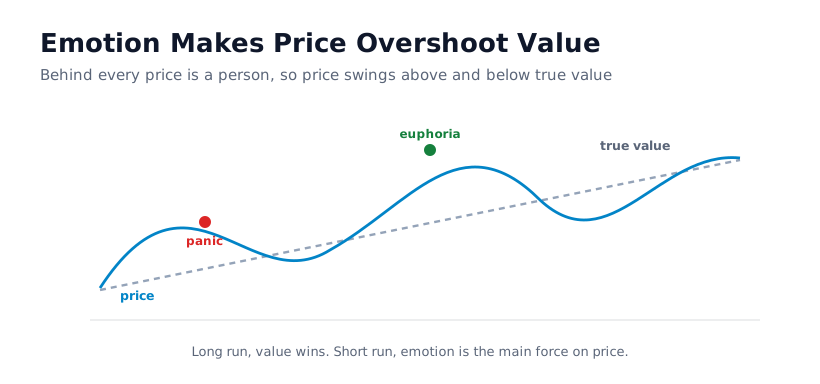
Emotions move markets because behind every price is a person, and people are not coldly rational about money. Fear and greed drive real buying and selling, so markets overshoot in both directions: too high in euphoria, too low in panic. We are wired for the herd by evolution, and emotion feeds on itself in self-reinforcing loops. Over the long run value wins, but over days and weeks emotion is the main force on price. This is education, not financial advice.
CFGI data
Emotion does not drift, it lurches, and CFGI is built to catch the lurch. Its 0 to 100 fear and greed score updates every 15 minutes across hundreds of assets, so a crowd flipping from greed to panic registers in minutes rather than after the fact. It has tracked that mood since March 2022.
Source: CFGI dataset, March 2022 to June 2026.
Key takeaways
- Behind every price is a person, and people are emotional about money.
- We are wired by evolution to follow the herd.
- Fear and greed drive real buying and selling.
- Emotion feeds on itself, so markets overshoot in both directions.
- Long run, value wins; short run, emotion does.
Why Does Emotion Win In the Short Run?
Markets are made of people, and people feel before they reason. When prices rise, greed and the fear of missing out pull more buyers in. When prices fall, fear and the urge to protect what is left push holders to sell. These reactions are fast and contagious, so they move price long before the fundamentals have changed. Benjamin Graham’s image fits perfectly: in the short run the market is a "voting machine", and the votes are emotional; only in the long run does it become a "weighing machine" that prices real value. The reason emotion dominates the short term is simply that buying and selling decisions are made by humans in real time, and humans are far more swayed by fear, greed and the behaviour of those around them than the textbook model of the cold, rational investor admits.
The Psychology That Wires Us for It
The field of behavioural finance has documented exactly why we are so predictably emotional about money, and it traces back to how our brains evolved. We are subject to powerful, hardwired biases: loss aversion makes the pain of a loss feel about twice as strong as the pleasure of a gain, driving panic; herd instinct makes following the crowd feel safe, because for our ancestors, sticking with the group genuinely was safer; FOMO makes us chase what others are profiting from; and recency bias makes us assume whatever just happened will continue. These instincts served our ancestors well on the savannah, where running with the herd and fearing losses kept you alive, but they are actively counterproductive in markets, where they push us to buy high in a crowd and sell low in a panic. In other words, we are not irrational by accident; we are running ancient survival software in an environment it was never designed for, which is why the same emotional mistakes repeat in every market, every generation.
Ancient Software, Modern Markets
Loss aversion, herding and FOMO are survival instincts that kept our ancestors alive but sabotage investors. We are running ancient software in a place it was never built for, so the same mistakes repeat.
How Does Emotion Create Cycles?
Emotion moves in a loop: optimism builds to euphoria at the top, then slides through anxiety to panic at the bottom, and back again. Because the crowd is most confident near tops and most despairing near bottoms, market sentiment tends to be most one-sided exactly when it is most stretched. This recurring emotional arc is the engine behind market cycles, and it repeats reliably across history precisely because human nature does not change, the assets and the headlines differ, but the feelings driving the crowd are the same in every era.
The Contrarian Idea
If the crowd is usually most wrong at the extremes, then measuring the crowd is useful. That is the whole premise of a Fear and Greed Index.
Why Emotion Feeds On Itself
What makes emotion such a powerful force on price is that it is self-reinforcing, it feeds on itself in a feedback loop. A rising price does not just reflect optimism; it creates more of it, because seeing an asset go up makes people more confident and draws in fresh buyers, whose buying pushes the price higher still, generating yet more optimism. Greed feeds greed. The same loop runs in reverse on the way down: a falling price breeds fear, fear drives selling, selling drives the price lower, and the fear deepens, a self-feeding spiral. This reflexivity is why markets overshoot so dramatically in both directions and why bubbles and crashes happen at all: they are runaway emotional feedback loops that carry price far from any reasonable value before finally exhausting themselves. Emotion is not just a passenger reacting to price; it is a driver that actively pushes price to extremes, which is exactly why it is so worth measuring.
How Does CFGI Measure It?
CFGI turns the mood into a number from 0 to 100, so the swing from fear to greed becomes something you can read rather than feel. It has recorded the full range, from a low of 12 to a high of 87, the measured distance between despair and euphoria. The value of putting a number on emotion is twofold. First, it lets you track the crowd objectively over time and across markets, rather than relying on a vague gut sense of the mood. Second, and more personally, it serves as a mirror: because you are part of the very crowd the index measures, a reading can catch you in the act of feeling the same fear or greed as everyone else, at exactly the moment that emotion is most dangerous to act on. See where the crowd stands now on the Fear and Greed Index.
Frequently asked questions
Why do emotions move markets?
Because behind every price is a person, and people feel before they reason. Fear and greed drive real buying and selling, faster and more contagiously than fundamentals change, so markets overshoot in both directions. Over the long run value wins; over days and weeks emotion dominates.
Why are we so emotional about money?
Behavioural finance traces it to hardwired biases, loss aversion, herd instinct, FOMO, recency bias, that evolved to keep our ancestors alive but backfire in markets, pushing us to buy high in a crowd and sell low in a panic. We run ancient survival software in a modern environment.
Why do markets overshoot?
Because emotion is self-reinforcing. A rising price creates more optimism, which drives more buying, which lifts the price further; a falling price breeds fear, which drives selling, which deepens the fall. These feedback loops are why bubbles and crashes happen.
Can you measure market emotion?
Yes. CFGI scores it from 0 to 100, and has tracked the full range from a low of 12 to a high of 87, turning a feeling into a number you can compare over time, and a mirror to check your own emotions against. This is education, not financial advice.
CFGI.io, Market sentiment research
The CFGI research team builds and maintains the CFGI Fear and Greed Index: a 0 to 100 sentiment score from 10 sub-indicators across hundreds of crypto assets and the equity market, refreshed every 15 minutes. We have tracked market emotion through multiple full crypto and equity cycles.
Think we missed something?
Spotted a gap, disagree with a take, or think we should cover a new topic? Message us and we'll act on your input.
Message us on TelegramKeep reading
This article is educational and is not financial advice. Crypto and equities are volatile and you can lose money. See our disclaimer.