Markets
What Is the Greater Fool Theory?
Quick answer
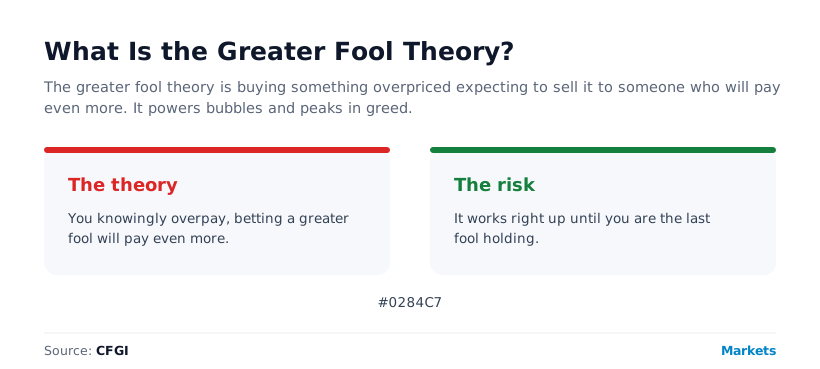
The greater fool theory describes buying an asset you know is overvalued, on the assumption that a greater fool will come along and pay you even more for it. It works, until it does not. When the supply of greater fools runs out, the price collapses and whoever holds last takes the loss. It dominates assets with little intrinsic value, where price depends entirely on the next buyer, and it is the logic of bubbles, thriving at the peak of greed. This is education, not financial advice.
CFGI data
Greater-fool buying is greed in its purest form. It dominates near the top of the scale, when CFGI reads Extreme Greed and people buy not on value but on the belief someone will pay more. That the greed extreme is reached less often than fear is part of why these peaks are so dangerous.
Source: CFGI dataset, 2021 to June 2026.
Key takeaways
- It is buying overpriced assets to sell to a greater fool.
- It works until the supply of buyers runs out.
- It dominates assets with little or no intrinsic value.
- Whoever holds last, the greatest fool, takes the loss.
- It is the logic of bubbles and peaks in greed.
Betting On the Next Buyer
Normally you buy something because you think it is worth the price. Greater-fool buying abandons that idea: the buyer knows the price is detached from value but expects to flip it to someone even more willing, the greater fool. As long as new buyers keep arriving, the game continues and prices climb. The flaw is built in. There is a finite supply of buyers, and when it runs dry, there is no one to sell to. The price falls, and the last holders, the greatest fools, absorb the loss. This is the engine inside most bubbles.
Why It Works, Until It Doesn’t
The unsettling thing about the greater fool theory is that, for a while, it genuinely works, which is exactly what makes it so seductive. As long as the next buyer exists, each participant really does profit by selling higher, and the rising price seems to validate the madness. Almost everyone playing knows, on some level, that the asset is overvalued; they simply believe they are clever enough to get out before the music stops, that someone else will be the last fool, not them. This collective self-deception is what sustains a bubble far longer than logic suggests it should. The cruel mathematics, though, is that they cannot all be right: by definition, someone has to be holding when the buyers run out, and far more people think they will dodge it than actually do.
Which Assets Run On Greater Fools
The greater fool theory has the most power over assets with little or no intrinsic value, because their price depends almost entirely on the next buyer. A productive asset like a stock generates earnings, and a bond pays interest, so they have an anchor of value beneath the price, a reason to own them even if no one ever buys them from you. A memecoin, a speculative collectible, or a tulip bulb in 1637 produces nothing; its entire worth rests on someone else paying more later. The less an asset is anchored by real cash flow or utility, the more purely it runs on greater-fool dynamics, which is why the wildest greater-fool bubbles tend to form around assets that, stripped of the hype, do not actually do anything.
No Anchor, No Floor
An asset that produces income has a value beneath its price; one that produces nothing is worth only what the next buyer will pay. The second kind is pure greater-fool territory.
Bubbles and the Last Fool
The greater fool theory is the mechanism by which bubbles inflate and burst. Through history, from Dutch Tulip Mania to the dotcom boom to crypto’s memecoin frenzies, the pattern is the same: a self-feeding rise as each buyer counts on the next, followed by a sudden collapse when the supply of greater fools is finally exhausted. At that point the buying simply stops, there is no one left to sell to at the inflated price, and the value evaporates with brutal speed, leaving the latecomers, the "bag-holders", nursing the losses. The painful irony is that the very confidence that the rise will continue, "it can only go up", is what draws in the final wave of fools right before the top. The bigger the greater-fool game, the harder the eventual fall.
The Greater Fool and Greed
Greater-fool dynamics are most powerful at peak greed, when euphoria convinces people the rise will never stop and the "this time is different" stories silence any doubt. A Fear and Greed Index pinned in Extreme Greed, with prices clearly detached from any underlying value, is a warning that the game may be running on greater fools rather than fundamentals. The gauge cannot tell you when the last fool will arrive, no tool can, but it can show you, in a single number, that the crowd has reached the kind of one-sided euphoria in which greater-fool buying flourishes. When you find yourself buying something purely because you are sure someone will pay more, an Extreme Greed reading is a cue to ask whether you might be the greater fool.
Frequently asked questions
What is the greater fool theory?
Buying an asset you know is overvalued, expecting to sell it to a greater fool who will pay even more. It works while new buyers keep arriving, but when the supply runs out, the price collapses and the last holder takes the loss.
Why does it work for a while?
Because as long as the next buyer exists, each participant really does profit by selling higher, and the rising price seems to validate it. Most players know it is overvalued but believe they will get out before the music stops, which sustains the game far longer than logic suggests.
Which assets run most on the greater fool theory?
Those with little or no intrinsic value, like memecoins, speculative collectibles or tulip bulbs, whose price depends entirely on the next buyer. Productive assets like stocks (earnings) and bonds (interest) have an anchor of value beneath the price; non-productive ones do not.
How does it relate to fear and greed?
It is greed in its purest form, most powerful at peak euphoria. Extreme Greed with prices detached from value is a sign the game may be running on greater fools, and a cue to ask whether you might be one. This is education, not financial advice.
CFGI.io, Market sentiment research
The CFGI research team builds and maintains the CFGI Fear and Greed Index: a 0 to 100 sentiment score from 10 sub-indicators across hundreds of crypto assets and the equity market, refreshed every 15 minutes. We have tracked market emotion through multiple full crypto and equity cycles.
Think we missed something?
Spotted a gap, disagree with a take, or think we should cover a new topic? Message us and we'll act on your input.
Message us on TelegramKeep reading
This article is educational and is not financial advice. Crypto and equities are volatile and you can lose money. See our disclaimer.