Markets
What Does a Fear and Greed Score of 50 Mean?
Quick answer
A Fear and Greed score of 50 is dead neutral. It sits in the middle of the 40 to 59 neutral band, meaning the crowd is balanced, neither fearful nor greedy. It is the least informative reading on the scale, because a Fear and Greed Index earns its keep at the extremes, not the middle. A 50 is, in effect, a signal that there is no strong sentiment signal right now, so it is a cue to lean on other tools, though the direction the score is heading through 50 can still be telling. This is education, not financial advice.
CFGI data
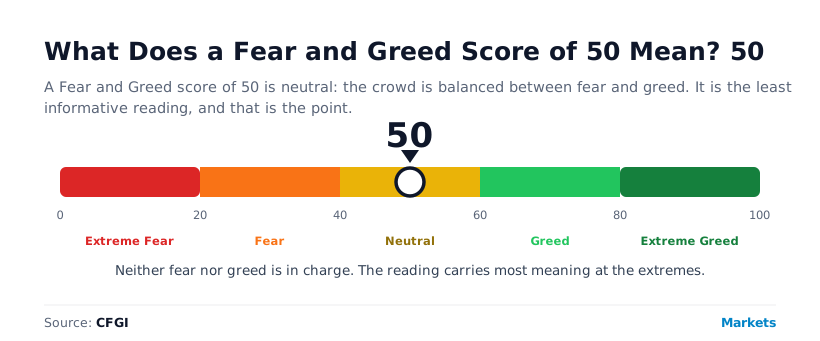
On the CFGI 0 to 100 scale, 50 is the centre of the neutral band, where sentiment offers little edge. The useful readings sit at the extremes, under 20 and over 80, which is why a 50 mostly tells you to look at price, trend and the direction sentiment is travelling rather than the level itself.
Source: CFGI dataset, March 2022 to June 2026.
Key takeaways
- A 50 is dead neutral: the crowd is balanced.
- It sits in the middle of the 40 to 59 neutral band.
- It is the least informative reading, because the edge lives at the extremes.
- Neutral sentiment says nothing about market direction.
- The direction the score is moving through 50 matters more than the level.
Neutral, by Design
On the Fear and Greed Index, 50 is the exact middle of the 0 to 100 scale. It means the measurable signals are balanced: no strong fear, no strong greed. The crowd is neither protecting capital in a panic nor chasing returns with conviction. That is not a failure of the index; it is information of a kind. It tells you sentiment is not currently one-sided, so there is little contrarian edge to read from it right now.
Where 50 Sits On the Scale
| Score | Zone |
|---|---|
| 0 to 19 | Extreme Fear |
| 20 to 39 | Fear |
| 40 to 59 | Neutral (50 is the centre) |
| 60 to 79 | Greed |
| 80 to 100 | Extreme Greed |
The five zones, and where 50 falls.
A 50 is the dead centre of the neutral band. Readings anywhere from roughly 40 to 59 carry a similar message, balanced sentiment, with no strong lean in either direction.
Why the Middle Is the Least Useful Part
A Fear and Greed Index is not equally informative across its range, its value is shaped like a U. The signal lives at the two ends, where the crowd is most one-sided and therefore most likely to be stretched, and it fades to almost nothing in the middle. A 50 sits at the bottom of that U. When the gauge is deep in Extreme Fear or runaway Extreme Greed, it is telling you something potentially valuable; when it reads 50, it is essentially saying "nothing unusual here". That is genuinely worth knowing, because it stops you from forcing a sentiment signal out of a reading that does not contain one.
What a 50 Does Not Mean
It is easy to over-read a neutral score, so it is worth being clear about what it is not. A 50 does not mean the market is "safe", nor that it is a good or bad time to buy. Crucially, neutral sentiment says nothing about market direction: prices can rise or fall just as easily from a neutral reading, because the gauge measures mood, not momentum. A market can climb steadily for weeks with the score parked around 50, or sell off from there. Treating a neutral reading as a green light, or a warning, is reading meaning into a number that is, by design, meaningless on its own.
The Key Distinction
Neutral sentiment is not the same as a neutral market. A 50 tells you the crowd is balanced, not that prices are about to stand still. Direction comes from elsewhere.
Neutral Is Often a Transition
Here is where a 50 can still be useful, if you look at it the right way. The neutral zone is often where the market passes through on its journey between extremes, on the way up from fear toward greed, or down from greed toward fear. So the level may be uninformative, but the direction can be telling. A score rising through 50, from the low 40s toward the 60s, suggests confidence is building; a score falling through 50 from the high 50s toward the 30s suggests caution is creeping in. Watching the trend of sentiment as it crosses the middle is far more useful than fixating on the static number.
What to Do With a 50
In practice, a neutral reading is a cue to lean on tools other than sentiment: price action, the trend, valuations and your own plan. There is no contrarian edge to extract, so do not try to manufacture one. The disciplined approach is to note that the gauge is quiet, keep an eye on which way it is drifting, and save the real sentiment read for when it pushes back toward an extreme, where it once again carries information. A 50 is a reminder that the most valuable thing a sentiment indicator can sometimes tell you is "wait".
Neutral, Or Heading for an Extreme?
The live gauge shows where the market sits right now, and just as importantly, which way it is travelling. If it is parked at 50, the sentiment story is quiet; if it is sliding toward fear or climbing toward greed, that drift is the part worth watching. Use the neutral reading as a calm baseline and let the extremes, when they come, do the talking.
Frequently asked questions
What does a Fear and Greed score of 50 mean?
It is dead neutral: the crowd is balanced between fear and greed. It sits at the centre of the 40 to 59 neutral band and is the least informative reading on the scale.
Is 50 a buy or sell signal?
Neither. A neutral reading offers no contrarian edge and says nothing about market direction. The index is most useful at the extremes, under 20 and over 80, not in the middle.
Can a neutral reading still be useful?
Yes, through its direction. The level is uninformative, but a score rising through 50 suggests building confidence and a score falling through 50 suggests creeping caution. Watch the trend, not the static number.
Should I act on a neutral reading?
Not from sentiment alone. A 50 is a cue to rely on price, trend and your plan rather than the index, and to wait for an extreme before reading much into the gauge. This is education, not financial advice.
CFGI.io, Market sentiment research
The CFGI research team builds and maintains the CFGI Fear and Greed Index: a 0 to 100 sentiment score from 10 sub-indicators across hundreds of crypto assets and the equity market, refreshed every 15 minutes. We have tracked market emotion through multiple full crypto and equity cycles.
Think we missed something?
Spotted a gap, disagree with a take, or think we should cover a new topic? Message us and we'll act on your input.
Message us on TelegramKeep reading
This article is educational and is not financial advice. Crypto and equities are volatile and you can lose money. See our disclaimer.