Markets
What Is a Leading Indicator?
Quick answer
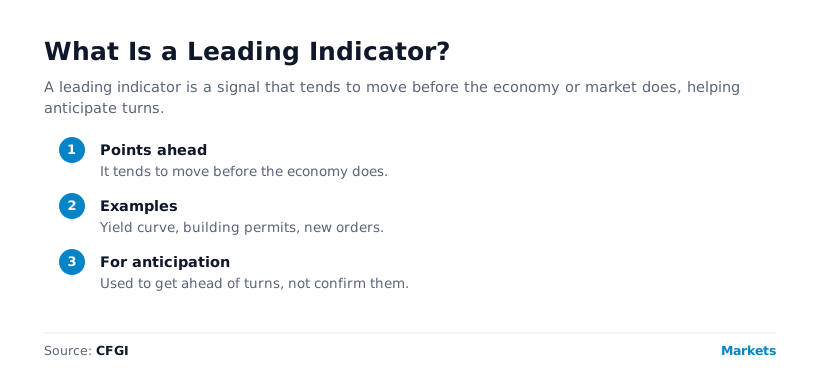
A leading indicator is a measure that tends to change before the broader economy or market does, so it can hint at where things are heading rather than where they have been. Examples include new factory orders, building permits, jobless claims, the yield curve and market sentiment itself. Leading indicators are valuable for anticipating turns six to twelve months out, but they give false signals, so they are best treated as clues and probabilities, not guarantees.
CFGI data
A Fear and Greed Index is itself a leading-style signal: sentiment often turns before price, especially at the extremes. CFGI marks Extreme Fear below 20 and Extreme Greed above 80 on its 0 to 100 scale, tracked since March 2022, the zones where the crowd is most likely to be near a turning point the hard data has not yet confirmed.
Source: CFGI dataset, March 2022 to June 2026.
Key takeaways
- A leading indicator moves before the economy or market does.
- It helps anticipate turns rather than confirm them after the fact.
- The Conference Board bundles ten of them into the Leading Economic Index.
- Analysts judge a decline by its duration, depth and diffusion.
- Leading indicators give false signals, so combine several and treat them as odds.
Pointing Ahead, Not Behind
Most economic data tells you what already happened. A leading indicator is prized because it tends to move first: new factory orders soften before output falls, building permits drop before construction does, and an inverted yield curve has often preceded recessions by many months. By turning ahead of the economy, a good leading indicator offers a glimpse of the road in front, which is why investors and policymakers watch them so closely.
The Classic Leading Indicators
A handful of measures have earned their reputation for moving early.
- The yield curve. When short-term rates rise above long-term ones, recession has often followed.
- Building permits. Permits are pulled before homes are built, so they signal future construction activity.
- Jobless claims. A steady rise in new unemployment filings is an early sign the labour market is cooling.
- New orders and PMI. Manufacturers’ new orders and purchasing-manager surveys flag activity before it shows up in output.
- Consumer expectations and the stock market. Both reflect what people expect, which shapes what happens next.
The Leading Economic Index
Because no single signal is reliable, the Conference Board combines ten of them into one widely watched gauge, the Leading Economic Index, or LEI. Its components include building permits, the stock market, the interest-rate spread, jobless claims, manufacturing hours and new orders, and consumer expectations. Bundled together, they have historically led turning points in the business cycle by around seven months, which is why a sustained fall in the LEI is treated as a serious recession warning rather than noise.
Reading a Decline: The 3Ds
Not every dip in a leading index means trouble, so analysts judge a decline by three things, sometimes called the 3Ds. Duration is how long the index has been falling. Depth is how far it has dropped. Diffusion is how widespread the weakness is across the underlying components, measured on a 0 to 100 scale, where a reading below 50 means most components are deteriorating at once. A decline that is long, deep and broad, all three Ds flashing, is a far more credible recession signal than a shallow, brief wobble in a single component. It is a useful reminder that one number rarely tells the whole story.
The Practical Test
Before reacting to a falling leading index, ask the three questions: how long, how far, and how broad? A signal that is durable, deep and diffuse deserves real attention.
Useful, But Not Infallible
The catch with anything that moves early is reliability. Because leading indicators react quickly, they also react to things that fizzle out, giving false alarms, most often signalling a growth slowdown that never becomes a full recession. The faster a signal turns, the noisier it tends to be. The sensible response is not to abandon them but to use them well: combine several rather than trusting any one, watch for confirmation across indicators, and treat each as a shift in the odds rather than a prophecy. A leading indicator improves your timing; it does not remove uncertainty.
Leading, Coincident and Lagging
Leading indicators are one of three families. Coincident indicators, like GDP and employment, move in step with the economy and tell you where things stand right now. Lagging indicators, like the unemployment rate and inflation, only confirm a change after it has happened. Each answers a different question, and the most complete picture comes from reading all three together: leaders to anticipate, coincident to locate, and laggers to confirm. A turn is only truly real once the laggers agree.
Sentiment As a Leading Indicator
Sentiment belongs firmly in the leading camp, and it is one of the fastest signals there is. Where official data is collected and revised with a lag, a Fear and Greed Index reads the market’s own behaviour in close to real time, and the crowd often turns fearful or greedy before the economic numbers, or even prices, catch up. Like any leader it is noisy in the middle and most useful at the extremes, where it leads price as a contrarian signal. Read alongside the hard leading data, it adds the one thing the official numbers cannot: how the crowd feels right now.
Frequently asked questions
What is a leading indicator?
A measure that tends to change before the broader economy or market does, helping anticipate turns six to twelve months out. Examples include new orders, building permits, the yield curve, jobless claims and sentiment.
What is the Leading Economic Index?
The Conference Board LEI, a single gauge that combines ten leading indicators, such as building permits, the stock market, the yield-curve spread and jobless claims. It has historically led business-cycle turns by around seven months.
How is a leading indicator different from a lagging one?
A leading indicator moves before the economy, hinting at what is coming; a lagging indicator, like the unemployment rate, moves after, confirming a trend that has already taken hold.
Are leading indicators reliable?
They are useful but imperfect and prone to false signals, often flagging slowdowns that never become recessions. Combine several, look for confirmation, and treat them as odds, not guarantees. This is education, not financial advice.
CFGI.io, Market sentiment research
The CFGI research team builds and maintains the CFGI Fear and Greed Index: a 0 to 100 sentiment score from 10 sub-indicators across hundreds of crypto assets and the equity market, refreshed every 15 minutes. We have tracked market emotion through multiple full crypto and equity cycles.
Think we missed something?
Spotted a gap, disagree with a take, or think we should cover a new topic? Message us and we'll act on your input.
Message us on TelegramKeep reading
This article is educational and is not financial advice. Crypto and equities are volatile and you can lose money. See our disclaimer.