Markets
Fear and Greed As a Contrarian Indicator
Quick answer
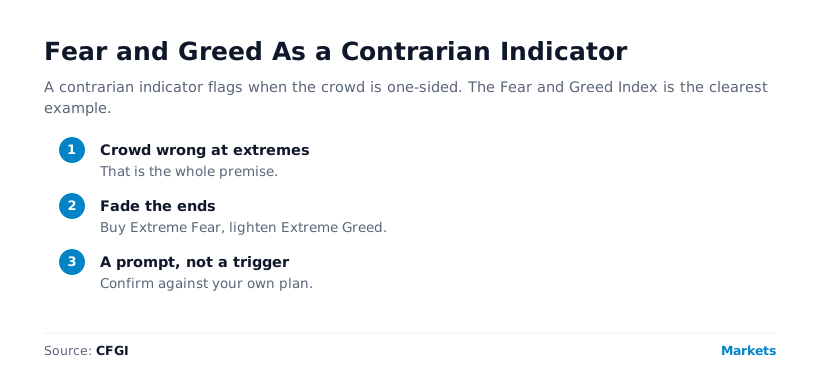
A contrarian indicator is one you read against the crowd, and the Fear and Greed Index is the clearest example. When it reaches Extreme Fear the crowd is most pessimistic, and when it reaches Extreme Greed the crowd is most optimistic, which is often where moves exhaust. Fear extremes tend to be sharper signals than greed extremes. The catch is that the crowd can stay one-sided for a long time, so extremes are a warning, not a trigger. This is education, not financial advice.
CFGI data
Contrarian reading rests on extremes mattering, and in CFGI data since March 2022 they cluster near turning points but do not mark them. Same-day, the score matches market direction 79% of the time; the next day, 49%. So an extreme says the crowd is stretched, not that it reverses tomorrow.
Source: CFGI dataset, March 2022 to June 2026.
Key takeaways
- A contrarian indicator is read against the crowd.
- Fear and Greed extremes flag when the crowd is most one-sided.
- Moves often exhaust where everyone is already positioned.
- Fear extremes tend to be sharper signals than greed extremes.
- The risk is timing: extremes can persist, so they warn rather than trigger.
What Contrarian Means Here
Contrarian investing means leaning against the consensus. A contrarian indicator is anything that shows when the consensus is most crowded. The Fear and Greed Index does this directly: a low reading means almost everyone is fearful, a high reading means almost everyone is greedy. The logic is supply and demand of conviction. When everyone has already sold in fear, the marginal seller is gone, and the path of least resistance is up. When everyone has already bought in greed, the marginal buyer is gone. Extremes mark where the fuel runs low.
Why It Works: Exhaustion At the Extremes
The deep reason a sentiment gauge works as a contrarian indicator is the simple but powerful logic of exhaustion. A market can only keep rising while there is fresh money left to buy, and it can only keep falling while there are still holders left to sell. At an extreme of greed, when sentiment is euphoric and nearly everyone is already fully invested, the pool of potential new buyers has been drained, there is little buying power left to push prices higher, so the rally is running on fumes and primed to reverse. At an extreme of fear, the mirror happens: once panic has driven nearly everyone to sell, the selling pressure exhausts itself, and with so few sellers left, even a little buying can turn the market. This is why extremes of sentiment so often coincide with turning points, not because the crowd is "wrong" in some abstract sense, but because, at an extreme, the crowd has by definition run out of the fuel needed to continue in its current direction. The contrarian is really betting on exhaustion.
Why It Works, and When It Does Not
| Reading | Crowd | Contrarian read |
|---|---|---|
| Under 20 | Maximum fear | Selling may be exhausted |
| 80 to 100 | Maximum greed | Buying may be exhausted |
| 40 to 59 | Balanced | No contrarian edge |
Reading extremes as a contrarian.
It fails when sentiment stays extreme. In a strong trend, the crowd can remain one-sided for weeks, and a contrarian who acts at the first extreme gets run over. That is why extremes are best treated as a reason to pay attention, not a reason to act immediately.
Fear Is a Sharper Signal Than Greed
An important refinement, often missed, is that the two extremes are not equally reliable as contrarian signals. Extreme Fear tends to be the sharper, more useful signal of the two, and Extreme Greed the weaker. The reason traces back to the nature of the emotions: fear is a sudden, violent, self-exhausting emotion, panic flares up fast and burns out fast, so deep fear genuinely does cluster tightly around bottoms. Greed, by contrast, is a slow-building, persistent emotion, euphoria can simmer for a long time and markets can "stay irrational" and keep climbing for months past the point a contrarian thinks reasonable. The practical consequence is that "buying the fear" has historically been a more dependable application of contrarian thinking than "selling the greed", and that an Extreme Greed reading is better treated as a reason to manage risk and grow cautious than as a precise signal to sell or short. The two ends of the scale deserve to be weighted differently.
The Two Ends Are Not Equal
Fear is violent and self-exhausting, so deep fear clusters tightly near bottoms. Greed simmers and persists, so high readings are far less precise. Buying fear is a sharper signal than selling greed.
Using It Without Getting Run Over
The safest way to read a contrarian indicator is to wait for an extreme and for the trend to start turning, rather than catching a falling market on the first low reading. As the saying goes, the market can stay irrational longer than you can stay solvent, so patience is the contrarian’s real edge. In practice, that means using an extreme as a prompt to look harder and prepare, not as a button to press: confirm with the price trend, scale into a position gradually rather than betting everything at once, size every position to what you can afford to lose, and treat the index as one input alongside your own plan. A contrarian indicator, used with discipline and patience, is a genuinely valuable tool for spotting where the crowd is dangerously one-sided; used impatiently, as a mechanical "buy every low, sell every high" rule, it is a fast way to get run over by a strong trend. This is education, not financial advice.
Frequently asked questions
Is the Fear and Greed Index a contrarian indicator?
Yes, it is the clearest example. It is read against the crowd: Extreme Fear flags maximum pessimism, Extreme Greed flags maximum optimism, which is often where moves exhaust because the crowd has run out of fuel to continue.
Why do sentiment extremes mark turning points?
Because of exhaustion. A market can only rise while there is money left to buy and fall while there are holders left to sell. At an extreme, the crowd has drained that fuel, so few buyers are left at a top and few sellers at a bottom, priming a reversal.
Is fear or greed the better contrarian signal?
Fear, generally. Fear is violent and self-exhausting, so deep fear clusters tightly near bottoms, while greed simmers and can persist for months. "Buying the fear" has historically been more dependable than "selling the greed", which is better used to manage risk.
How do you use it safely?
Treat an extreme as a reason to watch, not to act. Many wait for the extreme and for the trend to begin turning, scale in gradually, and always combine it with risk management. Sentiment can stay irrational longer than you can stay solvent. This is education, not financial advice.
CFGI.io, Market sentiment research
The CFGI research team builds and maintains the CFGI Fear and Greed Index: a 0 to 100 sentiment score from 10 sub-indicators across hundreds of crypto assets and the equity market, refreshed every 15 minutes. We have tracked market emotion through multiple full crypto and equity cycles.
Think we missed something?
Spotted a gap, disagree with a take, or think we should cover a new topic? Message us and we'll act on your input.
Message us on TelegramKeep reading
This article is educational and is not financial advice. Crypto and equities are volatile and you can lose money. See our disclaimer.