Markets
What Is an Economic Indicator?
Quick answer
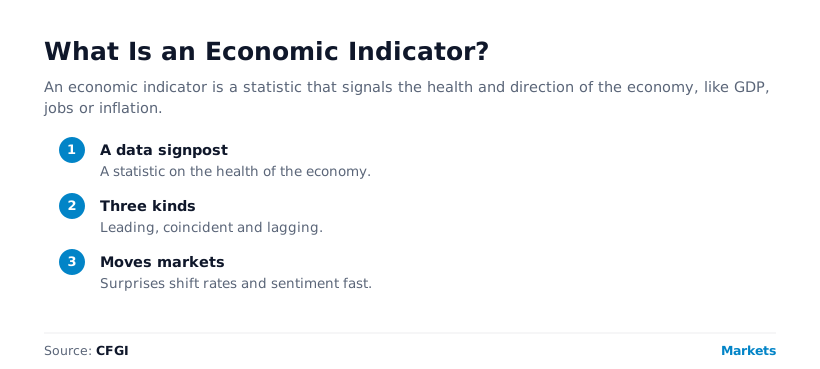
An economic indicator is a published statistic that signals the health and direction of the economy, such as GDP, unemployment, inflation or retail sales. Investors and policymakers use them to judge where the economy is now and where it is heading. They come in three flavours, leading ones that point ahead, coincident ones that move with the economy, and lagging ones that confirm a trend after the fact, and the biggest releases reliably move markets the moment they land.
CFGI data
A Fear and Greed Index is itself an economic indicator, just one about emotion rather than output. CFGI distils 10 market inputs into a single score on a 0 to 100 scale, and because it reads positioning and price action, it often moves before the slow, lagging official data confirms what the crowd already feels.
Source: CFGI methodology, 0 to 100 sentiment model.
Key takeaways
- An economic indicator is a statistic that signals the economy’s health.
- Leading indicators point ahead, coincident move with, lagging confirm afterward.
- GDP, jobs, inflation and PMI are the most-watched examples.
- Markets react to the surprise versus expectations, not the raw number.
- Indicators are revised and noisy, so no single release tells the whole story.
Reading the Economy by the Numbers
No one can see the entire economy at once, so we rely on indicators, regular data releases that each capture one piece of it. GDP measures total output, the monthly jobs report measures employment, and inflation data tracks how fast prices are rising. Read together, they build a picture of whether the economy is growing, stalling or shrinking, and that picture drives decisions from central banks setting rates to investors positioning portfolios.
Leading, Coincident and Lagging
The most useful way to sort indicators is by timing relative to the economy.
| Type | Timing | Examples |
|---|---|---|
| Leading | Move 6 to 12 months ahead | Yield curve, building permits, jobless claims, consumer confidence |
| Coincident | Move with the economy | GDP, industrial production, employment, personal income |
| Lagging | Confirm after the turn | Unemployment rate, inflation (CPI), average earnings |
The three timing categories, with common examples.
The distinction matters because each answers a different question. Leading indicators help you anticipate a turn, coincident indicators tell you where things stand right now, and lagging indicators confirm a change has actually happened. The unemployment rate is the classic lag: it often keeps rising for two or three quarters after a recovery has already begun.
The Releases That Move Markets Most
A handful of indicators dominate the market calendar. The monthly US jobs report, the inflation print, GDP, central-bank decisions and the PMI surveys of business activity can each move stocks, bonds and currencies within seconds of release. The key is that markets do not trade the raw number, they trade the surprise. A release is measured against the consensus forecast economists set beforehand, and it is the gap between expected and actual that drives the reaction. An inflation figure that simply matches expectations can pass quietly; the same figure as a surprise can send markets lurching.
The timing is predictable, which is why traders mark their calendars. The US jobs report lands on the first Friday of each month, inflation data follows mid-month, and GDP arrives quarterly in several revisions. Knowing the schedule matters as much as knowing the numbers, because volatility tends to cluster around these moments and quiet markets can turn sharply the instant a major release crosses the wire.
The Yield Curve: A Famous Warning
One leading indicator deserves a special mention. The "yield curve" compares the interest rate on short-term and long-term government bonds. Normally long-term rates are higher, but occasionally the curve "inverts" and short-term rates climb above long-term ones, a sign investors expect trouble ahead. An inverted yield curve has preceded most modern US recessions, which is why a single line on a chart can dominate financial headlines for weeks. It is a reminder that the most powerful indicators are often the ones pointing furthest into the future.
Why Indicators Can Mislead
Indicators are guides, not gospel. Most are revised, sometimes heavily, in the months after release, so an initial reading can flip. They are noisy month to month, which is why analysts watch trends rather than single prints. And the market’s reaction is not always intuitive: in some climates, weak data is read as good news because it makes interest-rate cuts more likely, so the same number can lift stocks one year and sink them the next. Context, not the headline figure, is what gives an indicator meaning.
The Practical Habit
Watch the trend across several releases, compare each print to expectations, and ask what it implies for interest rates. A single number in isolation rarely tells you much.
Indicators and Market Sentiment
Sentiment is itself an indicator, and a fast one. Where official data is collected, revised and published with a lag, a Fear and Greed Index reads the market’s own behaviour, prices, volatility and momentum, in close to real time. That makes it a leading indicator of mood: the crowd often turns fearful or greedy before the economic numbers catch up. Reading the hard data and the sentiment gauge side by side, on the same 0 to 100 scale, gives you both the slow truth and the fast feeling.
Frequently asked questions
What is an economic indicator?
A published statistic that signals the health and direction of the economy, such as GDP, unemployment, inflation or retail sales, used to gauge where the economy is and where it is heading.
What are the three types of economic indicators?
Leading indicators move ahead of the economy and help anticipate turns; coincident indicators move with it and show current conditions; lagging indicators confirm a trend after it has happened, like the unemployment rate.
Which economic indicators move markets the most?
The monthly jobs report, inflation data, GDP, central-bank decisions and PMI surveys are the big ones. Markets react to the surprise versus the consensus forecast, not the raw number.
Why can economic indicators be misleading?
They are revised after release, noisy month to month, and their market impact depends on context, weak data can even lift stocks if it makes rate cuts more likely. This is education, not financial advice.
CFGI.io, Market sentiment research
The CFGI research team builds and maintains the CFGI Fear and Greed Index: a 0 to 100 sentiment score from 10 sub-indicators across hundreds of crypto assets and the equity market, refreshed every 15 minutes. We have tracked market emotion through multiple full crypto and equity cycles.
Think we missed something?
Spotted a gap, disagree with a take, or think we should cover a new topic? Message us and we'll act on your input.
Message us on TelegramKeep reading
This article is educational and is not financial advice. Crypto and equities are volatile and you can lose money. See our disclaimer.