Markets
What Is GDP?
Quick answer
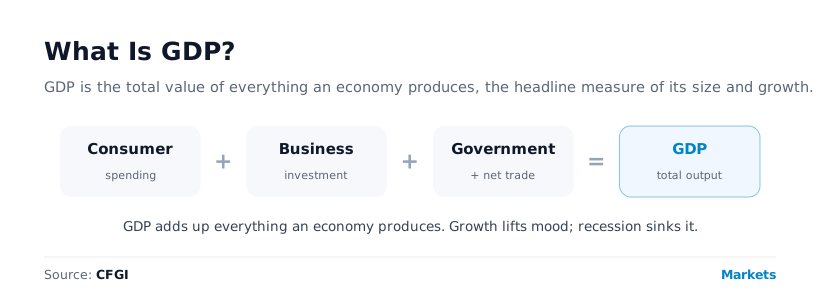
GDP, or gross domestic product, is the total market value of all the goods and services an economy produces in a period. It is the headline measure of economic size, and its growth rate is the standard gauge of whether an economy is expanding or shrinking. Markets watch GDP closely because growth supports company earnings and confidence, while two straight quarters of falling output is a common, if rough, marker of a recession.
CFGI data
GDP is reported quarters after the fact; CFGI is live. It scores the crowd’s reaction to growth data on a 0 to 100 scale, every 15 minutes in crypto and daily in stocks, so the mood around a GDP release, relief or alarm, shows up at once rather than weeks later when the number is confirmed.
Source: CFGI methodology, 0 to 100 sentiment model.
Key takeaways
- GDP is the total market value of what an economy produces in a period.
- It is calculated as consumption plus investment plus government plus net exports.
- Real GDP strips out inflation; nominal GDP does not.
- Two consecutive quarters of falling real GDP is a common recession marker.
- GDP measures output, not wellbeing, inequality or environmental cost.
The Size of the Economy
GDP adds up the market value of everything an economy produces, goods, services, investment and more, over a quarter or a year. On its own the headline figure is enormous and abstract; what actually matters is the growth rate, whether GDP is rising or falling and how fast. That growth rate is the single most-watched summary of an economy’s health, the number politicians campaign on and central banks steer by.
How GDP Is Calculated
The most common method adds up everything the economy spends, captured in a simple formula: GDP equals consumption plus investment plus government spending plus net exports, often written C plus I plus G plus NX.
- C, consumption. Household spending on everything from groceries to haircuts. In most rich economies this is the largest slice by far.
- I, investment. Business spending on equipment and buildings, plus new housing.
- G, government spending. Public spending on goods and services, from roads to salaries.
- NX, net exports. Exports minus imports, so a country that imports more than it exports has a negative contribution here.
Nominal Versus Real GDP
This distinction trips up almost everyone, and it matters enormously. Nominal GDP is measured at current prices, so it rises both when an economy produces more and simply when prices go up. Real GDP strips out that price effect using an adjustment called the deflator, leaving only the genuine change in the quantity of stuff produced. If nominal GDP grew 5% but prices rose 3%, real growth was only about 2%. When economists talk about "growth", they almost always mean real GDP, because that is the part that reflects a richer, more productive economy rather than just a more expensive one.
GDP Growth and Recession
The growth rate of real GDP is the headline gauge of economic health: rising is good, falling is bad. The widely repeated rule of thumb is that two consecutive quarters of negative real GDP growth count as a recession. It is a useful shorthand, but only a shorthand: in the US, the official call is made by the National Bureau of Economic Research, which weighs employment, income and spending too, and can declare a recession that does not fit the neat two-quarter rule, or decline to call one that does.
What GDP Doesn’t Measure
For all its power, GDP is a famously incomplete picture, and knowing its blind spots is part of using it well.
- Distribution. It measures the size of the pie, not how it is sliced, so strong growth can mask deepening inequality.
- Unpaid and informal work. Care done at home, volunteering and the black market are largely uncounted.
- Wellbeing. Health, leisure, education quality and the environment do not show up, and pollution can even raise GDP.
- Depreciation. The "gross" in GDP means it ignores the wear and tear on the machines and buildings doing the producing.
This is why analysts pair GDP with other measures, like GDP per person, to judge how an economy is really doing for the people in it.
Why Markets Care
A growing economy generally means growing company earnings, which supports stocks and confidence, while shrinking GDP signals trouble for both. As with most data, markets trade the surprise, the gap between the GDP figure and what economists expected, more than the raw number. The catch is that GDP is deeply backward-looking, reported weeks after the quarter it covers and revised more than once afterwards, so by the time it confirms a slowdown, markets, which look forward, have usually moved already.
GDP, Growth and Sentiment
Because GDP arrives late, sentiment often turns first. The crowd starts to feel a slowdown, or a recovery, before the official numbers confirm it, which is why a live Fear and Greed Index can lead the hard data. Reading a GDP release alongside where sentiment already sits, on the same 0 to 100 scale, tells you not just how the economy did, but how much of that was already expected and priced in by a forward-looking market.
Frequently asked questions
What is GDP?
Gross domestic product, the total market value of all goods and services an economy produces in a period. It is the headline measure of economic size, and its growth rate gauges expansion or contraction.
What is the difference between real and nominal GDP?
Nominal GDP is measured at current prices, so it rises with both output and inflation. Real GDP strips out price changes, leaving only the genuine change in output. "Growth" almost always refers to real GDP.
How is GDP linked to recession?
The common rule of thumb is that two consecutive quarters of falling real GDP signal a recession. In the US, though, the official call also weighs jobs, income and spending, so it does not always match the two-quarter rule.
What are the limits of GDP?
It is backward-looking and revised, and it measures output rather than wellbeing, distribution, unpaid work or environmental cost. It is a key gauge, not a complete picture. This is education, not financial advice.
CFGI.io, Market sentiment research
The CFGI research team builds and maintains the CFGI Fear and Greed Index: a 0 to 100 sentiment score from 10 sub-indicators across hundreds of crypto assets and the equity market, refreshed every 15 minutes. We have tracked market emotion through multiple full crypto and equity cycles.
Think we missed something?
Spotted a gap, disagree with a take, or think we should cover a new topic? Message us and we'll act on your input.
Message us on TelegramKeep reading
This article is educational and is not financial advice. Crypto and equities are volatile and you can lose money. See our disclaimer.