Markets
What Is the Yield Curve?
Quick answer
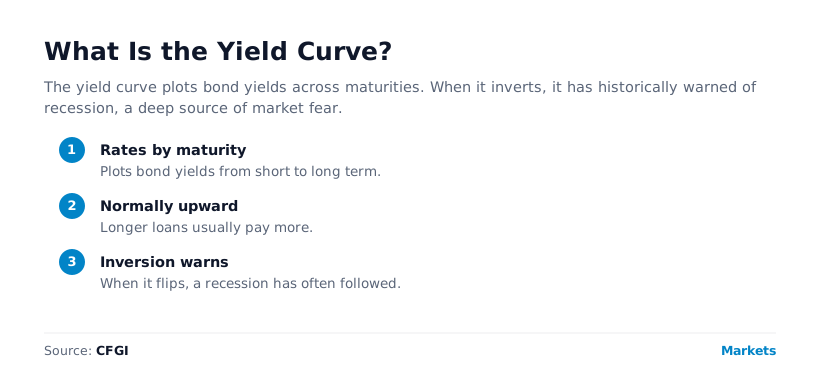
The yield curve is a line plotting the interest rates, or yields, of government bonds across different maturities, from months to decades. Normally longer bonds yield more than shorter ones, an upward slope. When that flips into an inverted curve, where short rates exceed long rates, it has preceded every US recession since 1955, which makes it one of the most watched, and most feared, signals in markets. But the lag from inversion to recession is long, typically 12 to 18 months. This is education, not financial advice.
CFGI data
The yield curve is a slow-moving fear signal; a Fear and Greed Index is a fast one. An inversion can warn of recession months ahead, while CFGI reads the day-to-day mood, like the equity score of 3 on 8 April 2025, that such fears produce in real time on its 0 to 100 scale.
Source: CFGI dataset and standard fixed-income definitions, June 2026.
Key takeaways
- The yield curve plots bond yields across maturities.
- Normally longer bonds yield more than shorter ones, an upward slope.
- An inverted curve has preceded every US recession since 1955.
- The lag from inversion to recession is typically 12 to 18 months.
- It is a slow but powerful source of market fear.
A Line That Reads the Future
Lend money for longer and you normally expect a higher rate, so the yield curve usually slopes upward. Its shape reflects what markets expect from growth, inflation and the Federal Reserve. A steep curve suggests optimism about growth; a flat one suggests uncertainty. The signal that draws the most attention is inversion: when short-term yields rise above long-term ones. It means markets expect rates, and growth, to fall, and an inverted curve has preceded most modern US recessions, though the lag can be a year or more.
The Three Shapes
The curve takes three broad shapes, and each tells a different economic story.
| Shape | Looks like | Signals |
|---|---|---|
| Normal | Slopes upward | Healthy growth ahead |
| Flat | Roughly level | Uncertainty, transition |
| Inverted | Slopes downward | Recession risk |
Reading the shape of the curve.
A normal, upward curve is the healthy default. A flat curve, where short and long yields are similar, often appears as the economy shifts between states and reflects doubt about the outlook. An inverted, downward-sloping curve is the rare and worrying one.
Why Inversion Is So Feared
An inverted curve is counterintuitive: why would anyone accept a lower yield to lend for longer? The answer reveals what it signals. Investors pile into long-term bonds, pushing their yields down, precisely because they expect the economy to weaken and the Fed to cut short-term rates in response. By locking in today’s long-term yield, they are effectively betting that rates, and growth, are about to fall. The most-watched version is the gap between the 10-year and 2-year Treasury yields, the "10Y-2Y spread"; when the 2-year yield climbs above the 10-year, the spread turns negative and the curve has inverted. It is, in essence, the bond market collectively pricing in a downturn.
The Bond Market’s Verdict
An inversion is the enormous, sober Treasury market effectively forecasting a slowdown. That is why it carries more weight than almost any single commentator’s recession call.
The Recession Track Record
The yield curve’s fame rests on a remarkable record: prior to every US recession since 1955, the curve inverted first. The 10Y-2Y inversion in particular preceded the downturns of 2000 to 2001, the 2007 to 2008 financial crisis, and the 2020 shock, among others. Few economic indicators can claim that kind of consistency, which is why economists, investors and the Fed itself watch it so closely, and why an inversion reliably grabs headlines and rattles risk appetite. When the curve inverts, it is taken seriously precisely because it has been right so many times before, a signal earned through decades of being on the correct side of history.
The Limits and the Lag
For all its reliability, the yield curve is a terrible timing tool. The lag between an inversion and the recession it warns of is typically 12 to 18 months, and it varies, so an inversion today says little about next week or even next quarter. Markets have often kept rising for a year or more after the curve inverted, which can lull investors who treat it as an immediate sell signal. Each cycle also brings "this time is different" debates about whether the signal still holds in a changed financial system. The honest reading is that an inversion is a credible long-range warning that recession risk is elevated, not a precise countdown, and acting on it as if it were the latter is a common mistake.
The Yield Curve and Sentiment
The yield curve and a Fear and Greed Index work on very different clocks, which makes them complementary. An inversion is a slow-burning fear signal: it can warn of trouble a year or more before it arrives, and its mere presence can quietly dampen risk appetite for months. A Fear and Greed reading, by contrast, captures the immediate, day-to-day mood, the sharp spikes of panic and relief that play out in hours. Watching both gives you two layers of the picture at once: the long-range structural warning from the bond market, and the live emotional temperature of the crowd reacting to it. Neither replaces the other, and together they are more informative than either alone.
Frequently asked questions
What is the yield curve?
A line plotting government bond yields across maturities, from months to decades. Its shape, normal, flat or inverted, reflects market expectations for growth, inflation and interest rates.
What does an inverted yield curve mean?
It means short-term yields are higher than long-term ones, because investors expect rates and growth to fall. The bond market is effectively pricing in a downturn, and inversion has preceded every US recession since 1955.
Does an inverted curve mean a recession is coming soon?
Not soon. The lag from inversion to recession is typically 12 to 18 months and varies, and markets have often risen for a year or more after an inversion. It signals elevated risk over the medium term, not an imminent crash.
Is the yield curve a fear signal?
A slow one. An inversion can dampen risk appetite long before a downturn arrives. A Fear and Greed Index reads the faster, day-to-day mood alongside it, so the two complement each other. This is education, not financial advice.
CFGI.io, Market sentiment research
The CFGI research team builds and maintains the CFGI Fear and Greed Index: a 0 to 100 sentiment score from 10 sub-indicators across hundreds of crypto assets and the equity market, refreshed every 15 minutes. We have tracked market emotion through multiple full crypto and equity cycles.
Think we missed something?
Spotted a gap, disagree with a take, or think we should cover a new topic? Message us and we'll act on your input.
Message us on TelegramKeep reading
This article is educational and is not financial advice. Crypto and equities are volatile and you can lose money. See our disclaimer.