Markets
What Is a Depression?
Quick answer
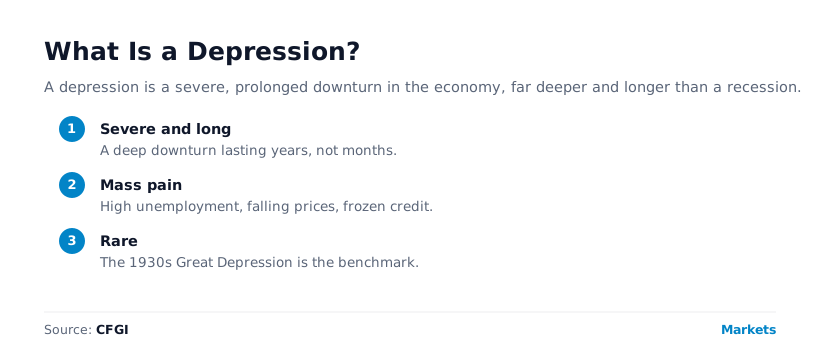
A depression is an extreme, prolonged economic downturn, far deeper and longer-lasting than a recession. There is no precise threshold, but a depression involves a severe fall in output, mass unemployment and widespread financial distress sustained over years rather than months. They are rare, the 1930s Great Depression being the defining example, and they coincide with the deepest, most persistent fear an economy and its markets can produce.
CFGI data
A depression is the macro extreme a Fear and Greed Index would log as its longest, lowest stretch: sustained Extreme Fear, below 20 on CFGI’s 0 to 100 scale, pinning the score to its floor for an extended period rather than the brief sub-20 spike of a single panic.
Source: CFGI methodology, 0 to 100 sentiment model.
Key takeaways
- A depression is a severe, prolonged economic downturn.
- It is far deeper and longer than a recession, with no exact cutoff.
- In the Great Depression, US output fell about 30% and unemployment topped 25%.
- They are self-reinforcing spirals of collapse, unemployment and debt.
- Modern policy makes them rare, as the 2008 response showed.
Beyond a Recession
A recession is a meaningful slowdown, often a couple of quarters of shrinking output, with a toll that is significant but manageable. A depression is that taken to an extreme: a deep collapse in economic activity sustained for years, with unemployment soaring and businesses and banks failing in large numbers. The line between the two is about severity and duration, and there is no official cutoff. A useful rule of thumb is that a downturn becomes "depression-like" once output falls by more than around 10%, or the slump drags on for several years rather than a few quarters.
Recession Or Depression? the Dividing Line
| Recession | Depression | |
|---|---|---|
| Depth | Output falls modestly | Output collapses (often 10%+) |
| Duration | Months | Years |
| Unemployment | Rises | Soars, often above 20% |
| Financial toll | Significant but manageable | Overwhelming, widespread failures |
The difference is one of degree, not kind.
In both cases the same things happen, falling production, rising unemployment, weaker demand, but in a depression the scale is so much greater that it changes the experience entirely, from a hard year to a lost decade.
The Great Depression
The benchmark for the word is the Great Depression of the 1930s. The first, brutal downturn ran from August 1929 to March 1933, 43 months in which US output shrank by around 30%, roughly six times the fall of the 2008 crisis, and the unemployment rate climbed above 25%. It came with a vicious deflation of nearly 10% a year, a collapsing stock market, a wave of bank failures, and mass defaults by businesses and households. Its two defining features, captured in the name, were its severity and its sheer duration: unemployment stayed in double digits for most of the decade.
Why Depressions Are So Destructive
What turns a bad recession into a depression is a self-reinforcing spiral. Falling demand forces businesses to cut jobs, the newly unemployed spend less, which cuts demand further, which causes more job losses. Layer deflation on top, and debts grow heavier in real terms even as incomes fall, so borrowers default and banks fail. Each failed bank wipes out savings and chokes off lending, deepening the collapse. The economy can get stuck at the bottom of this loop, because every individual response, save more, spend less, call in loans, is rational on its own yet makes the whole worse. That trap is why depressions are so hard to escape.
The Core Danger
A recession can run its course; a depression can feed on itself. The difference is whether the downward spiral is broken before it becomes self-sustaining.
Why They Are Rare Now: The 2008 Test
Depressions are uncommon today precisely because policymakers learned from the 1930s how to break the spiral. The clearest test was the 2008 financial crisis. By the raw ingredients, a banking collapse and a housing crash, it had the makings of a depression, yet it became the "Great Recession": output fell about 5%, unemployment peaked near 10%, and house prices dropped by over a third, painful, but a fraction of the 1930s. The difference was the response. Central banks slashed rates and acted as lenders of last resort, governments deployed huge fiscal stimulus, and deposit insurance stopped bank runs, together cutting the spiral off before it could take hold.
Could It Happen Again?
Never say never, but the guardrails are strong. The combination of active monetary policy, automatic and discretionary fiscal support, deposit insurance and a central bank willing to act as backstop is specifically designed to keep a recession from spiralling into a depression. These tools are not perfect, and a large enough shock or a serious policy mistake could still overwhelm them, which is exactly why economists watch the warning signs so closely. But for now, a true depression is a rare-event risk to understand, not a routine part of the business cycle.
Depression and Market Sentiment
If an ordinary sell-off is a spike of fear, a depression is fear that never lifts. It would show up not as a single plunge but as the deepest, most persistent reading a Fear and Greed Index can produce, sustained Extreme Fear held for an extended stretch on the 0 to 100 scale. That is the tell that distinguishes a genuine systemic crisis from a passing scare: not just how low sentiment goes, but how long it refuses to recover. Watching the duration of fear, not only its depth, is part of reading whether a downturn is a bad year or something far more serious.
Frequently asked questions
What is a depression?
A severe, prolonged economic downturn, far deeper and longer than a recession, involving a steep fall in output, mass unemployment and widespread financial distress sustained over years.
What is the difference between a recession and a depression?
A recession is a meaningful but shorter slowdown with a manageable toll; a depression is far more severe and lasts much longer. The distinction is about depth and duration, with no exact threshold, though a fall in output above roughly 10% is often called depression-like.
How bad was the Great Depression?
In the US, output fell about 30% between 1929 and 1933, unemployment topped 25%, prices fell nearly 10% a year, and banks failed in waves. Unemployment stayed in double digits for most of the 1930s.
Are depressions common?
No, they are rare. Modern monetary and fiscal policy, deposit insurance and central-bank backstops are designed to stop recessions from spiralling into depressions, as the 2008 response showed. This is education, not financial advice.
CFGI.io, Market sentiment research
The CFGI research team builds and maintains the CFGI Fear and Greed Index: a 0 to 100 sentiment score from 10 sub-indicators across hundreds of crypto assets and the equity market, refreshed every 15 minutes. We have tracked market emotion through multiple full crypto and equity cycles.
Think we missed something?
Spotted a gap, disagree with a take, or think we should cover a new topic? Message us and we'll act on your input.
Message us on TelegramKeep reading
This article is educational and is not financial advice. Crypto and equities are volatile and you can lose money. See our disclaimer.