Markets
Combining Fear and Greed With Other Indicators
Quick answer
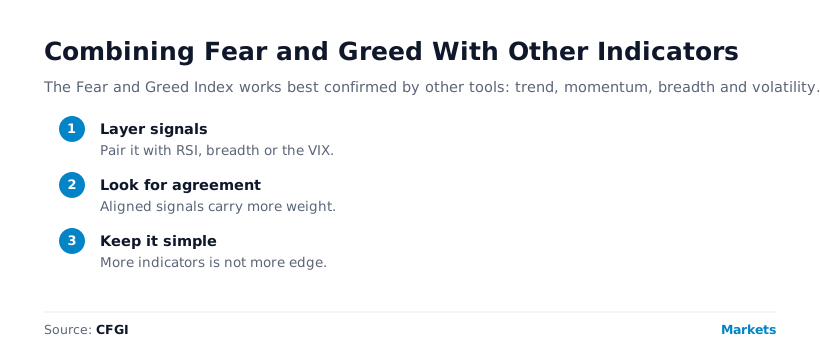
The Fear and Greed Index is strongest when confirmed by other indicators rather than used alone. Trend tells you the direction to respect, momentum tells you whether a move is fading, and volatility tells you how stretched conditions are. Sentiment frames the crowd; the others tell you whether the tape agrees. The aim is a few confirming tools that measure different things, not a wall of overlapping signals that just create paralysis. This is education, not financial advice.
CFGI data
Sentiment alone is a weak forecast: CFGI matches same-day market direction 79% of the time and next-day 49%, on data since March 2022. Layering confirmation, trend, momentum, breadth, is how a single weak read becomes a stronger, conditional one.
Source: CFGI dataset, March 2022 to June 2026.
Key takeaways
- Sentiment is strongest when other indicators confirm it.
- Trend sets the direction to respect; momentum flags fading moves.
- Volatility and breadth show how stretched conditions are.
- Many indicators already feed the score, so avoid double-counting.
- Aim for a few confirming tools, not a wall of signals.
Why Layer Indicators
No single indicator is reliable on its own, and the Fear and Greed Index is no exception, it reads the present mood accurately but forecasts poorly. Layering a few tools that measure different things, sentiment, trend, momentum, reduces the chance that any one false reading drives a decision. When several independent signals agree, the conclusion is far more robust than when one screams in isolation. The trick is to add confirmation, not noise: the goal is a small set of complementary tools, not a dashboard so crowded that it tells you everything and nothing at once.
What Pairs Well With Sentiment
| Indicator | Adds | Confirms sentiment when |
|---|---|---|
| Trend | Direction to respect | The trend is turning, not just stretched |
| Momentum (RSI) | Whether a move is fading | Momentum diverges at an extreme |
| Volatility (VIX) | How stressed the market is | Volatility spikes with Extreme Fear |
| Breadth | How broad a move is | Breadth confirms or contradicts the crowd |
Indicators that confirm a Fear and Greed reading.
Each of these answers a question sentiment cannot. Trend tells you which direction deserves respect; momentum, via a tool like the RSI, tells you whether a move is running out of steam; volatility shows how stressed conditions are; and breadth reveals whether a move is broad or carried by just a few names. Fundamentals, like valuation, are worth a place too, since the Fear and Greed Index measures mood rather than value, a market can be both fearful and expensive, and only a valuation lens tells you that.
The Right Way to Combine Them
The most useful way to layer them is to treat sentiment as the framing layer and the others as confirmation. The Fear and Greed Index tells you the crowd has become stretched, deep in fear or greed, and then you check whether the rest of the tape agrees before acting. Does the trend support a turn, or is the move just emotionally extreme? Is momentum diverging, hinting the move is fading? Is breadth confirming or quietly contradicting the price? When sentiment and these confirming tools all point the same way, you have a much stronger, more conditional read than sentiment alone. And when they disagree, that divergence is itself valuable information, a reason to wait rather than act.
The Overlap Problem
Here is a subtlety many people miss: most of the indicators that pair with the Fear and Greed Index already feed into it. A well-built sentiment index uses volatility, momentum and breadth as inputs, so watching all of them alongside the index means double-counting the same information and fooling yourself into thinking you have independent confirmation when you do not. The smarter move is to pair the index with something it does not fully capture, most obviously the price trend itself, since the index measures emotion, not direction. Adding one genuinely different lens beats stacking five that all say the same thing in slightly different words.
Avoid Double-Counting
Volatility, momentum and breadth already feed a Fear and Greed score, so re-watching them is not real confirmation. Pair the index with something it lacks, like the price trend, instead.
Keep It Simple
The final and most important rule is restraint. More indicators do not mean better decisions; past a small number, they inevitably start to conflict, leaving you frozen in "analysis paralysis" as one says buy and another says sell. The goal is not to find the one perfect combination of signals that removes all doubt, no such combination exists, but to assemble a small, complementary set that measures genuinely different things and to accept that even strong confirmation reduces false signals without removing risk. A clean process of "sentiment plus trend plus my own plan" beats a cluttered screen of a dozen flashing indicators every time. The best traders are usually distinguished not by how many indicators they watch, but by how disciplined they are with a small, well-understood handful.
Frequently asked questions
What indicators work well with the Fear and Greed Index?
Trend, momentum such as RSI, volatility such as the VIX, and breadth. Each measures something different, so they confirm or contradict the sentiment read rather than repeat it. Trend is especially useful, since the index does not measure direction.
How should I combine them?
Treat sentiment as the framing layer and the others as confirmation: the index flags that the crowd is stretched, then you check whether the trend, momentum and breadth agree before acting. When they all point the same way, the read is much stronger.
Do these indicators overlap with the index?
Yes, and this matters. A Fear and Greed Index already uses volatility, momentum and breadth as inputs, so re-watching them is double-counting, not independent confirmation. Pair the index with something it lacks, like the price trend.
Will more indicators improve my results?
Only up to a point. A few that measure different things add confirmation; too many conflict and cause analysis paralysis. Confirmation reduces false signals but removes no risk. This is education, not financial advice.
CFGI.io, Market sentiment research
The CFGI research team builds and maintains the CFGI Fear and Greed Index: a 0 to 100 sentiment score from 10 sub-indicators across hundreds of crypto assets and the equity market, refreshed every 15 minutes. We have tracked market emotion through multiple full crypto and equity cycles.
Think we missed something?
Spotted a gap, disagree with a take, or think we should cover a new topic? Message us and we'll act on your input.
Message us on TelegramKeep reading
This article is educational and is not financial advice. Crypto and equities are volatile and you can lose money. See our disclaimer.