Markets
Crypto vs Stock Fear and Greed Index
Quick answer
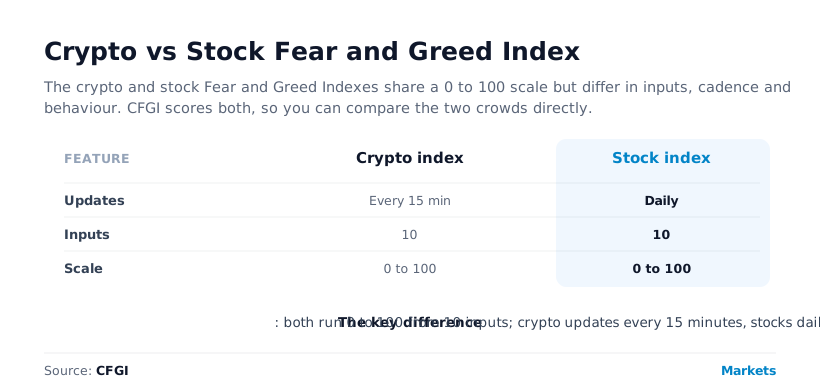
A crypto Fear and Greed Index and a stock one both score sentiment from 0 to 100, but they read different markets. Crypto trades 24/7 and swings harder, so its index refreshes every 15 minutes; stocks trade set hours, so theirs updates daily. Crypto reaches extremes more often and more deeply. CFGI scores both on the same scale, which lets you compare the crypto crowd and the equity crowd directly, and see when sentiment is a crypto story or a whole-market one. This is education, not financial advice.
CFGI data
CFGI scores crypto and stocks on one 0 to 100 scale, crypto every 15 minutes across 4 timeframes since March 2022, stocks daily since 2021. Reading both together shows the gaps: the crypto crowd can run greedy while equities stay cautious, a split visible only when they share a scale.
Source: CFGI dataset, 2021 to June 2026.
Key takeaways
- Both score sentiment from 0 to 100, on different markets.
- Crypto refreshes every 15 minutes; stocks update daily.
- Crypto reaches extremes more often and more deeply.
- CFGI scores both on one scale, so the two crowds compare directly.
- Comparing them shows whether a move is crypto-specific or market-wide.
Same Idea, Different Markets
The crypto and stock Fear and Greed indexes use the same 0 to 100 format, but the markets behave differently. Crypto trades around the clock and moves with more volatility, so sentiment is read every 15 minutes. Stocks trade on set hours and close overnight, so the equity score updates daily. Same idea, same scale, but tuned to two markets with very different rhythms.
Crypto vs Stock Fear and Greed, Side by Side
| Crypto | Stocks | |
|---|---|---|
| Trading hours | 24/7 | Set exchange hours |
| Update frequency | Every 15 minutes | Daily |
| Typical volatility | Higher | Lower |
| Reaches extremes | More often, more deeply | Less often |
| Scale | 0 to 100 | 0 to 100 |
How the crypto and stock indexes differ.
The shared 0 to 100 scale is what makes the comparison meaningful: a 30 in crypto and a 30 in stocks both signify the same level of fear, even though the markets reaching them look nothing alike. There is one subtlety worth keeping in mind, though. Because crypto routinely reaches the far ends of the scale and equities do so more rarely, the same number can be a more "everyday" event in crypto than in stocks, a crypto 15 is a deep but not unheard-of fear reading, while an equity 15 marks a more exceptional panic. The scale is shared, but how often each market visits its extremes is not, so it pays to read each number against that market’s own history as well as against the other.
Why Crypto Swings Harder
Crypto sentiment reaches extremes far more readily than equity sentiment, for structural reasons. Crypto trades 24 hours a day with no circuit breakers to pause a panic, carries heavy leverage that turns moves into liquidation cascades, is younger and less regulated so confidence is more fragile, and is driven heavily by emotional retail flows with little fundamental anchor. The result shows up clearly in the data: the crypto score has plunged to depths like the 17 during the Terra collapse, while the equity score’s lows, dramatic as the 3 in April 2025 was, are rarer events. Reading the two together means recalibrating, a swing that would be a once-a-year shock for stocks can be an ordinary week for crypto.
Why Compare the Two Crowds?
Because they often disagree, and the disagreement is informative. Crypto can be euphoric while equities are nervous, or both can turn fearful together in a broad risk-off move. Crypto frequently behaves as a leading, high-octane gauge of risk appetite, sometimes selling off first when the mood sours, since it sits at the speculative end of the risk spectrum. As institutional money has flowed into crypto, the two markets have also become more correlated than they once were, which makes the moments they diverge all the more telling. Putting both on one scale shows whether a wave of fear is a crypto-specific story, a hack, a regulatory scare, or part of a whole-market, macro-driven move.
The Cross-Market Read
Both fearful together points to a macro, risk-off move. Crypto fearful while stocks stay calm points to something specific to crypto. One shared scale is what lets you tell the two apart.
Reading Them Together
The practical value of scoring both crowds on one ruler is that it adds a layer no single-market index can. If crypto and stocks are both pinned in Extreme Fear, the message is that the whole risk landscape has turned, likely driven by macro forces like rates or a global shock, and a contrarian would weigh that breadth heavily. If only one is at an extreme, the story is narrower and asset-specific. Either way, the comparison turns two separate gauges into a single, richer picture of where fear and greed sit across the markets that matter most, which is exactly the kind of cross-asset view a unified Fear and Greed Index is built to provide.
Frequently asked questions
Why does the crypto index update more often than the stock one?
Crypto trades 24/7, so its sentiment is read every 15 minutes. Stocks trade on set hours and close overnight, so the equity score updates daily. CFGI runs both on the same 0 to 100 scale.
Why does crypto reach extremes more than stocks?
Because it trades 24/7 with no circuit breakers, carries heavy leverage that fuels liquidation cascades, is younger and less regulated, and is driven by emotional retail flows with little fundamental anchor, so its sentiment swings wider and deeper.
Do crypto and stock sentiment move together?
Sometimes. In broad risk-off moves both can turn fearful together, and the two have become more correlated as institutions entered crypto, but crypto often reaches extremes the equity market does not. Scoring both on one scale shows when they diverge.
Why compare the two crowds?
Because it shows whether a wave of fear is crypto-specific or a whole-market, macro move. Both fearful together signals a broad risk-off; only one at an extreme signals something narrower. This is education, not financial advice.
CFGI.io, Market sentiment research
The CFGI research team builds and maintains the CFGI Fear and Greed Index: a 0 to 100 sentiment score from 10 sub-indicators across hundreds of crypto assets and the equity market, refreshed every 15 minutes. We have tracked market emotion through multiple full crypto and equity cycles.
Think we missed something?
Spotted a gap, disagree with a take, or think we should cover a new topic? Message us and we'll act on your input.
Message us on TelegramKeep reading
This article is educational and is not financial advice. Crypto and equities are volatile and you can lose money. See our disclaimer.