Stocks
What Is FOMO In the Stock Market?
Quick answer
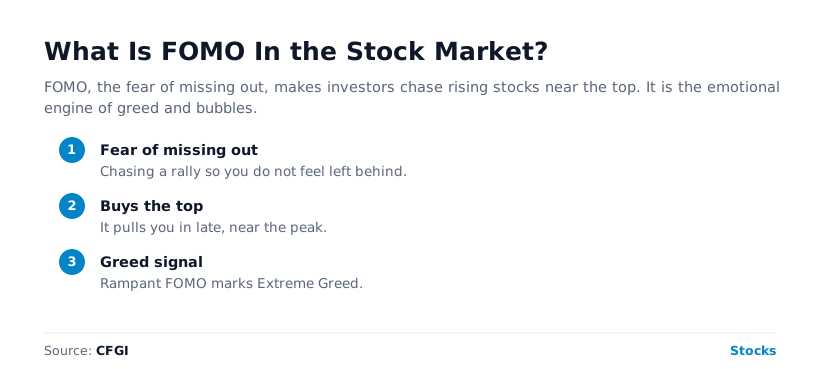
FOMO, the fear of missing out, is the anxiety that others are profiting from a move you are not in, which pushes investors to buy a rising stock late, near the top. It is the emotional engine behind greed and bubbles: the higher prices go, the stronger the urge to join, often just as risk is greatest. Driven by social proof and regret aversion, it traps buyers in the last wave of a rally. On a Fear and Greed Index, peak FOMO reads as Extreme Greed. This is education, not financial advice.
CFGI data
FOMO drives sentiment toward the greed extreme. Although CFGI data since 2021 shows the equity score reaches greed highs near 83 less often than it reaches fear lows, when it pins near the top on a fast rally, it is the signature of a crowd buying out of fear of missing out.
Source: CFGI dataset, 2021 to June 2026.
Key takeaways
- FOMO is the fear of missing out on a move others are profiting from.
- It makes investors chase rising stocks late, near the top.
- It is powered by social proof and the fear of regret.
- It is the emotional engine of greed and bubbles.
- Peak FOMO reads as Extreme Greed.
The Pull to Chase
FOMO turns a rising price into a social pressure. Seeing others profit, in the news, online, among friends, makes sitting out feel like a mistake, so investors buy not because the case is good but because they cannot bear to miss more upside. The trouble is that this urge is strongest after a big run, when risk is highest. FOMO is what carries a rally past fair value into a bubble. It is greed dressed as caution: the feeling is fear, fear of being left behind, but the behaviour is reckless buying.
Why FOMO Is So Powerful
FOMO is so hard to resist because it is rooted in deep features of human psychology, not in any judgement about the asset. One driver is social proof: when we see a crowd doing something, our instinct is to assume they know something we do not, so a stampede of buyers feels like evidence the trade is right. Another is regret aversion, the pain of watching others profit while we sit out is felt sharply, often more sharply than the fear of an actual loss, so we act to avoid the imagined future regret of having missed the move. Add the ancient herd instinct that once kept us safe, and the modern amplifiers of social media and rolling news that broadcast every winning trade, and you have a powerful emotional machine built to make us buy at exactly the wrong time.
It Is Regret, Not Analysis
FOMO buying is driven by the fear of regret and the pull of the crowd, not by the merits of the asset. Recognising that the urge is emotional, not analytical, is the first step to resisting it.
How FOMO Inflates Bubbles
FOMO is the engine that drives a rally past reason and into a bubble. The mechanism is a self-feeding loop: a rising price attracts FOMO buyers, whose buying pushes the price higher, which generates even more FOMO, and so on, each new high manufacturing the fear that fuels the next. This is how prices detach from any underlying value and a melt-up takes hold, running on pure greater-fool dynamics. The cruelty is in the timing: FOMO draws in the largest crowd of buyers right at the top, the moment of peak euphoria, just before the move exhausts itself, which is why the latecomers who finally capitulate to the fear of missing out so often become the "bag-holders" left nursing losses when the bubble bursts.
How to Manage FOMO
You cannot switch FOMO off, but you can build defences against it. The single most effective is a written plan made in calmer times, what you will buy, at what size, and why, because a plan made when you are not in the grip of the emotion is something concrete to fall back on when the urge strikes. Beyond that: accept in advance that you will miss some moves, because no one catches every rally and there is always another opportunity; size positions so that chasing, if you do, cannot do serious damage; use a steady approach like regular, fixed-amount buying to remove the timing decision altogether; and treat the strength of the urge itself as a warning sign, the more desperate you feel to buy, the more likely you are buying near a top. The goal is not to feel no FOMO, but to stop it from driving your decisions.
FOMO and the Greed Extreme
A Stock Fear and Greed Index is a useful mirror for FOMO. When the score is pinned in Extreme Greed and you feel the urge to chase, that is the moment to slow down, not speed up, because the gauge is confirming, objectively, that the crowd you feel pulled to join is already as one-sided as it gets. The reading is a prompt to check whether you are buying the case or just the crowd. Used this way, the index becomes a quiet external check on a powerful internal emotion: it cannot stop you feeling the fear of missing out, but it can remind you, at exactly the dangerous moment, that everyone else is feeling it too, which is precisely when chasing has historically been most costly.
Frequently asked questions
What is FOMO in the stock market?
The fear of missing out: the anxiety that others are profiting from a move you are not in, which pushes investors to buy a rising stock late, often near the top. The feeling is fear, but the behaviour is reckless buying.
Why is FOMO so powerful?
Because it is rooted in psychology, not analysis: social proof (a crowd of buyers feels like evidence), regret aversion (the pain of missing out is felt sharply), and the herd instinct, all amplified by social media and rolling news broadcasting every winning trade.
Why is FOMO dangerous?
Because the urge to chase is strongest after a big run, when risk is highest. FOMO carries rallies past fair value into bubbles via a self-feeding loop, and traps the largest crowd of buyers near the top, just before the move exhausts.
How do you manage FOMO?
Build a written plan in calm times, accept you will miss some moves, size positions so chasing cannot do serious damage, use steady fixed-amount buying, and treat Extreme Greed and the strength of the urge itself as prompts to slow down. This is education, not financial advice.
CFGI.io, Market sentiment research
The CFGI research team builds and maintains the CFGI Fear and Greed Index: a 0 to 100 sentiment score from 10 sub-indicators across hundreds of crypto assets and the equity market, refreshed every 15 minutes. We have tracked market emotion through multiple full crypto and equity cycles.
Think we missed something?
Spotted a gap, disagree with a take, or think we should cover a new topic? Message us and we'll act on your input.
Message us on TelegramKeep reading
This article is educational and is not financial advice. Crypto and equities are volatile and you can lose money. See our disclaimer.