Markets
What Are Fear and Greed In Markets?
Quick answer
Fear and greed are the two emotions that drive markets. Greed is the urge to buy when prices rise and miss-out anxiety takes over; fear is the urge to sell when prices fall and self-protection kicks in. They are the same force in opposite directions, fear tends to run deeper and faster than greed, and because both peak at extremes, they tend to cluster near market turning points. This is education, not financial advice.
CFGI data
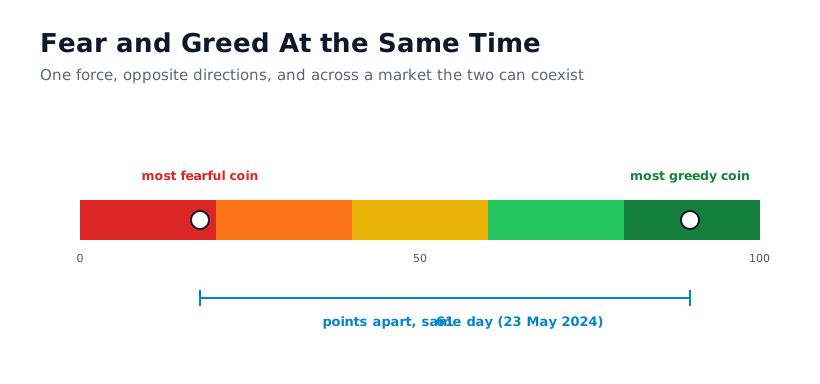
Fear and greed often run side by side across a market. CFGI measures both at once, and on 23 May 2024 the gap between the most fearful and most greedy major coins reached 61 points on its 0 to 100 scale. Scoring hundreds of assets individually since March 2022 is what reveals that split.
Source: CFGI dataset, March 2022 to June 2026.
Key takeaways
- Greed drives buying as prices rise; fear drives selling as they fall.
- They are one force in opposite directions.
- Fear runs deeper and faster than greed.
- Both peak at extremes, which cluster near turning points.
- Across a market, fear and greed can coexist at the same time.
The Two Forces
Greed is what rising prices feel like from the inside: confidence, optimism and the fear of missing out, which pull more buyers in. Fear is the opposite: falling prices breed anxiety and the urge to protect what is left, which pushes holders to sell. Every market, in every era, runs on this pair. From the tulip mania of the 1600s to today’s crypto swings, the technology and the assets change, but the two emotions driving the crowd never do, which is why understanding them is the foundation of understanding markets at all.
Two Sides of the Same Coin
Fear and greed are best understood not as two separate things but as opposite poles of a single emotional spectrum, like hot and cold on one thermometer. A market is almost never in a stable, neutral middle for long; instead it swings, pendulum-like, from one pole toward the other and back. Greed builds as prices rise, feeding on itself until it reaches euphoria, then some shock or exhaustion tips it over, and the same crowd that was greedy becomes fearful, often with startling speed. This is why the two are really one force: the optimism that drives a rally and the panic that drives a crash are the same human tendency to follow the herd and to feel emotion more strongly than reason, simply pointed in opposite directions. The market’s history is the story of this single pendulum swinging back and forth.
Why Fear Runs Deeper Than Greed
Although they are two sides of one coin, fear and greed are not perfectly symmetrical: fear is the stronger, sharper emotion. This is rooted in loss aversion, the well-documented finding that the pain of a loss is felt about twice as intensely as the pleasure of an equivalent gain. The practical result is that fear acts faster and reaches deeper than greed. Panics unfold in days, while greed-driven rallies build over weeks and months, the market "takes the stairs up and the elevator down". You can see this asymmetry directly in sentiment data: the equity score has plunged as low as 3 in a panic but, over the same period, topped out only at 83 in its greediest moment, far deeper into fear than into greed. Knowing that fear is the more powerful and explosive of the two emotions is key to anticipating how a market is likely to behave when the mood turns.
Fear Is the Stronger Force
Because losses hurt about twice as much as gains feel good, fear acts faster and runs deeper than greed. Panics are sudden and violent; greed builds slowly. The score reaches deeper into fear than greed.
Why Do They Mark Turning Points?
Because they peak when the crowd is most one-sided. At the top, almost everyone is greedy and already bought, so there is little buying left, and the market stalls. At the bottom, almost everyone is fearful and has already sold, so it takes little to turn it. That is why extreme readings cluster near reversals, and why emotions move markets most at the edges. This is the entire basis of contrarian thinking, captured in Warren Buffett’s maxim to "be fearful when others are greedy, and greedy when others are fearful". The extremes of fear and greed are not just emotional states; they are structural conditions of maximum vulnerability, the points at which a market has run out of fuel to continue in its current direction, which is exactly why measuring them is so useful.
How Does CFGI Measure Fear and Greed?
CFGI scores the balance of the two on a single scale from 0 (extreme fear) to 100 (extreme greed). The useful twist is that it scores hundreds of assets individually, so it can show fear and greed coexisting across the market at the same moment: on 23 May 2024 the spread between the most fearful and most greedy major coins reached 61 points. This matters because a single market-wide number averages away exactly that divergence, hiding the fact that one corner of the market can be gripped by panic while another runs euphoric. Reading both the overall balance and the per-asset split gives a far richer picture of where fear and greed actually live. Read the balance now on the Fear and Greed Index, or compare assets on the by-coin directory.
Frequently asked questions
What is the difference between fear and greed?
They are the same emotional force in opposite directions. Greed drives buying as prices rise; fear drives selling as they fall. They are two poles of one spectrum, and a Fear and Greed Index scores the balance between them.
Why does fear run deeper than greed?
Because of loss aversion: the pain of a loss is felt about twice as intensely as an equivalent gain. So fear acts faster and reaches deeper, panics unfold in days while greed builds over months. The equity score has reached 3 but only topped out at 83.
Why do fear and greed signal turning points?
Because they peak when the crowd is most one-sided. Peak greed leaves few buyers and the market stalls; peak fear leaves few sellers and it takes little to turn it. So extremes cluster near reversals, though they never guarantee one.
Can fear and greed exist at the same time?
Across a market, yes. CFGI scores hundreds of assets individually, and on 23 May 2024 the gap between the most fearful and most greedy major coins reached 61 points. A single market average hides exactly that divergence. This is education, not financial advice.
CFGI.io, Market sentiment research
The CFGI research team builds and maintains the CFGI Fear and Greed Index: a 0 to 100 sentiment score from 10 sub-indicators across hundreds of crypto assets and the equity market, refreshed every 15 minutes. We have tracked market emotion through multiple full crypto and equity cycles.
Think we missed something?
Spotted a gap, disagree with a take, or think we should cover a new topic? Message us and we'll act on your input.
Message us on TelegramKeep reading
This article is educational and is not financial advice. Crypto and equities are volatile and you can lose money. See our disclaimer.