Crypto
What Is a DAO?
Quick answer
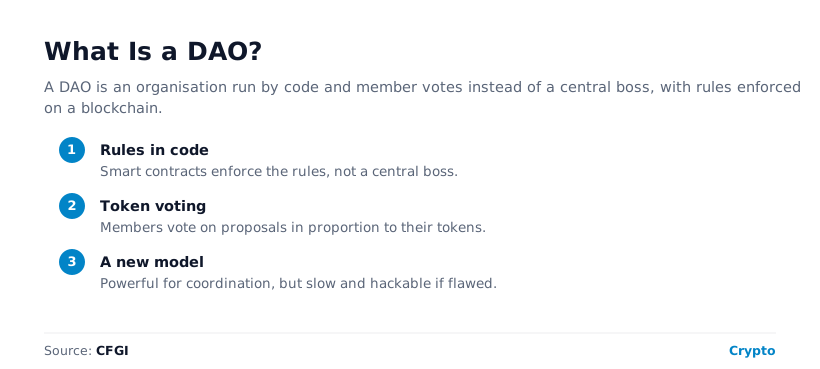
A DAO, or decentralised autonomous organisation, is a group that runs on rules written into smart contracts instead of a central management team. Members hold governance tokens that let them vote on proposals, and when a vote passes, the outcome executes automatically on a blockchain, including spending from a shared on-chain treasury. The idea is collective ownership without a boss: the code, and the token holders, are in charge.
CFGI data
A DAO is only worth what its members believe it is worth, which makes its governance token a pure sentiment instrument. CFGI has tracked crypto mood on a 0 to 100 scale since March 2022, swinging from a fearful 12 to a greedy 87, and DAO token prices and voter turnout tend to rise and fall with that same tide.
Source: CFGI dataset, March 2022 to June 2026.
Key takeaways
- A DAO is run by smart-contract rules and member votes, not a central boss.
- Governance tokens give voting power, usually one token, one vote.
- A passed proposal can execute automatically, including spending the treasury.
- The 2016 DAO hack split Ethereum into Ethereum and Ethereum Classic.
- Real limits remain: low turnout, whale concentration and buggy code.
An Organisation Run by Code
A traditional company has directors who decide how money is spent. A DAO replaces them with smart contracts: the rules for spending and decision-making are written in code on a blockchain, visible to anyone. There is no chief executive and no head office. The treasury sits on-chain, and what happens to it is decided by holders of the DAO’s governance token.
Because the rules execute automatically and the books are public, a DAO can coordinate strangers across the world without anyone needing to trust a central authority. That is the appeal, and the ongoing experiment, of decentralisation.
How a DAO Actually Decides
The loop is simple. A member writes a proposal: fund this project, change this fee, hire this team. Token holders vote, usually with one token counting as one vote, so more tokens means more weight. If the proposal clears the rules coded into the DAO, the smart contract carries it out, no signature from a manager required.
That last step is the radical part. In a normal company a vote is advice that humans then act on. In a DAO the vote is the action: the code releases the funds or changes the setting on its own. It makes a DAO transparent and hard to censor, and it makes a mistake in the code very expensive.
The DAO That Broke Ethereum
The cautionary tale is the original, called simply "The DAO". Launched in April 2016 as an investor-directed fund, it raised one of the largest crowdfunding totals in history at the time. In June 2016 an attacker exploited a reentrancy bug in its code and began draining the funds, eventually siphoning around 60 million US dollars of Ether, roughly a third of everything raised. The code had done exactly what it was written to do, which was the whole problem.
The community faced an impossible choice: honour "code is law" and let the theft stand, or rewrite history to claw the money back. In July 2016 most of the network chose to hard fork, reversing the hack. Those who refused kept running the original chain. That split is why two blockchains exist today: Ethereum, the forked majority, and Ethereum Classic, the unforked minority. No event better captures the promise and the peril of letting code run an organisation.
What DAOs Are Used for Now
Modern DAOs are less reckless and more useful. Most govern a DeFi protocol, steering its parameters and treasury.
- Uniswap, the largest decentralised exchange, is governed by holders of its UNI token, launched in 2020.
- MakerDAO governs the rules behind a major stablecoin.
- Compound and Curve let token holders vote on lending and trading parameters.
- Grant and collector DAOs pool funds to back projects, buy art, or, famously, almost buy a copy of the US Constitution.
Strengths and Real Limits
DAOs are transparent and censorship-resistant, but they are not magic. Three problems recur. Turnout is often dismal, so a tiny minority decides for everyone. Tokens concentrate, so a few "whales" can dominate a vote that is supposed to be democratic. And the code can be wrong, as The DAO proved at a cost of millions. A DAO is only as good as the rules its members write and the participation they actually sustain.
DAOs and Market Sentiment
A governance token has no earnings and no central bank behind it. Its price is almost pure belief in the protocol and its future, which makes it one of the most sentiment-driven assets in crypto. When the Crypto Fear and Greed Index reads greed, governance tokens and DAO activity tend to surge; when fear takes over, turnout falls and treasuries shrink with the wider market. Watching the mood on a 0 to 100 scale is a useful gut-check before reading too much into a token’s price.
Frequently asked questions
What is a DAO?
A decentralised autonomous organisation: a group run by rules in smart contracts and member token votes, with no central management team. Passed proposals execute automatically on a blockchain.
How do DAOs make decisions?
Members hold governance tokens and vote on proposals, usually one token per vote. If a proposal passes the coded rules, the smart contract executes the outcome on-chain by itself.
What was the DAO hack?
In June 2016, an attacker exploited a bug in the original "The DAO" and drained around $60 million of Ether, a third of its funds. To reverse it, Ethereum hard forked in July 2016, which is why Ethereum and Ethereum Classic both exist.
Can a DAO own real-world assets or be sued?
Increasingly yes. Some jurisdictions, such as Wyoming, now let a DAO register as a legal entity, a DAO LLC, so it can hold assets, sign contracts and limit member liability. Without that wrapper, a DAO sits in a legal grey area where members can be exposed personally.
Are DAOs safe?
They are transparent but carry real risks: buggy code, concentrated token ownership, and low voter turnout can all undermine them. This is education, not financial advice.
CFGI.io, Market sentiment research
The CFGI research team builds and maintains the CFGI Fear and Greed Index: a 0 to 100 sentiment score from 10 sub-indicators across hundreds of crypto assets and the equity market, refreshed every 15 minutes. We have tracked market emotion through multiple full crypto and equity cycles.
Think we missed something?
Spotted a gap, disagree with a take, or think we should cover a new topic? Message us and we'll act on your input.
Message us on TelegramKeep reading
This article is educational and is not financial advice. Crypto and equities are volatile and you can lose money. See our disclaimer.