Crypto
What Is a Crypto Fork?
Quick answer
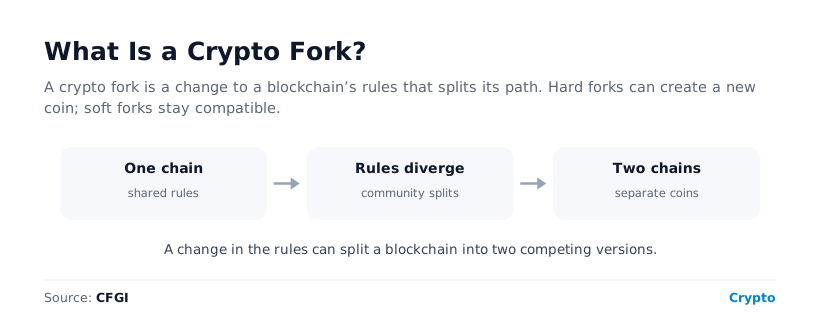
A crypto fork is a change to the rules of a blockchain. A soft fork is backward-compatible, so the network stays as one. A hard fork is not, and if part of the community keeps the old rules, the chain can split in two, sometimes creating a whole new coin. Forks are how blockchains upgrade and improve, and occasionally how they divide, and the contentious ones are among the most dramatic, sentiment-charged events in crypto.
CFGI data
A contentious fork splits a community, and sentiment splits with it. CFGI scores assets individually on a 0 to 100 scale, refreshed every 15 minutes since March 2022, so the two sides of a fork, the original chain and the new coin, can read very differently on the same gauge.
Source: CFGI dataset, March 2022 to June 2026.
Key takeaways
- A fork is a change to a blockchain’s rules.
- A soft fork is backward-compatible; the chain stays unified.
- A hard fork is not, and can split the chain into two.
- Bitcoin Cash and Ethereum Classic were born from hard forks.
- Holders of the original coin usually receive the new forked coin.
Changing the Rules
A blockchain runs on shared rules that every participant follows. A fork is a change to those rules. The crucial distinction is whether the change is compatible with the old version. A soft fork tightens the rules in a backward-compatible way, so nodes that have not upgraded still accept the chain and the network stays as one. A hard fork changes the rules in a way old software rejects, so everyone must upgrade to stay on the same chain, and if some refuse, the chain can break apart.
Soft Fork Versus Hard Fork
| Soft fork | Hard fork | |
|---|---|---|
| Compatible? | Yes, backward-compatible | No, a clean break |
| Must everyone upgrade? | No | Yes, to stay on the chain |
| Community | Usually united | Can split into factions |
| Result | One chain, upgraded | Possibly two chains |
The two kinds of fork.
A soft fork is like a routine software update that older devices can still work with; the upgrade rolls out and life goes on. A hard fork is more like switching to incompatible software: if the whole community moves together it is just a bigger upgrade, but if it does not, the network can divide.
Why Forks Happen
Most forks begin innocently, as ordinary upgrades to improve a blockchain’s performance, fees or security. Things get interesting when people disagree. Because a blockchain has no central authority, changing the rules requires rough consensus among developers, miners or validators, and users, and when those groups split into rival camps over the right path forward, a routine update can escalate into a contested hard fork. Forks have also been used deliberately, as a defence, to reverse the damage of a major hack by rewriting the chain’s history. In all cases, a fork is governance made visible: it is how a decentralised network decides, or fails to agree, what it should become.
When a Fork Creates a New Coin
If a hard fork is contentious and part of the community refuses to adopt the new rules, the blockchain can split into two chains that share an identical history up to the fork and diverge after it. From that moment they are separate networks with separate coins, separate communities and separate prices. This is how some well-known cryptocurrencies were born from older ones. The split is rarely amicable: it is usually the climax of a bitter disagreement, and the resulting two chains often spend years arguing over which is the "real" one.
The Famous Forks
Two splits define the genre. In 2017, a long-running dispute over how to scale Bitcoin, one camp wanting bigger blocks, the other a different upgrade, ended in a hard fork that created Bitcoin Cash, a separate coin built for larger, cheaper transactions. Earlier, in 2016, after a hack drained around 60 million dollars from "The DAO" on Ethereum, the community voted to hard fork and reverse the theft. Those who accepted the reversal continued on the chain we call Ethereum; those who insisted "code is law" and rejected the rewrite kept the original as Ethereum Classic. Both episodes show forks at their most consequential: not just technical, but deeply ideological.
The "Free Coins" and the Scams
When a hard fork splits a chain, holders of the original coin generally receive an equal amount of the new one, since both chains share history up to the split. When Bitcoin Cash forked off, Bitcoin holders found themselves with matching BCH. That sounds like free money, and it draws scammers like moths. A classic fraud is a fake "claim your forked coins" site or wallet that asks for your seed phrase or a contract approval, then drains your funds. The rule is the same as for any airdrop: a legitimate fork never requires you to hand over your seed phrase to anyone, and anything that does is theft.
The Safety Rule
You do not need to "claim" forked coins by entering your seed phrase anywhere. If a site or app demands it to release your "free" fork tokens, it is a scam, full stop.
Forks and Market Sentiment
Contentious forks are emotional, uncertain events, and uncertainty is what moves markets. In the run-up to a major fork, the community divides, the outcome is unclear, and prices can swing violently as supporters and sceptics battle it out. Afterwards, the two resulting coins often head in very different directions, one thriving, one fading. Because the Crypto Fear and Greed Index scores assets individually on a 0 to 100 scale, it can capture that divergence directly, with the two sides of a split reading as very different moods. A fork is one more case where a single market-wide number would miss the real, per-coin story.
Frequently asked questions
What is a crypto fork?
A change to the rules of a blockchain. A soft fork stays backward-compatible and keeps the network unified; a hard fork is not compatible and can split the chain into two.
What is the difference between a hard fork and a soft fork?
A soft fork tightens rules in a compatible way, so un-upgraded nodes still follow the chain and the community usually stays united. A hard fork changes rules incompatibly, so everyone must upgrade or the chain can split into two coins.
What are examples of crypto forks?
Bitcoin Cash, created in 2017 by a hard fork of Bitcoin over scaling, and Ethereum Classic, created in 2016 when part of the community rejected Ethereum’s hard fork to reverse the DAO hack.
Do I get free coins from a fork?
Usually, holders of the original coin receive an equal amount of the new forked coin. But beware: legitimate forks never require your seed phrase, and "claim your fork coins" sites asking for it are scams. This is education, not financial advice.
CFGI.io, Market sentiment research
The CFGI research team builds and maintains the CFGI Fear and Greed Index: a 0 to 100 sentiment score from 10 sub-indicators across hundreds of crypto assets and the equity market, refreshed every 15 minutes. We have tracked market emotion through multiple full crypto and equity cycles.
Think we missed something?
Spotted a gap, disagree with a take, or think we should cover a new topic? Message us and we'll act on your input.
Message us on TelegramKeep reading
This article is educational and is not financial advice. Crypto and equities are volatile and you can lose money. See our disclaimer.