Crypto
What Is Crypto Mining?
Quick answer
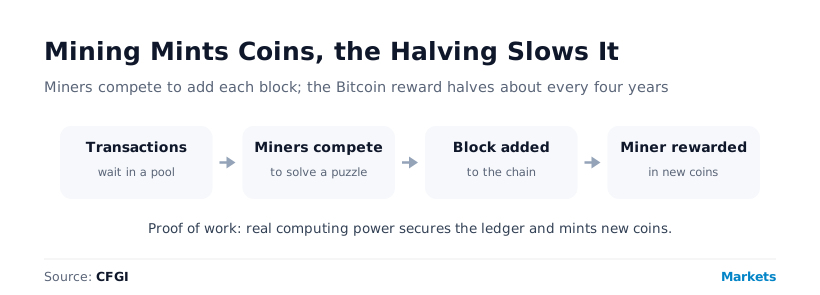
Crypto mining is how proof-of-work coins like Bitcoin confirm transactions and create new coins. Computers around the world compete to solve a hard mathematical puzzle; the winner adds the next block and earns newly minted coins. The huge computing effort is what secures the network, and it is also the tap that controls new supply, which the Bitcoin halving steadily tightens. Supply is one side of the sentiment balance. This is education, not financial advice.
CFGI data
Mining secures proof-of-work coins like Bitcoin, and the halving slowly tightens new supply. CFGI scores those coins individually on a 0 to 100 scale from 10 indicators, every 15 minutes since March 2022, so supply-driven shifts in mood show up per asset rather than as one blurred market number.
Source: CFGI dataset, March 2022 to June 2026.
Key takeaways
- Mining confirms transactions and creates new coins on proof-of-work networks.
- Miners compete to solve a puzzle; the winner adds the block and earns the reward.
- The computing power spent is what secures the network.
- The Bitcoin halving cuts the reward roughly every four years.
- Supply pressure is one input into how the crowd prices fear and greed.
What Is Crypto Mining?
Mining is the process that keeps proof-of-work blockchains like Bitcoin honest. Computers race to solve a hard mathematical puzzle. The first to solve it earns the right to add the next block of transactions to the blockchain, and is rewarded with newly created coins plus transaction fees. All that computing power is the security: to attack the chain you would need more power than the entire honest network, which is wildly expensive. Mining, in effect, replaces a trusted central authority with a costly, competitive race that makes cheating economically irrational.
How Mining Works
The "puzzle" miners race to solve is not clever maths but brute-force guessing: they repeatedly hash data, trying trillions of combinations per second, until one finds a result below a target value, essentially a lottery where more computing power buys more tickets. This is the "proof of work": the winning miner has demonstrably spent real energy to earn the right to add the block, and everyone else can verify it instantly. The network automatically adjusts the puzzle’s difficulty to keep new blocks arriving at a steady pace (about every ten minutes for Bitcoin) no matter how much mining power joins. Because competition is so fierce, mining today is done with specialised hardware (ASICs) and miners often band together into "pools" to share the work and smooth out the rewards. The winner collects the "block reward", newly minted coins, plus the fees from the transactions in the block, which is the economic incentive that powers the whole system.
What Is the Halving?
Bitcoin is designed to release new coins slowly and predictably. Roughly every four years the mining reward is cut in half, an event called the halving. New supply drops, while demand may not, which is why the halving cycle is watched so closely, and why it is central to Bitcoin’s scarcity story: the halvings march steadily toward the hard cap of 21 million coins, making each new coin progressively harder to produce.
Supply Is One Half of the Balance
Price is set where supply meets demand. Mining and the halving control the supply side; sentiment drives the demand side. Both meet in the price, and in the score.
The Energy Debate
Mining’s most prominent criticism is its energy use, and it is worth understanding both sides honestly. The objection is straightforward: proof-of-work mining consumes a large and growing amount of electricity, raising real environmental concerns about its carbon footprint. The defence is that this energy expenditure is not waste but the very source of the network’s security, the real-world cost is precisely what makes attacking Bitcoin prohibitively expensive, and there is no cheaper way to achieve the same trustless, decentralised security. Defenders also note that mining increasingly uses renewable and otherwise-stranded energy, and can even support grid stability. The debate is genuine and unresolved, but it is a major reason many newer networks chose a different path: proof of stake, the low-energy alternative that Ethereum and others use, which achieves security through locked-up capital rather than electricity. How much you weigh mining’s energy cost against its security is, in the end, a value judgement.
Energy As Security, Or Waste?
Mining’s heavy energy use is its biggest criticism. Defenders argue that real-world cost is exactly what secures the network and cannot be faked; critics point to the carbon footprint. Proof of stake is the low-energy alternative.
How Does Mining Connect to Sentiment?
Mining itself does not create greed or fear, but the supply it controls is one side of the equation the crowd is reacting to. A tightening supply against steady demand is a backdrop optimism builds on, which is much of the narrative power of the halving; conversely, miners selling their coin reserves to cover their substantial electricity and hardware costs can add a steady stream of sell pressure, so "miner selling" is itself a watched on-chain signal. CFGI does not try to separate every cause. It measures the net result, how fearful or greedy the crowd is right now, on the Crypto Fear and Greed Index, built from 10 indicators including volume, volatility and on-chain flows. So while mining works quietly on the supply side, its effects ultimately show up, alongside everything else, in the single number that captures the crowd’s mood.
Frequently asked questions
What is crypto mining?
The process that secures proof-of-work blockchains like Bitcoin and creates new coins. Computers compete to solve a hard puzzle by brute force; the winner adds the next block of transactions and earns newly minted coins plus fees. The computing power spent is what secures the network.
What is the Bitcoin halving?
A scheduled event, roughly every four years, that cuts the mining reward in half. It slows the creation of new Bitcoin, tightening supply over time as it marches toward the 21-million cap, which is central to Bitcoin’s scarcity story.
Why does crypto mining use so much energy?
Because security comes from real computing work, the energy spent is what makes attacking the network impractical and impossible to fake. Critics cite the carbon footprint; defenders argue it is the price of trustless security. Proof-of-stake coins use a far less energy-intensive method.
Does mining affect the price of Bitcoin?
Indirectly. Mining controls how fast new supply enters, which is one side of the supply-and-demand balance, and miners selling reserves can add sell pressure. Demand, driven by sentiment, is the other side. This is education, not financial advice.
CFGI.io, Market sentiment research
The CFGI research team builds and maintains the CFGI Fear and Greed Index: a 0 to 100 sentiment score from 10 sub-indicators across hundreds of crypto assets and the equity market, refreshed every 15 minutes. We have tracked market emotion through multiple full crypto and equity cycles.
Think we missed something?
Spotted a gap, disagree with a take, or think we should cover a new topic? Message us and we'll act on your input.
Message us on TelegramKeep reading
This article is educational and is not financial advice. Crypto and equities are volatile and you can lose money. See our disclaimer.