Crypto
What Is a Seed Phrase?
Quick answer
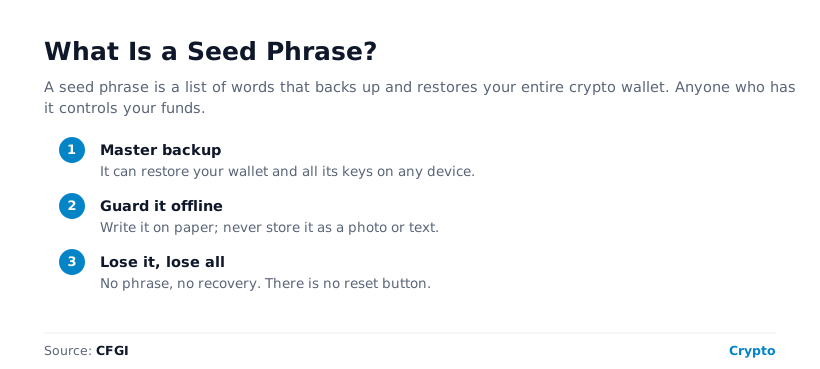
A seed phrase is a list of usually 12 or 24 words that acts as the master backup for your crypto wallet. From those words, your wallet can recreate every private key and recover all your funds, on any compatible device. That power cuts both ways: anyone who gets your seed phrase controls your crypto. Guarding it offline is the single most important habit in self-custody, because the phrase is not a password you can reset, it is the keys themselves in human-readable form.
CFGI data
A seed phrase only matters if you hold your own coins, and self-custody rises and falls with trust. CFGI has tracked crypto sentiment on a 0 to 100 scale since March 2022, and its low of 17 on 12 May 2022 marked exactly the kind of confidence shock that sends holders reaching for their seed phrases and pulling funds off exchanges into their own hands.
Source: CFGI dataset, March 2022 to June 2026.
Key takeaways
- A seed phrase is the master backup for your entire wallet.
- It is usually 12 or 24 words drawn from a fixed list of 2,048.
- One phrase can recreate every key and address your wallet holds.
- Anyone who reads it can take all of your funds.
- Store it offline on paper or metal, and never type or photograph it.
The Master Key, In Words
When you set up a self-custody wallet, it shows you a seed phrase and tells you to write it down. Those words encode the private keys for every address the wallet controls, so the phrase alone can rebuild your whole wallet on a new device if your phone breaks or your hardware wallet is lost. It is a backup and a master key at the same time.
Why Words, and Why 12 Or 24
The words are not random English. They come from a fixed list of 2,048 words defined by a standard called BIP-39, and each word stands in for 11 bits of the underlying secret. Twelve words encode 128 bits of randomness; twenty-four words encode 256 bits, matching the full strength of a Bitcoin private key. The final word carries a built-in checksum, so if you write one word wrong, a compatible wallet can usually tell that the phrase is invalid rather than silently sending you to an empty wallet.
Words were chosen over a long string of letters and numbers for one human reason: people copy words far more accurately than they copy hexadecimal. A misremembered character in a raw key means lost funds. A standard wordlist, with no two words sharing their first four letters, makes the backup something a person can actually transcribe and check.
One Seed, a Whole Wallet
A modern wallet is "hierarchical deterministic", which is a long way of saying every key it will ever use is grown from that single seed by a fixed recipe. Restore the seed in any compatible wallet and the same tree of addresses and keys reappears, in order, every time. That is why you back up one short phrase instead of hundreds of individual keys, and why moving from one wallet brand to another is usually as simple as typing the words into the new app.
Why It Must Stay Secret
Because the seed phrase can recreate your entire wallet, it is the single most valuable thing a scammer can get from you, more useful to them than any password. The rules are short and strict: write it down offline, store it somewhere safe, never type it into a website, never share it with anyone, and never keep it in a screenshot, email or cloud note. No legitimate wallet, exchange or support agent will ever ask you to enter your seed phrase. Anyone who does is stealing.
How Fortunes Get Lost
The seed phrase is also where most permanent crypto losses happen, in both directions. Roughly 20% of all bitcoin, close to 3.8 million coins, is estimated to be lost forever, much of it to seed phrases that were never written down or were thrown away, like the famous hard drive sitting in a Newport landfill with the keys to 8,000 BTC. On the other side, theft is almost always social. The classic scam is a fake "sync" or "validate your wallet" page that asks for your twelve words, and the moment you type them, the funds are gone. Fake hardware wallets that ship with a pre-filled phrase are another trap.
How to Back One Up Properly
- Write the words by hand, in order, the moment the wallet shows them. Never photograph or type them into anything connected to the internet.
- Move the backup to metal if the amount is meaningful: a steel plate survives fire and flood, paper does not.
- Keep a copy in more than one safe place, so a single fire or theft does not wipe you out.
- Consider an optional passphrase, sometimes called a 25th word, for an extra layer that is never written with the others.
- Test recovery with a small amount before trusting the backup with real savings.
Seed Phrases, Self-Custody and Sentiment
Reaching for a seed phrase is what self-custody feels like in practice, and the urge to do it tends to surge at moments of fear. When an exchange fails or a custodian freezes withdrawals, trust drops and holders move funds into wallets they control, exactly the kind of confidence shock the Crypto Fear and Greed Index captures on a 0 to 100 scale. A seed phrase is the tool that makes "not your keys, not your coins" real, so understanding it is part of understanding why sentiment and custody move together.
Frequently asked questions
What is a seed phrase?
A list of usually 12 or 24 words that is the master backup for your crypto wallet. From it, your wallet can recreate every private key and recover all your funds on any compatible device.
Why is a seed phrase 12 or 24 words?
The words come from a fixed 2,048-word BIP-39 list, each standing for 11 bits of the secret. Twelve words encode 128 bits of randomness and twenty-four encode 256 bits, with a checksum word that helps catch a mistake in transcription.
What happens if someone gets my seed phrase?
They can restore your wallet on their own device and take everything. Anyone with the seed phrase has full control of the funds, which is why it must never be shared, typed online or stored digitally.
How should I store my seed phrase?
Offline. Write it by hand, ideally stamp it into metal, keep copies in more than one safe place, and never save it in a photo, email or cloud note. Test recovery with a small amount first. This is education, not financial advice.
CFGI.io, Market sentiment research
The CFGI research team builds and maintains the CFGI Fear and Greed Index: a 0 to 100 sentiment score from 10 sub-indicators across hundreds of crypto assets and the equity market, refreshed every 15 minutes. We have tracked market emotion through multiple full crypto and equity cycles.
Think we missed something?
Spotted a gap, disagree with a take, or think we should cover a new topic? Message us and we'll act on your input.
Message us on TelegramKeep reading
This article is educational and is not financial advice. Crypto and equities are volatile and you can lose money. See our disclaimer.