Crypto
What Is a Good Crypto Fear and Greed Score?
Quick answer
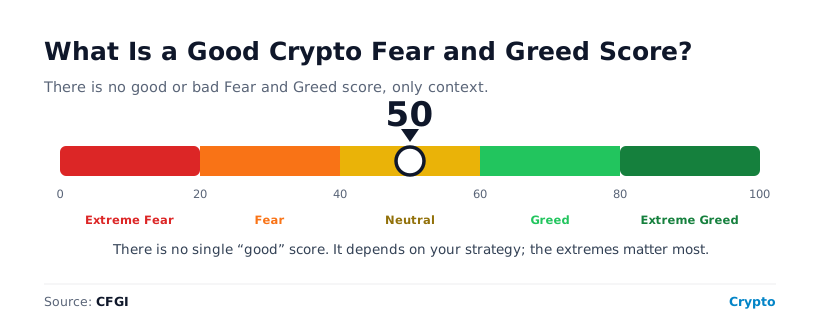
There is no good or bad Crypto Fear and Greed score, only context. A low score means the crowd is fearful, a high score means it is greedy, and neither is good or bad in itself, because the index is contrarian. What matters is whether the reading is at an extreme: under 20 (Extreme Fear) or 80 and above (Extreme Greed) is where the crowd is most one-sided, and where the index is most informative. In crypto, it also matters which asset you are reading, since CFGI scores each coin individually. This is education, not financial advice.
CFGI data
A reading is useful only relative to the scale, and in CFGI data since March 2022 the crowd has used all of it. The stock score ran from an extreme-fear 3 on 8 April 2025 to 83 on 19 December 2023, so context, not a target number, is what makes a score meaningful.
Source: CFGI dataset, March 2022 to June 2026.
Key takeaways
- No score is good or bad; each is context.
- Low means fearful, high means greedy, and the index is contrarian.
- The extremes carry the information; the middle is noise.
- It grades crowd emotion, not the quality of the asset.
- In crypto, also check the specific coin, not just the market.
Why "Good" Is the Wrong Question
Asking for a good Crypto Fear and Greed score assumes high is good and low is bad, but the index is contrarian. A low score, deep fear, is where value-seekers look; a high score, greed, is where risk is highest. So the question is not whether a score is good, but where the crowd is standing.
| Score | Zone | Context |
|---|---|---|
| 0 to 19 | Extreme Fear | Crowd very pessimistic |
| 20 to 39 | Fear | Caution dominates |
| 40 to 59 | Neutral | No strong edge |
| 60 to 79 | Greed | Optimism building |
| 80 to 100 | Extreme Greed | Crowd euphoric, risk high |
What each zone means, not good or bad.
It Measures the Crowd, Not the Coin
The key mental shift is to read the score as a thermometer of emotion, not a report card on an asset. A high number does not mean a coin is "doing well" in any fundamental sense; it means sentiment around it is running hot, which historically raises risk. A low number does not mean a coin is "broken"; it means sentiment is cold, which historically sits nearer opportunity. This inverts the naive intuition, so a contrarian treats a very high score as a yellow flag and a very low one as a potential green light. Once you read the gauge as a measure of how stretched the crowd is, rather than how good the asset is, the whole "is this a good score?" question dissolves.
High Is Not Good, Low Is Not Bad
The score grades the crowd’s emotion, not the asset’s quality. Extreme Greed feels great and often precedes risk; Extreme Fear feels awful and often marks opportunity.
Where the Information Lives
The score is not equally meaningful across its range; its value is shaped like a U. The information concentrates at the two extremes, under 20 and over 80, where the crowd is most one-sided and therefore most likely to be stretched, and it fades to almost nothing in the neutral middle around 50. So rather than hunting for a "good" number, the practical approach is to largely ignore the score when it sits in the middle and pay close attention when it reaches an extreme. A reading of 50 is genuinely uninformative; a reading of 10 or 90 is the gauge telling you something worth weighing, with care. The extremes are the message; the middle is noise.
It is also worth remembering the direction of travel, not just the level. A score of 35 that has been falling fast out of greed tells a very different story than a 35 that has been climbing out of the single digits, even though the number is identical. So "where the crowd is standing" is really two questions, how stretched is it, and which way is it moving, and a score that looks unremarkable on its own can be quite informative once you see the path it took to get there.
In Crypto, Which Coin Matters Too
Crypto adds a twist the stock market does not have: there is rarely a single "the score", because CFGI scores hundreds of coins individually, and they can sit at very different points at the same moment. A "good" score therefore depends not only on what you are trying to do, a buyer hunting bargains values deep fear, while a holder managing risk values knowing about greed, but also on which asset you are actually reading. The market reading might be neutral while the specific coin you hold is pinned in Extreme Greed, or the reverse. So the most useful question is never "is this a good score?" but "what does this score mean, for this coin, for what I am trying to do?"
Frequently asked questions
What is a good Crypto Fear and Greed score?
There is no good or bad score, only context. Low means fearful, high means greedy, and the index is contrarian. The extremes, under 20 and over 80, carry the most information; the neutral middle is mostly noise.
Is a high score better than a low one?
No. The index grades the crowd’s emotion, not the asset’s quality, and it is contrarian: a low score can mean value, a high score can mean risk. Neither is good or bad in itself.
Which scores matter most?
The extremes, under 20 (Extreme Fear) and over 80 (Extreme Greed), where the crowd is most one-sided. The neutral middle around 50 is mostly noise, best read as a thermometer of how stretched sentiment has become.
Does the "good" score depend on the coin?
Yes. CFGI scores hundreds of coins individually, so the market reading and a specific coin’s reading can differ sharply. The useful question is what a score means for that coin and for your goals, not whether the number itself is good. This is education, not financial advice.
CFGI.io, Market sentiment research
The CFGI research team builds and maintains the CFGI Fear and Greed Index: a 0 to 100 sentiment score from 10 sub-indicators across hundreds of crypto assets and the equity market, refreshed every 15 minutes. We have tracked market emotion through multiple full crypto and equity cycles.
Think we missed something?
Spotted a gap, disagree with a take, or think we should cover a new topic? Message us and we'll act on your input.
Message us on TelegramKeep reading
This article is educational and is not financial advice. Crypto and equities are volatile and you can lose money. See our disclaimer.