Crypto
How Often Does the Crypto Fear and Greed Index Update?
Quick answer
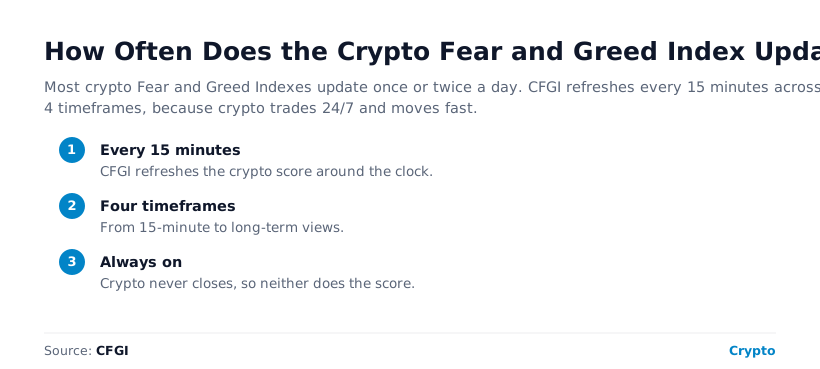
It depends on the provider. The original crypto index updates once a day, and some others every 12 hours. CFGI refreshes the crypto score every 15 minutes, across 4 timeframes, because crypto trades around the clock and sentiment can swing hard within hours. A faster refresh matters most if you act on sentiment intraday or around volatile moments, rather than checking it once a day. This is education, not financial advice.
CFGI data
CFGI refreshes crypto Fear and Greed every 15 minutes across 4 timeframes, and has since March 2022. That cadence is built for a market that never closes: a once-a-day reading can miss a move that flipped the crowd from greed to fear overnight, which the gauge would otherwise only show you the following day.
Source: CFGI dataset, March 2022 to June 2026.
Key takeaways
- The original index updates once a day; some others every 12 hours.
- CFGI refreshes every 15 minutes, across 4 timeframes.
- Crypto trades 24/7, so a fast refresh keeps pace with the market.
- A slow refresh can lag an overnight or weekend swing in sentiment.
- Faster keeps the reading current, but does not improve forecasting.
How Often Each Updates
| Provider | Update frequency |
|---|---|
| alternative.me | Once a day |
| CoinStats | Every 12 hours |
| CoinMarketCap | About once a day |
| CFGI | Every 15 minutes |
Crypto Fear and Greed update frequency by provider.
The original and most-cited crypto index, from alternative.me, publishes a single new reading each day. Others land somewhere in between. CFGI sits at the fast end, refreshing every 15 minutes, a difference that only matters depending on how you actually use the gauge.
Why the Cadence Matters
Crypto never closes, and some of its biggest moves happen overnight or at the weekend, exactly when traditional markets are shut. A Fear and Greed Index that updates once a day can show yesterday’s mood while the market has already lurched from greed to fear and back. A 15-minute refresh keeps the reading close to live, which matters most if you check sentiment around volatile moments, a sudden sell-off, a breakout, a piece of news, rather than glancing at it once at the same time each day.
What "Every 15 Minutes" Actually Means
A 15-minute cadence means CFGI recalculates each score from the latest market data four times an hour, not that the number jumps around randomly. In calm conditions it may barely move between refreshes; in a fast, news-driven hour it can shift meaningfully, capturing a swing a once-daily snapshot would entirely miss until the next day. The same fast refresh runs across hundreds of assets individually, so you are seeing a near-live reading not just for the market, but for Bitcoin, Ethereum and the rest, each on its own.
Every one of those refreshes is also stored, which means the history is recorded at 15-minute resolution rather than as a single daily dot. That finer-grained record lets you look back and see how sentiment actually moved through a crash or a rally hour by hour, instead of just where it happened to sit at one moment each day, a level of detail a once-daily index simply cannot offer after the fact.
The Four Timeframes
CFGI also scores sentiment across four different timeframes, which is distinct from how often the gauge refreshes. A short timeframe reacts quickly to the last few hours of trading; a longer one smooths over days or weeks. This matters because a coin can be greedy in the short term while still fearful over a longer window, or vice versa, just after a turn. Looking across the timeframes tells you whether a move is a brief flicker or part of a more durable shift in mood, which a single number cannot show on its own.
Does Faster Mean More Accurate?
It is worth being honest about what speed does and does not buy you. A faster refresh keeps the reading current, which genuinely helps if you act intraday. What it does not do is improve forecasting: any sentiment index reads the present well and the future poorly, no matter how often it updates. A 15-minute gauge will not predict tomorrow any better than a daily one; it simply describes right now more precisely. So treat the extra speed as better situational awareness, not a crystal ball, and resist the temptation to over-trade on every small flicker.
Match the Cadence to Your Use
Checking sentiment once a day for context? A daily index is fine. Reacting around live, volatile moments? A 15-minute refresh is the one that keeps up.
Why Crypto Updates Faster Than Stocks
The contrast with equities makes the logic clear. CFGI updates its stock score once a day, because stock exchanges close overnight and a session is the natural unit to measure. Crypto has no closing bell, so a once-a-day snapshot would leave long gaps where sentiment moved unseen. The principle behind both is the same: the update frequency should match how often the underlying market actually trades. For crypto, that means minutes, not days.
See It Live
Frequently asked questions
How often does the Crypto Fear and Greed Index update?
It varies by provider: the original index from alternative.me updates once a day, some others every 12 hours, and CFGI every 15 minutes across 4 timeframes.
Why does CFGI update every 15 minutes?
Because crypto trades 24/7 and sentiment can swing fast, including overnight and at weekends. A 15-minute refresh keeps the score close to live rather than reflecting a reading from earlier in the day.
What are the four timeframes?
Separate from how often it refreshes, CFGI scores sentiment over four lookback windows, from short to long. A coin can read greedy short-term while still fearful over a longer window, and comparing the timeframes shows whether a move is a flicker or a durable shift.
Does a faster update make it more accurate?
It keeps the reading current, which helps if you act intraday, but it does not improve forecasting. Any sentiment index reads the present well and the future poorly. This is education, not financial advice.
CFGI.io, Market sentiment research
The CFGI research team builds and maintains the CFGI Fear and Greed Index: a 0 to 100 sentiment score from 10 sub-indicators across hundreds of crypto assets and the equity market, refreshed every 15 minutes. We have tracked market emotion through multiple full crypto and equity cycles.
Think we missed something?
Spotted a gap, disagree with a take, or think we should cover a new topic? Message us and we'll act on your input.
Message us on TelegramKeep reading
This article is educational and is not financial advice. Crypto and equities are volatile and you can lose money. See our disclaimer.