Crypto
Can the Crypto Fear and Greed Index Be Manipulated?
Quick answer
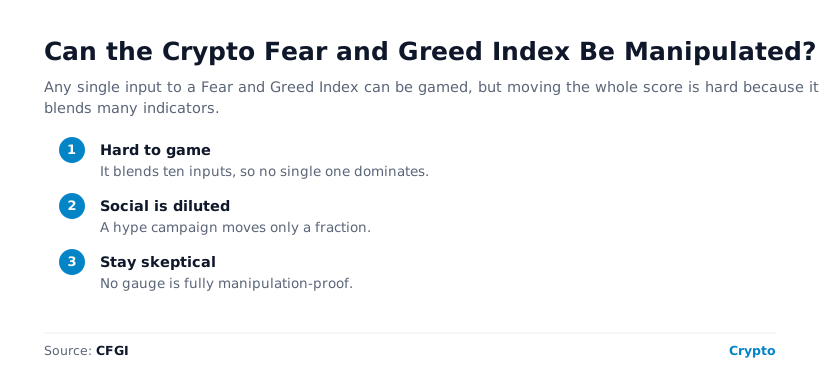
Individual inputs can be nudged, social chatter can be botted, a single price wick can be engineered, but moving the whole Crypto Fear and Greed Index is hard. Because the score blends many independent indicators, faking one barely shifts the result. Manipulating the index meaningfully would mean moving price, volatility and volume across the market at once, which is far harder than spamming a hashtag, though a small, thin coin is easier to influence than a major one. This is education, not financial advice.
CFGI data
CFGI’s defence against manipulation is breadth: it combines 10 indicators, so no single gamed input dominates. To shift the score you would have to move several real market signals together, which is exactly the kind of broad pressure a lone actor cannot easily fake.
Source: CFGI methodology, 10-indicator model.
Key takeaways
- A single input can be gamed, but it barely moves the blend.
- The score combines many independent indicators by design.
- Real manipulation would mean moving the whole market at once.
- Breadth is what makes the index hard to fake.
- A small, thin coin is easier to influence than a major one.
One Input Versus the Whole Score
Could someone bot a wave of bullish posts to lift the social component? Yes. Could that alone swing the Crypto Fear and Greed Index into Extreme Greed? No. The score is built from many indicators, so a single faked input is diluted by the others that did not move. The whole design philosophy of a blended index is that it should be far harder to fake than any of its parts, and that is exactly what makes the "can it be manipulated?" question more interesting than it first appears.
Which Inputs Are Easiest to Game
Not all inputs are equally vulnerable, and it is worth being honest about which ones are softer. Social-media volume and tone are the most gameable, bot networks can manufacture chatter, and coordinated groups can briefly flood a hashtag. Search interest can be nudged at the margins. Even price can be wicked momentarily by a large, aggressive order. But these manipulations are shallow and short-lived: a botted social spike is one signal among ten, a price wick reverses in minutes, and none of them shifts the deeper measures the index also reads. The gameable inputs are exactly the ones a well-built index leans on least, precisely because they are known to be noisy.
Why the Blend Is the Defence
The reason the index resists manipulation is its breadth. CFGI combines ten independent indicator groups, price momentum, volatility, volume, social activity, dominance, search and on-chain signals, and weights them so that no single input can dominate. To move the blended score meaningfully, a manipulator would have to move many of these at once, in the same direction, and keep them there. That is not gaming a number; it is recreating the actual conditions of real fear or greed across the market. The synthesis turns a set of individually spoofable signals into a composite that is genuinely hard to spoof, which is the whole point of building an index rather than watching one metric.
Breadth Beats Spoofing
You can fake one signal cheaply. Faking ten independent signals together is so expensive it amounts to actually moving the market, which is no longer manipulation of the gauge but of the thing it measures.
The Honest Answer
So the honest verdict is: not unfakeable, but robust. To meaningfully manipulate the index you would have to move price, volatility, volume and momentum across the market together, which is to say, actually move the market. At that point you are not gaming an indicator; you are moving the thing it measures, and that takes capital far beyond what a lone manipulator commands. A botted social spike or a single price wick might wobble the reading for a moment, but it cannot sustain a false signal across the whole blend. The index is resilient by design, even if, like any tool, it is not perfectly bulletproof.
The Thin-Coin Caveat
There is one honest exception worth flagging. CFGI scores assets individually, and the cost of moving the underlying market is far lower for a small, thinly traded coin than for a giant like Bitcoin. On an illiquid micro-cap, a relatively modest amount of capital really can push price and volume around, which means its per-asset reading is genuinely easier to influence than that of a deep, heavily traded major. This is the same reason thin coins are more prone to manipulation generally. The practical takeaway is to trust the sentiment reading most where the market is deepest, on Bitcoin and the largest assets, and to treat the score on a tiny, obscure token with the same caution you would treat the token itself.
Even there, the manipulation is self-limiting, because moving a coin’s price and volume enough to shift its sentiment score means buying or selling real size, which is itself a real market action with real cost and risk. A manipulator who pumps a thin coin to fake greed has, in doing so, actually created some of that greed, and will face genuine losses when the position unwinds. The index measures behaviour, and faking behaviour convincingly is expensive almost everywhere, which is ultimately why it holds up far better than its most spoofable single inputs would suggest.
Frequently asked questions
Can the Crypto Fear and Greed Index be manipulated?
A single input can be gamed, but moving the whole score is hard. It blends many independent indicators, so faking one barely shifts the result. Real manipulation would mean moving the market itself.
Which inputs are easiest to game?
Social-media volume and tone are the most vulnerable, since bots can manufacture chatter, and price can be wicked briefly by a large order. But these are shallow and short-lived, and they are the very signals a well-built index leans on least.
Why is the index hard to manipulate?
Because of breadth. It combines ten independent indicators weighted so no one dominates, so moving the score meaningfully would require moving many real market signals at once, which amounts to actually moving the market.
Are some readings easier to fake than others?
Yes. A small, thinly traded coin is far cheaper to influence than a major like Bitcoin, so trust the sentiment reading most where the market is deepest, and treat the score on a tiny, obscure token with extra caution. This is education, not financial advice.
CFGI.io, Market sentiment research
The CFGI research team builds and maintains the CFGI Fear and Greed Index: a 0 to 100 sentiment score from 10 sub-indicators across hundreds of crypto assets and the equity market, refreshed every 15 minutes. We have tracked market emotion through multiple full crypto and equity cycles.
Think we missed something?
Spotted a gap, disagree with a take, or think we should cover a new topic? Message us and we'll act on your input.
Message us on TelegramKeep reading
This article is educational and is not financial advice. Crypto and equities are volatile and you can lose money. See our disclaimer.