Crypto
What Causes Extreme Fear In Crypto?
Quick answer
Extreme Fear in crypto, a Fear and Greed reading under 20, is caused by several signals turning negative together: a sharp price drop, a spike in volatility, falling trading volume, and a wave of negative social sentiment and news. Those signals are themselves triggered by real-world events, an exchange collapse, a hack, a stablecoin failure, hostile regulation or a macro shock. No single input does it alone; Extreme Fear is what you get when most of them point the same risk-off way at once. This is education, not financial advice.
CFGI data
CFGI builds its score from 10 indicators, so Extreme Fear, under 20 on its 0 to 100 scale, means many of them, price, volatility, volume, social activity, are aligned to the downside at the same time. That alignment is why deep-fear readings are rarer and more meaningful than a single falling price, and why the crypto low of 17 on 12 May 2022 stands out.
Source: CFGI dataset, March 2022 to June 2026.
Key takeaways
- No single input causes it; several turn negative together.
- Sharp price drops and spiking volatility are the main drivers.
- Real-world triggers include crashes, hacks, exchange failures and regulation.
- Crypto reaches Extreme Fear faster and deeper than stocks.
- It is the alignment of many risk-off signals at once.
What Pushes the Score Under 20
The Crypto Fear and Greed Index reads several signals at once, and Extreme Fear is what happens when they line up negatively.
- Price. A sharp, fast drop is the single biggest driver, because fear follows falling prices.
- Volatility. A spike in volatility signals stress, panic and uncertainty.
- Volume. Falling volume can mean buyers have stepped back entirely.
- Social and news. A wave of negative posts, headlines and worried search interest amplifies the mood.
How the Signals Add Up
Each signal captures a different face of fear, and they tend to feed each other. A sudden price crash is usually the spark: it spikes volatility, and the violent moves frighten buyers into stepping aside, which drains volume. Meanwhile, social media and the news cycle light up with alarm, and search interest in words like "crash" surges. As Bitcoin dominance often rises in a flight to relative safety, the alts get hit hardest. By the time all of these are pointing the same way, the score is dragged into the Extreme Fear zone, and it usually got there fast.
The Real-World Triggers
Those signals do not move on their own; events move them. Crypto’s deepest fear has been set off by a recognisable set of shocks: the collapse of a major exchange, like FTX in late 2022; the failure of a large stablecoin or protocol, like Terra in May 2022, which sent CFGI’s crypto score to its low of 17; a big hack draining funds from a bridge or platform; a wave of hostile regulation or enforcement; and macro shocks such as aggressive interest-rate rises that crush risk appetite everywhere. Often these chain together, one failure triggering contagion and liquidation cascades that turn a scare into a rout.
Why the Alignment Matters
Any one signal can wobble without much meaning: a quiet day of low volume, a single scary headline, a brief dip. Extreme Fear is significant precisely because it takes several signals turning together to drag the score all the way under 20. That alignment makes deep-fear readings rarer than a single red day, harder to fake or manufacture, and more informative when they do occur. It is the difference between one instrument playing a low note and the whole orchestra dropping at once, the second is what an Extreme Fear reading represents.
Signal Versus Noise
A falling price alone is noise. A falling price plus spiking volatility, collapsing volume and a wave of negative sentiment is a signal, and that combination is what Extreme Fear measures.
Why Crypto Fears Harder Than Stocks
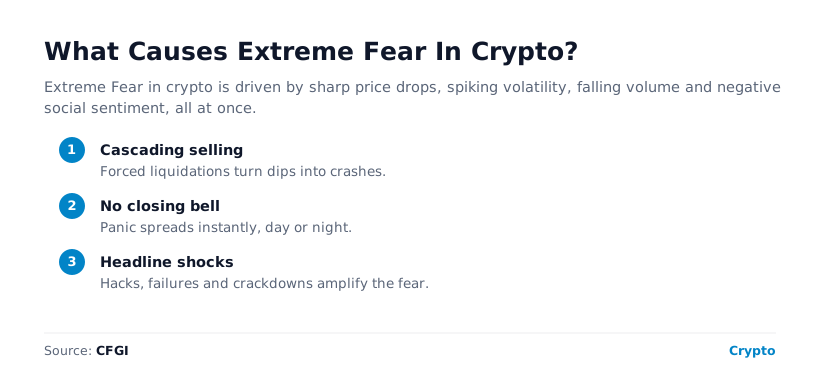
Crypto reaches Extreme Fear more readily, and more violently, than traditional markets, and the reasons are structural. It trades 24 hours a day with no circuit breakers to pause a panic, it carries heavy leverage that turns drops into forced-selling cascades, it is younger and less regulated so confidence is more fragile, and it is driven heavily by emotional retail flows. Put together, these mean a shock that would dent a stock index can flush crypto into deep fear within hours. It is one reason a fast-updating, crypto-specific gauge is so useful: in this market, the mood can collapse before most people have finished reading the news.
What to Do With an Extreme Fear Reading
Knowing the cause is as important as knowing the reading. Extreme Fear driven by a passing scare, a hawkish headline that fades, is a very different situation from fear driven by a genuine structural break, like a major platform’s insolvency. So when the gauge hits the Extreme Fear zone, the useful next question is "what caused it?", because the answer shapes whether the fear is likely to lift or deepen. As always, treat the reading as context to weigh alongside the trigger and your own plan, not as an automatic signal to act on.
See It Live
Frequently asked questions
What causes Extreme Fear in crypto?
Several signals turning negative together: a sharp price drop, spiking volatility, falling volume and negative social sentiment. These are triggered by real-world events like crashes, exchange failures, hacks and regulation. Extreme Fear, under 20, is the alignment of these risk-off signals at once.
Does a price drop alone cause Extreme Fear?
Not usually. Price is the biggest single driver, but it takes volatility, volume and sentiment moving the same way to push the score all the way under 20.
Why does crypto reach Extreme Fear so fast?
Because it trades 24/7 with no circuit breakers, carries heavy leverage that fuels liquidation cascades, is less mature so confidence is fragile, and is driven by emotional retail flows. A shock can flush it into deep fear within hours.
Is Extreme Fear a buy signal?
Not on its own. It signals the crowd is very risk-off, which contrarians watch, but fear can persist, especially if a real structural break caused it. Use it as context, weighing the trigger and your plan. This is education, not financial advice.
CFGI.io, Market sentiment research
The CFGI research team builds and maintains the CFGI Fear and Greed Index: a 0 to 100 sentiment score from 10 sub-indicators across hundreds of crypto assets and the equity market, refreshed every 15 minutes. We have tracked market emotion through multiple full crypto and equity cycles.
Think we missed something?
Spotted a gap, disagree with a take, or think we should cover a new topic? Message us and we'll act on your input.
Message us on TelegramKeep reading
This article is educational and is not financial advice. Crypto and equities are volatile and you can lose money. See our disclaimer.