Crypto
Setting Fear and Greed Index Alerts
Quick answer
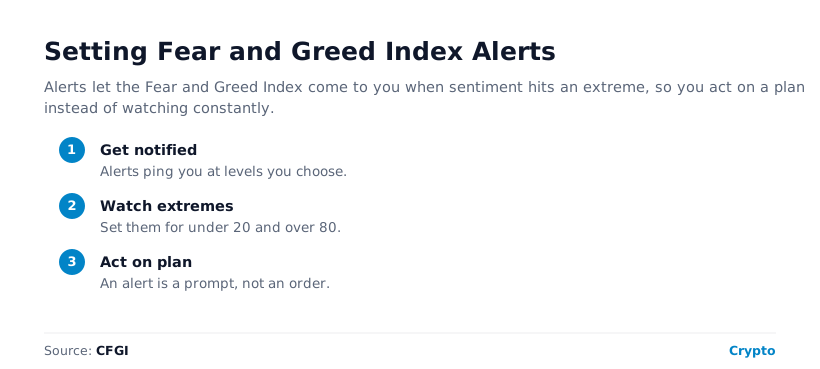
A Fear and Greed Index alert notifies you when sentiment crosses a level you choose, for example when it falls into Extreme Fear or rises into Extreme Greed. The point is not to react instantly, but to be prompted to check your pre-set plan at exactly the moments that matter, without staring at a screen. Set them at the extremes, match the timeframe to your horizon, and let them turn the index from something you watch into something that reminds you. This is education, not financial advice.
CFGI data
Alerts pair naturally with a pre-committed plan. Because CFGI refreshes every 15 minutes across timeframes, an alert can catch an asset crossing into Extreme Fear or Greed as it happens, prompting you to act on a rule set in calm rather than on impulse.
Source: CFGI dataset, March 2022 to June 2026.
Key takeaways
- Alerts notify you when sentiment crosses a level you set.
- Set them at the extremes, not the noisy middle.
- They prompt you to check your plan, not to react instantly.
- They remove the need to watch the index constantly.
- They work only as well as the plan behind them.
Why Alerts Help
The hardest part of using sentiment is being present at the right moment, and not overreacting at the wrong ones. Alerts solve the first problem: instead of checking the index all day, you are notified when it crosses into a zone you care about, like Extreme Fear or Extreme Greed. The discipline is in what happens next. An alert should trigger a review of a plan you made in advance, not a snap decision. That is what keeps it a tool rather than a source of noise, an alert that simply makes you trade on impulse is worse than no alert at all.
What Makes a Good Alert Setup
A few principles separate a useful alert setup from an annoying one. First, set alerts at the extremes, not the middle: a notification every time the score wanders through the neutral 40-to-59 band would fire constantly and tell you nothing, whereas an alert at, say, Extreme Fear under 25 or Extreme Greed over 75 fires only when something genuinely meaningful is happening. Second, match the timeframe to your horizon: a short-term trader might watch a faster reading, while a long-term investor wants alerts on the longer, slower timeframe so they are not pinged by every intraday wobble. Third, use per-asset alerts where you can, an alert on the specific coin you actually hold is far more useful than one on the whole-market average, since it tells you when your asset has hit an extreme even if the broad market has not. The goal is to be notified rarely but meaningfully: each alert should be a genuine event worth a moment of your attention, not a constant background buzz that you learn to ignore.
Rare But Meaningful
Set alerts at the extremes, on the timeframe that matches your horizon, and on the specific asset you hold. The aim is a notification that fires rarely but always means something, not a constant buzz.
How to Use Alerts Well
- Decide your plan first: what you will review when fear or greed hits an extreme.
- Set alerts at the levels that matter to you, such as Extreme Fear under 25 or Extreme Greed over 75.
- Choose the timeframe that matches your horizon, shorter for trading, longer for investing.
- When an alert fires, check your plan and the wider picture, do not act on the alert alone.
- Review and adjust your alert levels as your strategy evolves.
A Prompt to Think
An alert is a prompt to consult your plan, not a command to trade. Its value depends entirely on the discipline behind it. This is education, not financial advice.
Alerts and the Power of Pre-Commitment
The deepest value of alerts is behavioural, and it comes from combining them with a plan made in advance. There is an old idea, sometimes called a "Ulysses pact", of binding your future self to a decision made by your present, calmer self, so that you cannot be swayed by emotion in the heat of the moment. An alert plus a pre-written plan is exactly this. By deciding in a calm moment "if sentiment hits Extreme Fear, I will review whether to add to my long-term holdings" or "if it hits Extreme Greed, I will check whether I am over-exposed and consider trimming", and then setting an alert to summon you at that exact moment, you arrange for your rational self to govern your future, emotional self. This neatly defuses two of the biggest enemies of good investing at once: it removes the need to watch the market constantly (which breeds anxiety and overtrading), and it ensures that when a genuine extreme arrives, you respond to a considered rule rather than a panicked or euphoric impulse. The alert is just the trigger; the real power is the pre-commitment behind it.
Frequently asked questions
What is a Fear and Greed Index alert?
A notification when sentiment crosses a level you choose, such as into Extreme Fear or Extreme Greed. It prompts you to check your plan at the moments that matter without watching the index constantly.
What levels should I set alerts at?
At the extremes, not the noisy middle: common choices are Extreme Fear under 25 and Extreme Greed over 75, on a timeframe matching your horizon (shorter for trading, longer for investing), and ideally on the specific asset you hold. The aim is alerts that fire rarely but meaningfully.
Should I act the moment an alert fires?
No. An alert should trigger a review of a plan you set in advance, not a snap decision. Acting on impulse when an alert fires is worse than having no alert; the discipline behind it is what makes it useful.
Why are alerts useful behaviourally?
They let you make a "Ulysses pact": decide a rule in a calm moment, then have an alert summon you at the exact extreme to act on that rule rather than on emotion. They remove the need to watch constantly and ensure you respond to a plan, not an impulse. This is education, not financial advice.
CFGI.io, Market sentiment research
The CFGI research team builds and maintains the CFGI Fear and Greed Index: a 0 to 100 sentiment score from 10 sub-indicators across hundreds of crypto assets and the equity market, refreshed every 15 minutes. We have tracked market emotion through multiple full crypto and equity cycles.
Think we missed something?
Spotted a gap, disagree with a take, or think we should cover a new topic? Message us and we'll act on your input.
Message us on TelegramKeep reading
This article is educational and is not financial advice. Crypto and equities are volatile and you can lose money. See our disclaimer.