Crypto
Crypto Fear and Greed vs Bitcoin Dominance
Quick answer
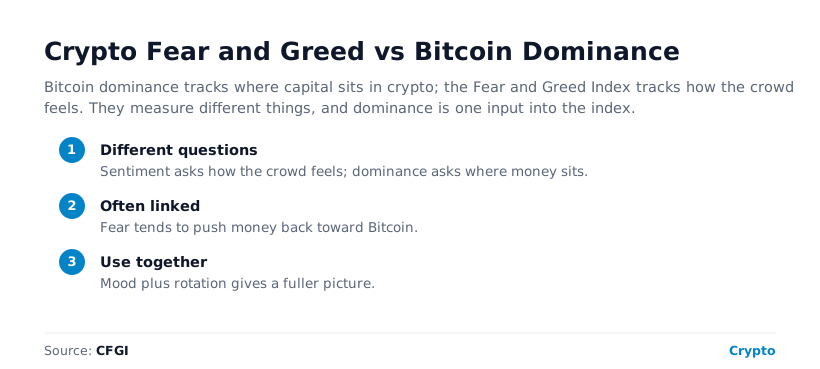
Bitcoin dominance measures Bitcoin’s share of the total crypto market cap, so it tracks where capital is rotating, into Bitcoin or out into altcoins. The Fear and Greed Index measures crowd sentiment from 0 to 100. They are different tools: dominance is about capital flow, sentiment is about mood, and dominance is one of the signals the index reads. Read together, flow and mood tell a fuller story than either alone. This is education, not financial advice.
CFGI data
Bitcoin dominance is a market-structure metric; CFGI Fear and Greed is a sentiment score built from 10 indicators, dominance among them, across hundreds of assets every 15 minutes since March 2022. Per-asset scoring is what lets CFGI show Bitcoin and altcoins at different moods even as dominance shifts between them.
Source: CFGI dataset, March 2022 to June 2026.
Key takeaways
- Bitcoin dominance is Bitcoin’s share of total crypto market cap.
- The Fear and Greed Index measures crowd sentiment from 0 to 100.
- Dominance tracks capital flow; sentiment tracks mood.
- Dominance is one of the 10 indicators CFGI reads.
- Per-asset scoring shows Bitcoin and altcoins at different moods.
What Does Each One Track?
Bitcoin dominance is the percentage of the total crypto market cap held by Bitcoin. Rising dominance usually means capital is favouring Bitcoin over altcoins; falling dominance often signals an altcoin run. It is a measure of where money sits, not how people feel. The Fear and Greed Index measures sentiment directly, from 0 to 100, across several signals. Dominance is one of those signals, but the index also reads volatility, momentum, volume, social activity and on-chain flows.
Dominance vs Fear and Greed, Side by Side
| Bitcoin dominance | Fear and Greed Index | |
|---|---|---|
| Measures | Capital flow into Bitcoin | Crowd sentiment |
| Form | A percentage | A 0 to 100 score |
| Signals | Market caps | Several (CFGI uses 10) |
| Per asset | Market-structure metric | Yes, in CFGI |
How Bitcoin dominance and the Fear and Greed Index differ.
One number is a ratio of market caps; the other is a blended read of behaviour. They are not two versions of the same thing, but two different lenses, one on structure, one on mood.
What Bitcoin Dominance Tells You
Dominance is really a map of risk appetite within crypto. When dominance rises, capital is concentrating in Bitcoin, the largest and most established coin, which often happens either when the market turns cautious and money retreats to the relative safety of Bitcoin, or when a rally is being led by Bitcoin specifically. When dominance falls, money is flowing out of Bitcoin and into smaller altcoins, the classic signature of an "altcoin season" when risk appetite is high and traders chase the bigger potential gains of riskier coins. So dominance captures the internal rotation of the crypto market, the tide moving between the safe-harbour majors and the higher-risk alts, in a way a single sentiment number cannot. It is a structural signal, telling you not how fearful or greedy the crowd is, but where, within crypto, that mood is sending their money. One nuance worth remembering is that dominance is a relative measure: it can rise simply because altcoins are falling faster than Bitcoin, not because Bitcoin itself is gaining, so it is best read alongside the actual prices rather than in isolation.
How They Work Together
Read together, mood and flow tell a fuller story than either alone. Rising dominance during Extreme Fear can mean money is retreating to Bitcoin for safety, a flight to quality inside crypto, while falling dominance during Greed can mark a risk-hungry altcoin chase. Pairing the two lets you ask sharper questions: is this greed broad-based, lifting the whole market, or narrowly concentrated in alts? Is this fear a total retreat, or a rotation toward Bitcoin? CFGI already folds dominance into its sentiment score, so the two overlap by design, but watching the raw dominance figure alongside the index adds a layer of structural context, showing you the direction capital is travelling beneath the surface of the mood.
Why Per-Asset Scoring Matters Here
There is a deeper reason the two pair so naturally: dominance hints at a rotation between Bitcoin and altcoins, and per-asset sentiment scoring lets you actually see it. A single market-wide Fear and Greed number blurs the whole market into one mood, hiding exactly the divergence dominance is pointing at. CFGI scores hundreds of assets individually, so it can show Bitcoin sitting in one zone while a basket of altcoins runs in another, the gap between major coins has reached 61 points, which is the sentiment-level picture of the same story dominance tells at the capital level. Used together, dominance flags that a rotation is underway and per-asset scoring shows you which coins are leading the mood, turning a vague market average into a detailed map of where fear and greed actually live. This is the practical payoff of the comparison: dominance and a market-wide sentiment number both summarise the crowd into a single figure, but a per-asset index lets you drill into that summary and watch the rotation play out coin by coin, rather than inferring it from a moving percentage.
Frequently asked questions
Is Bitcoin dominance a sentiment indicator?
Not directly. It measures Bitcoin’s share of the crypto market cap, which reflects capital rotation between Bitcoin and altcoins. Sentiment is read by a Fear and Greed Index, which uses dominance as one of several inputs.
What does Bitcoin dominance tell you?
Where risk appetite is within crypto. Rising dominance means capital is concentrating in Bitcoin (caution or a Bitcoin-led rally); falling dominance means money is flowing into altcoins, the classic signature of an "altcoin season" when risk appetite is high.
Does the Fear and Greed Index use Bitcoin dominance?
Yes. CFGI reads Bitcoin dominance as one of its 10 indicators, alongside volatility, momentum, volume, social activity and on-chain flows.
Which should I watch?
Both, for different reasons. Dominance shows where capital is moving; Fear and Greed shows how the crowd feels, and per-asset scoring shows which coins lead the mood. Neither predicts price alone. This is education, not financial advice.
CFGI.io, Market sentiment research
The CFGI research team builds and maintains the CFGI Fear and Greed Index: a 0 to 100 sentiment score from 10 sub-indicators across hundreds of crypto assets and the equity market, refreshed every 15 minutes. We have tracked market emotion through multiple full crypto and equity cycles.
Think we missed something?
Spotted a gap, disagree with a take, or think we should cover a new topic? Message us and we'll act on your input.
Message us on TelegramKeep reading
This article is educational and is not financial advice. Crypto and equities are volatile and you can lose money. See our disclaimer.