Crypto
What Is a Satoshi?
Quick answer
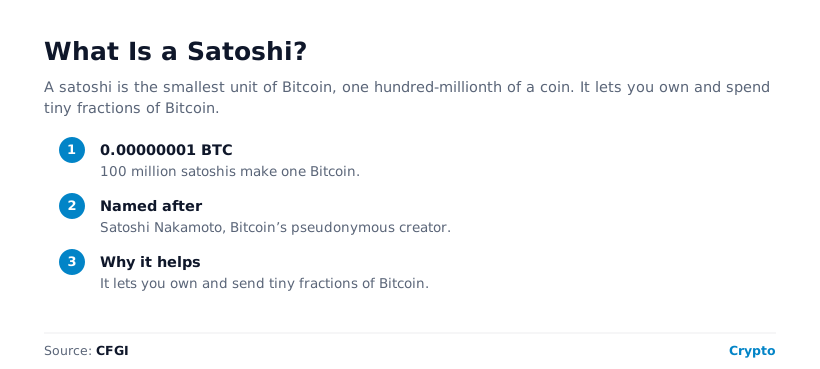
A satoshi is the smallest unit of Bitcoin: one hundred-millionth of a coin, written 0.00000001 BTC. There are exactly 100 million satoshis in one Bitcoin, and that rule is hard-coded and cannot change. Named after Bitcoin’s pseudonymous creator and often shortened to "sats", it means you never need to buy a whole coin. Just as a dollar splits into cents, a Bitcoin splits into 100 million sats, so you can own and spend whatever you can afford.
CFGI data
Thinking in sats is really a fix for a feeling. The fear of missing a whole coin, and the rush to "stack" in a rally, are sentiment, and CFGI has tracked exactly that mood on a 0 to 100 scale since March 2022, swinging from a fearful 12 to a greedy 87. The unit is fixed at 100 million; the emotion around it is not.
Source: CFGI dataset, March 2022 to June 2026.
Key takeaways
- A satoshi is the smallest unit of Bitcoin, 0.00000001 BTC.
- One Bitcoin is exactly 100 million satoshis, fixed in the code.
- It is named after Bitcoin’s creator, Satoshi Nakamoto.
- "Stacking sats" reframes a high coin price as small, regular buys.
- Sats exist partly to beat "unit bias", the urge to own a whole coin.
Bitcoin’s Smallest Piece
A high Bitcoin price can make a whole coin feel out of reach, but you never need one. Bitcoin is divisible to eight decimal places, and the smallest slice, a satoshi, is one hundred-millionth of a coin. Buy 20 US dollars of Bitcoin and you own a number of sats. The supply rule is exact and permanent: 1 BTC is always 100,000,000 sats, written into the protocol and impossible to inflate away.
Where the Name Came From
The unit honours Satoshi Nakamoto, the pseudonymous person or group who published the Bitcoin whitepaper in 2008 and mined the first block in 2009, then disappeared. The name was not in the original design. In late 2010, users on the BitcoinTalk forum started debating what to call the smaller denominations, floated options like "austrians" and "shillings", and settled on "satoshi" in early 2011. It stuck, and it is now the standard way to talk about anything smaller than a coin.
Stacking Sats
Out of the unit grew a whole approach: "stacking sats". Instead of trying to buy a whole, expensive coin, you accumulate small amounts on a schedule, say 5 or 25 US dollars every week, and let the sats add up over years. It is simply dollar-cost averaging wearing a Bitcoin name, and its appeal is psychological as much as financial: counting sats turns an intimidating price tag into a habit you can actually keep.
Sats In Everyday Terms
Because the unit is fixed forever, the conversions are just decimal places. The dollar value of a sat moves with the Bitcoin price, but the structure never does, which makes the ladder worth memorising.
| Bitcoin | Satoshis | Rough idea |
|---|---|---|
| 1 BTC | 100,000,000 | One whole coin |
| 0.1 BTC | 10,000,000 | A tenth of a coin |
| 0.001 BTC | 100,000 | A serious regular saver |
| 0.00001 BTC | 1,000 | A small tip or fee |
| 0.00000001 BTC | 1 | One satoshi, the floor |
How Bitcoin amounts translate into sats.
A practical habit is to do the maths in sats when amounts get small. A 5 US dollar buy is far easier to picture as "tens of thousands of sats" than as a string of zeros after a decimal point, and it is exactly how wallets, exchanges and payment apps increasingly display tiny balances.
Thinking in sats also future-proofs how you read the market. If a single Bitcoin ever traded far higher, the number of dollars in a sat would rise, but the count of sats you hold would not change. Anchoring to the fixed unit rather than the moving price is a small mental shift that keeps the focus on how much Bitcoin you actually own, not on a headline figure that swings with sentiment.
Unit Bias: The Trick Sats Play On Your Brain
Here is the part most explainers skip. People suffer from "unit bias", a documented behavioural quirk that makes a "whole" unit feel more satisfying to own than a fraction. Owning 1 of something reads as complete; owning 0.0008 of it reads as scraps, even when they cost the same. A six-figure Bitcoin runs straight into that bias and quietly pushes beginners toward cheaper coins where they can own thousands of "whole" units.
Sats are the antidote. Re-pricing the same holding as "40,000 sats" rather than "0.0004 BTC" makes it feel substantial, and that reframing matters, because the same bias is exactly what memecoins exploit with billion-token supplies and tiny unit prices. Understanding sats is really understanding that the number on the screen is shaping how you feel about the asset.
The Reframe
A high coin price does not mean "too expensive" and a low one does not mean "cheap". Price per unit tells you almost nothing without the supply behind it. Sats make that obvious.
Sats and the Lightning Network
Sats are not just an accounting nicety. They are the working unit of Bitcoin payments. On the Lightning Network, the layer built for fast, cheap transactions, amounts are measured in sats, often just hundreds or thousands of them, and even a single sat can be sent instantly. Lightning goes finer still, down to millisats, a thousandth of a sat, used to price tiny streaming payments. Talk to anyone building Bitcoin payments and they will quote you sats, never decimals of a coin.
Frequently asked questions
What is a satoshi?
The smallest unit of Bitcoin, one hundred-millionth of a coin (0.00000001 BTC). One Bitcoin is exactly 100 million satoshis, often shortened to sats.
How many satoshis are in a Bitcoin?
100 million. Bitcoin is divisible to eight decimal places, so each whole coin breaks into 100,000,000 satoshis, a rule fixed in the protocol.
What does stacking sats mean?
Accumulating Bitcoin in small, regular amounts, like 5 to 25 US dollars a week, instead of trying to buy a whole coin at once. It is dollar-cost averaging counted in sats.
Why is it called a satoshi?
After Satoshi Nakamoto, Bitcoin’s pseudonymous creator. Forum users chose the name for the smallest unit in early 2011. This is education, not financial advice.
CFGI.io, Market sentiment research
The CFGI research team builds and maintains the CFGI Fear and Greed Index: a 0 to 100 sentiment score from 10 sub-indicators across hundreds of crypto assets and the equity market, refreshed every 15 minutes. We have tracked market emotion through multiple full crypto and equity cycles.
Think we missed something?
Spotted a gap, disagree with a take, or think we should cover a new topic? Message us and we'll act on your input.
Message us on TelegramKeep reading
This article is educational and is not financial advice. Crypto and equities are volatile and you can lose money. See our disclaimer.