Crypto
Crypto Fear and Greed Index History
Quick answer
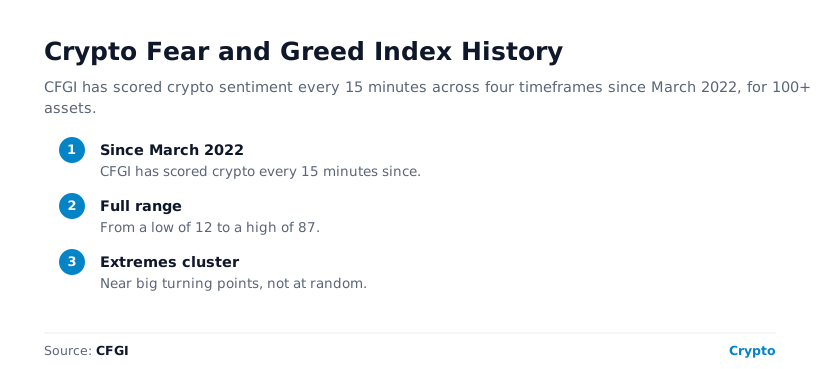
The CFGI Crypto Fear and Greed Index has recorded sentiment continuously since March 2022, refreshed every 15 minutes across four timeframes, for hundreds of assets scored individually. Its history shows fear and greed swinging in cycles, with extremes that rarely last, swings wider and faster than in stocks, and a market that spends more time fearful than euphoric. The record is what makes the index useful: it puts today’s reading in years of context. This is education, not financial advice.
CFGI data
CFGI’s crypto history is deep: since March 2022, 10 indicators distilled into one 0 to 100 score, every 15 minutes, across four timeframes, for hundreds of assets. On 23 May 2024 the gap between the most fearful and most greedy major coins reached 61 points, a spread only per-asset history can reveal.
Source: CFGI dataset, March 2022 to June 2026.
Key takeaways
- CFGI has scored crypto sentiment since March 2022.
- It refreshes every 15 minutes across four timeframes.
- hundreds of assets are scored individually.
- Crypto’s swings are wider and faster than stocks’.
- The record shows extremes that rarely last.
What the Record Covers
A sentiment reading only means something against history, and CFGI’s crypto record runs back to March 2022. Because the index scores each asset individually rather than producing one market-wide number, the history captures not just the overall mood but how widely coins diverge from it.
| Attribute | CFGI crypto history |
|---|---|
| Since | March 2022 |
| Refresh | Every 15 minutes |
| Timeframes | 4 (short to long-term) |
| Assets | 100+ scored individually |
| Scale | 0 to 100 |
The shape of the crypto record.
What the History Shows
Across the record, two patterns stand out. First, extremes are temporary: Extreme Fear and Extreme Greed both revert toward the middle over time, no reading stays pinned at 0 or 100. Second, the market is not uniform: on 23 May 2024 the spread between the most fearful and most greedy major coins reached 61 points, a divergence only per-asset history can show. Together these say that crypto sentiment is both cyclical and fragmented, swinging through fear and greed over time while individual coins can sit at very different points on the scale at any given moment. Both patterns are practical, not just academic: the first tells you extremes are opportunities to watch rather than permanent states, and the second tells you to look at the specific coin you care about, not only the market headline.
The Depth of Crypto’s Record
What sets the crypto history apart is its granularity. A classic fear and greed gauge produces one daily number for the whole market; CFGI’s crypto record refreshes every 15 minutes, across four separate timeframes, for hundreds of assets, each scored individually, all the way back to March 2022. That depth matters because crypto never sleeps and moves fast: a 15-minute cadence captures the rapid mood swings that a once-a-day snapshot would miss entirely, and the four timeframes preserve the difference between a fleeting intraday panic and a genuine shift in the longer-term trend. The result is a far richer record than a single daily line, one detailed enough to study the texture of crypto sentiment, not just its broad strokes.
Crypto’s Bigger, Faster Swings
The crypto record is more violent than its equity counterpart, exactly as you would expect from a younger, 24-hour, more retail-driven market. Its fear lows run deeper and arrive faster, the canonical example being the crypto score’s fall to 17 during the Terra collapse of 12 May 2022, a moment of maximum fear etched into the record. Greed peaks can be sharper too. Where equity sentiment tends to move in more measured cycles, crypto’s history is a chart of bigger amplitudes and quicker reversals, the signature of an asset class where volatility is the norm. Reading the crypto record means recalibrating: a swing that would be dramatic for stocks can be an ordinary week for crypto.
Recalibrate for Crypto
Crypto’s sentiment history swings wider and faster than stocks’. A move that would be a once-a-year event for equities can be a routine week in the crypto record, with the 17 low of May 2022 as the deep-fear benchmark.
Why Per-Asset History Matters
The single most valuable feature of CFGI’s crypto history is that it is kept per asset. A blended market history would tell you how "crypto" felt on a given day, but it would erase the fact that Bitcoin can be greedy while an altcoin is fearful, the very split that drives rotation and reveals where risk appetite is heading. The 61-point spread between major coins in May 2024 is exactly the kind of information a single market-wide history cannot hold. By preserving each asset’s own record, the index lets you compare coins against each other and against their own past, turning "how does crypto feel?" into the far more useful "how does each coin feel, and how unusual is that for it?" The live gauge below is one slice of that deep, per-asset record.
Frequently asked questions
How far back does the Crypto Fear and Greed Index go?
The CFGI crypto record runs to March 2022, refreshed every 15 minutes across four timeframes, with hundreds of assets scored individually on a 0 to 100 scale.
What does the crypto history show?
That extremes of fear and greed rarely last and revert over time, that swings are wider and faster than in stocks, and that individual coins can diverge sharply, by as much as 61 points between major coins on 23 May 2024.
How is crypto’s record different from stocks’?
It is deeper and more granular (every 15 minutes, four timeframes, hundreds of assets) and more violent, with deeper, faster fear lows, like the crypto score’s fall to 17 during the Terra collapse in May 2022.
Why does per-asset history matter?
Because a blended market history erases the fact that one coin can be greedy while another is fearful, the split that drives rotation. Keeping each asset’s own record lets you compare coins and judge how unusual a reading is for that specific coin. This is education, not financial advice.
CFGI.io, Market sentiment research
The CFGI research team builds and maintains the CFGI Fear and Greed Index: a 0 to 100 sentiment score from 10 sub-indicators across hundreds of crypto assets and the equity market, refreshed every 15 minutes. We have tracked market emotion through multiple full crypto and equity cycles.
Think we missed something?
Spotted a gap, disagree with a take, or think we should cover a new topic? Message us and we'll act on your input.
Message us on TelegramKeep reading
This article is educational and is not financial advice. Crypto and equities are volatile and you can lose money. See our disclaimer.