Crypto
What Is a Relief Rally In Crypto?
Quick answer
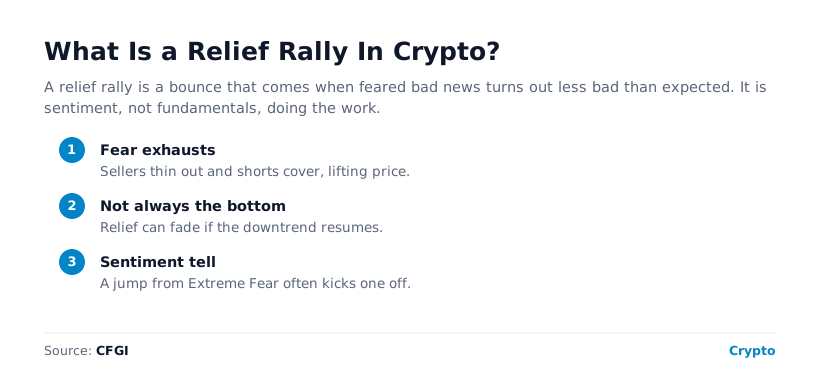
A relief rally is a rise in price that happens not because good news arrived, but because feared bad news turned out less bad than expected. The market had braced for the worst, so when it does not come, the pent-up fear releases and prices bounce. It is a sentiment move driven by expectations rather than events, and it shows how a Fear and Greed Index reading of deep fear can set up a sharp recovery. It can fade if conditions do not actually improve. This is education, not financial advice.
CFGI data
Relief rallies are why deep fear can precede a bounce. When CFGI sits in Extreme Fear, the crowd is braced for bad news; if the news disappoints to the upside, the snapback can be sharp. The index has marked these fear extremes across hundreds of assets since March 2022.
Source: CFGI dataset, March 2022 to June 2026.
Key takeaways
- A relief rally happens when feared bad news is less bad than expected.
- It is driven by released fear, not good news.
- It runs on expectations, the gap between feared and actual.
- Deep fear sets up the conditions for one.
- It is a sentiment move and can fade if conditions do not improve.
When "Not As Bad" Is Enough
Markets price in expectations. When a feared event looms, an inflation print, a regulatory decision, a possible collapse, the crowd often sells in advance, bracing for the worst. If the outcome is merely bad rather than catastrophic, the relief releases the pent-up fear, and prices bounce even though nothing genuinely good happened. That is the paradox of a relief rally: the trigger is the absence of bad news, not the arrival of good. It is sentiment unwinding, which is why these rallies can be sharp but can also fade if the underlying conditions have not changed.
Why Expectations, Not Events, Drive It
A relief rally only makes sense once you grasp that markets trade on the gap between what is expected and what actually happens, not on the raw news itself. If everyone already fears a terrible outcome, that fear is "priced in", already reflected in a depressed price, so the bad news arriving as expected changes little. What moves the price is the surprise. And a result that is merely bad when the crowd had braced for catastrophe is, in market terms, a positive surprise, even though no good news was involved. This is the mirror image of the old "buy the rumour, sell the news" pattern: here the crowd has sold the rumour of disaster, so when reality proves less dire, there is nothing left to fear and a great deal of pessimism to unwind, and the price snaps back.
Relief Rally Versus a Real Recovery
The crucial caveat is that a relief rally is an emotional release, not necessarily a genuine turn. Because it is driven by sentiment unwinding rather than improving fundamentals, it shares much with a bear market rally: a sharp bounce that can fizzle if the conditions that caused the fear are still in place. A true recovery is backed by something real changing for the better, while a relief rally is simply the market exhaling after a feared event passes. The two can look identical at first, and only time tells them apart. The practical lesson is to enjoy a relief rally for what it is, a sign that fear was overdone, without mistaking it for proof that the danger is gone, because the relief can evaporate as quickly as it arrived if the next feared event looms.
Relief Is Not the Same As Recovery
A relief rally is the market exhaling after a feared event passes, not proof the danger is over. If the underlying conditions have not improved, the bounce can fade as fast as it came.
Deep Fear Sets the Stage
A relief rally is most powerful when fear was most extreme, because there is the most pent-up emotion to release. A Crypto Fear and Greed Index reading in Extreme Fear is exactly the setup: a crowd braced for the worst, primed to bounce on relief, where even a non-catastrophic outcome can trigger a sharp snapback. This is part of the deeper logic of why deep fear so often precedes a bounce, when everyone has already sold in dread, the bar for a positive surprise is extraordinarily low. Watching the gauge sit in Extreme Fear ahead of a feared event is a way of seeing that the conditions for a relief rally are in place, even if, as always, nothing about the timing or the follow-through is guaranteed. It is one more reason the index is most informative at its extremes: a deep fear reading is not just a measure of how bad things feel, but a clue to how violently the mood could snap back if the feared outcome proves survivable.
Frequently asked questions
What is a relief rally?
A rise in price driven by feared bad news turning out less bad than expected. The market braced for the worst, so the relief releases pent-up fear and prices bounce, even though nothing genuinely good happened.
Why does a relief rally happen without good news?
Because markets trade on the gap between expected and actual outcomes. When the feared result is already priced in, a merely-bad outcome is a positive surprise compared with the catastrophe the crowd braced for, and that relief alone is enough to spark a bounce.
How is a relief rally different from a real recovery?
A relief rally is sentiment unwinding, not improving fundamentals, so it can fizzle if the conditions that caused the fear remain, much like a bear market rally. A true recovery is backed by something real changing for the better.
How does fear set up a relief rally?
The deeper the fear, the more pent-up emotion there is to release and the lower the bar for a positive surprise. An Extreme Fear reading means a crowd braced for the worst, primed to bounce on relief, though it can fade if conditions do not improve. This is education, not financial advice.
CFGI.io, Market sentiment research
The CFGI research team builds and maintains the CFGI Fear and Greed Index: a 0 to 100 sentiment score from 10 sub-indicators across hundreds of crypto assets and the equity market, refreshed every 15 minutes. We have tracked market emotion through multiple full crypto and equity cycles.
Think we missed something?
Spotted a gap, disagree with a take, or think we should cover a new topic? Message us and we'll act on your input.
Message us on TelegramKeep reading
This article is educational and is not financial advice. Crypto and equities are volatile and you can lose money. See our disclaimer.