Crypto
Fear and Greed Index Extremes Explained
Quick answer
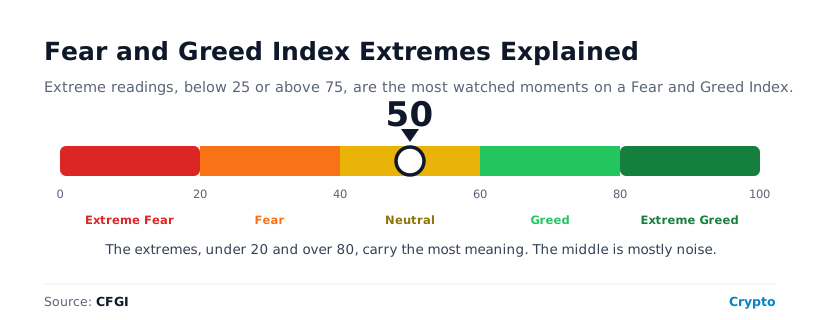
The extremes of a Fear and Greed Index, Extreme Fear below 20 and Extreme Greed above 80, are the readings that draw the most attention, because they mark the moments when the crowd is most one-sided. The CFGI record shows extremes are real but temporary: the equity score hit 3 on 8 April 2025 and 83 on 19 December 2023, and both reverted. Extremes are where the signal lives, but they are context for caution, not signals to act blindly. This is education, not financial advice.
CFGI data
CFGI’s record gives extremes real shape: a stock score of 3 on 8 April 2025, an 83 on 19 December 2023, and a 61-point gap between major coins on 23 May 2024. Extremes are where the crowd is most one-sided, and per-asset scoring shows how far individual assets can stretch past the market on the 0 to 100 scale.
Source: CFGI dataset, 2021 to June 2026.
Key takeaways
- Extreme Fear is below 20; Extreme Greed is above 80.
- Extremes mark the most one-sided moments.
- The record shows they are real but temporary, they revert.
- Individual assets can stretch far past the market reading.
- They are context for caution, not blind signals.
What Counts As an Extreme
| Reading | Zone | Meaning |
|---|---|---|
| Below 20 | Extreme Fear | Crowd maximally fearful |
| Above 80 | Extreme Greed | Crowd maximally greedy |
| 3 (8 Apr 2025) | Extreme Fear | A real equity low |
| 83 (19 Dec 2023) | Extreme Greed | A real equity high |
The extremes, in the CFGI record.
How Extremes Behave: They Revert
The first defining fact about extremes is that they do not last. Sentiment is one of the most strongly mean-reverting series in markets: it is bounded between 0 and 100, and human emotion physically cannot stay at fever pitch indefinitely. Every extreme in the CFGI record, including the equity 3 and the 83, eventually moved back toward the middle of the scale. This is exactly why the extremes draw a contrarian’s attention, they flag conditions that historically have not persisted. The crucial caveat is timing: an extreme tells you the crowd is stretched, but it does not tell you the day it will snap back, and sentiment can stay stretched longer than seems reasonable.
Extremes Are Uneven Across Assets
The second defining fact is that extremes are not uniform. Because CFGI scores assets individually, a single coin can be far more extreme than the market as a whole, pinned in euphoric greed while the broader index is merely warm, or in deep fear while everything else is calm. The 61-point gap between major coins on 23 May 2024 is the clearest example of just how far one asset’s sentiment can stretch past another’s. A single market-wide number would average all of this away; per-asset scoring is what makes these local extremes visible, and they are often where the most useful, actionable information hides.
The Extreme That Matters May Not Be the Market’s
A market reading near neutral can hide a single asset at a true extreme. Per-asset scoring is what surfaces the stretched coin the headline number conceals.
Why Extremes Matter Most
A Fear and Greed Index is not equally informative across its range, its value is shaped like a U. The signal concentrates at the two ends, where the crowd is most one-sided and therefore most likely to be stretched, and it fades to almost nothing in the neutral middle around 50. This is why the extremes get all the attention: a reading of 50 is genuinely uninformative, while a reading of 5 or 95 is the gauge telling you something potentially valuable. The whole practical art of using sentiment is to largely ignore the middle and pay close attention when the score reaches an extreme, because that is the only place a contrarian edge can plausibly exist.
There is also an asymmetry in how often each extreme appears. In the CFGI record, deep fear arrives faster and more often than deep greed, because panic is sharp and sudden while euphoria builds slowly and stays comparatively scarce. The equity 3 came in a violent, fast collapse; the 83 was reached gradually over a long climb. That pattern is worth remembering when reading the gauge: an Extreme Fear print is a relatively common, fast-moving event, while a pinned Extreme Greed reading is rarer and, when it does appear, all the more worth heeding.
How to Read an Extreme
Reading an extreme well means treating it as context, not a command. Note the asymmetry: buying into Extreme Fear has historically been more reliable than selling into Extreme Greed, because panic exhausts itself quickly while euphoria can persist. So deep fear is often a moment to be brave, carefully, and deep greed a moment to manage risk and trim rather than to dramatically sell out. In both cases the right move is to combine the reading with the trend, valuations and your own plan, and to remember that an extreme flags elevated odds of a turn, not its exact timing. Contrarians watch extremes precisely because they know they do not time the turn.
Frequently asked questions
What counts as an extreme on the Fear and Greed Index?
Extreme Fear is a reading below 20; Extreme Greed is above 80. These mark the moments when the crowd is most one-sided, which is where the index carries the most information.
Do extremes mark tops and bottoms?
They often coincide with turning points, but not reliably enough to time. Extremes in the CFGI record always reverted, but not on a fixed schedule, so they are context, not precise signals.
Can one asset be more extreme than the market?
Yes. Per-asset scoring showed a 61-point gap between major coins on 23 May 2024, so a single coin can stretch far past the market-wide reading, which is exactly the local extreme a blended number would hide.
Why do extremes matter more than the middle?
Because a sentiment index is most informative where the crowd is most one-sided. The signal concentrates at the extremes and fades to noise around the neutral 50, so the extremes are where a contrarian edge can exist. This is education, not financial advice.
CFGI.io, Market sentiment research
The CFGI research team builds and maintains the CFGI Fear and Greed Index: a 0 to 100 sentiment score from 10 sub-indicators across hundreds of crypto assets and the equity market, refreshed every 15 minutes. We have tracked market emotion through multiple full crypto and equity cycles.
Think we missed something?
Spotted a gap, disagree with a take, or think we should cover a new topic? Message us and we'll act on your input.
Message us on TelegramKeep reading
This article is educational and is not financial advice. Crypto and equities are volatile and you can lose money. See our disclaimer.