Crypto
CoinMarketCap Fear and Greed Index vs CFGI
Quick answer
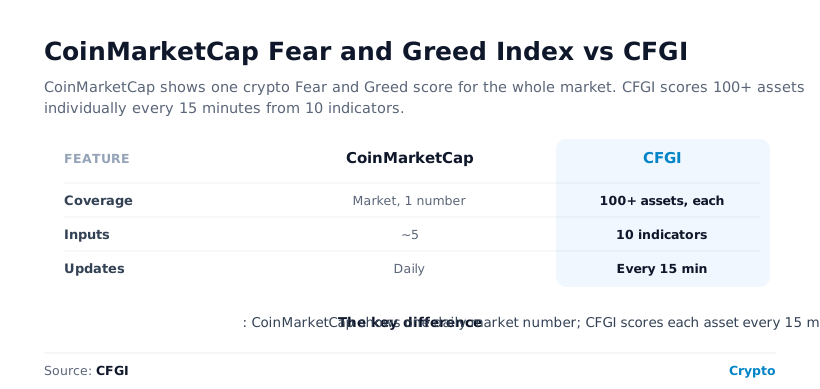
CoinMarketCap publishes a single crypto Fear and Greed score, from 0 to 100, for the market as a whole, refreshed about once a day from five signals plus some sophisticated options and volatility data. CFGI scores hundreds of assets individually from 10 indicators and refreshes every 15 minutes across 4 timeframes, so it shows the mood of each coin rather than one blended market number. This is education, not financial advice.
CFGI data
CoinMarketCap reads the crypto market as one number. CFGI has scored hundreds of assets individually every 15 minutes since March 2022. Same-day, CFGI sentiment matches market direction 79% of the time, which is why the per-asset split, not a single headline figure, is the useful part.
Source: CFGI dataset, March 2022 to June 2026.
Key takeaways
- CoinMarketCap shows one market-wide crypto score, refreshed roughly daily.
- It blends five signals plus options and implied-volatility data.
- CFGI scores hundreds of assets individually, every 15 minutes, across 4 timeframes.
- Both run a 0 to 100 scale; the difference is granularity and cadence.
- CFGI also scores the stock market on the same scale.
What Is the Difference?
CoinMarketCap folds the usual sentiment inputs into one market-wide crypto Fear and Greed score. It is a clean single gauge that refreshes about once a day. CFGI runs the same 0 to 100 format but scores each asset separately, from 10 indicators, every 15 minutes. So rather than one number for all of crypto, you see Bitcoin, Ethereum and hundreds of assets each on their own. Both sit on the same 0 to 100 scale, where under 20 is Extreme Fear and 80 or above is Extreme Greed, so a reading from either means the same thing, the real differences are how often each updates and how finely it breaks the market down.
What the CoinMarketCap Index Measures
As the largest crypto data site, CoinMarketCap builds its index from a richer-than-usual set of inputs. Its core is five signals, market volatility, price momentum (the performance of the top coins by market cap, excluding stablecoins), social sentiment, Bitcoin dominance and search trends, but it layers in some notably sophisticated data on top. It incorporates forward-looking implied-volatility indices for Bitcoin and Ethereum (the 30-day expectations of the options market), the put/call ratio in BTC and ETH options as a direct gauge of bearish versus bullish positioning, and a "market composition" measure using the stablecoin supply ratio. It is a thoughtfully built single gauge, but, by design, it still distils all of that into one number for the whole market, refreshed roughly daily. It is worth giving credit where due: the inclusion of options-derived data like implied volatility and the put/call ratio makes CoinMarketCap’s index more sophisticated than the typical price-and-volume sentiment gauge, since it reads what the derivatives market expects rather than only what spot prices have already done. The trade-off is that all this richness is still compressed into a single market-wide figure, so the depth goes into how the one number is calculated rather than into showing how different coins feel.
CoinMarketCap vs CFGI, Side by Side
| CoinMarketCap | CFGI | |
|---|---|---|
| Scope | Whole market, one number | hundreds of assets, scored individually |
| Inputs | 5 signals + options/volatility data | 10 indicators |
| Update frequency | About once a day | Every 15 minutes |
| Timeframes | One | 4 |
| Per-asset scores | No | Yes |
| Stocks too | No | Yes, on the same scale |
The two crypto Fear and Greed indexes compared.
Both are well-built reads of overall crypto mood from standard signals. The two structural differences are cadence, daily versus every 15 minutes, and granularity, one market number versus 100+ per-asset scores.
Which Is More Useful?
A single daily number is fine for a quick read of overall mood, and CoinMarketCap’s is a thoughtful one. But crypto rarely moves as one block, and a once-a-day cadence can lag a market that swings hard within hours. Per-asset scoring is what lets you see one coin in Extreme Fear while another runs greedy, which is exactly the information a market average hides, and a 15-minute refresh keeps pace with crypto’s round-the-clock volatility in a way a daily snapshot cannot. The honest framing is that the two answer different questions: CoinMarketCap gives a tidy daily verdict on the market’s overall mood, while CFGI is built for granularity and speed, the per-coin, near-real-time detail an active crypto participant tends to need. A reasonable way to use them together is to treat CoinMarketCap’s daily reading as a broad backdrop, the overall temperature of the market, and a per-asset index as the working tool for the specific coins you actually hold or are watching. The backdrop tells you the general mood; the per-asset detail tells you whether the particular asset in front of you is moving with that mood or against it, which is frequently the more actionable piece of information.
Frequently asked questions
How does the CoinMarketCap Fear and Greed Index work?
It blends five core signals, market volatility, momentum (top coins by market cap excluding stablecoins), social sentiment, Bitcoin dominance and search trends, plus sophisticated extras like BTC/ETH implied volatility, options put/call ratios and a stablecoin supply ratio, into one market-wide score refreshed about daily.
How is CFGI different from CoinMarketCap?
CFGI scores hundreds of assets individually from 10 indicators and refreshes every 15 minutes across 4 timeframes, where CoinMarketCap shows one market-wide score refreshed about once a day. CFGI also covers stocks on the same scale.
Is the CoinMarketCap Fear and Greed Index accurate?
It is a thoughtful, well-built read of overall crypto mood from rich inputs. Like any single market number, it cannot show divergence between coins or react within the day, which is where a per-asset, 15-minute index such as CFGI adds detail.
Do they use the same 0 to 100 scale?
Yes. Both use the 0 to 100 Fear and Greed scale, where under 20 is Extreme Fear and 80 or above is Extreme Greed. The difference is how finely and how often each one scores. This is education, not financial advice.
CFGI.io, Market sentiment research
The CFGI research team builds and maintains the CFGI Fear and Greed Index: a 0 to 100 sentiment score from 10 sub-indicators across hundreds of crypto assets and the equity market, refreshed every 15 minutes. We have tracked market emotion through multiple full crypto and equity cycles.
Think we missed something?
Spotted a gap, disagree with a take, or think we should cover a new topic? Message us and we'll act on your input.
Message us on TelegramKeep reading
This article is educational and is not financial advice. Crypto and equities are volatile and you can lose money. See our disclaimer.