Crypto
Bitget Fear and Greed Index vs CFGI
Quick answer
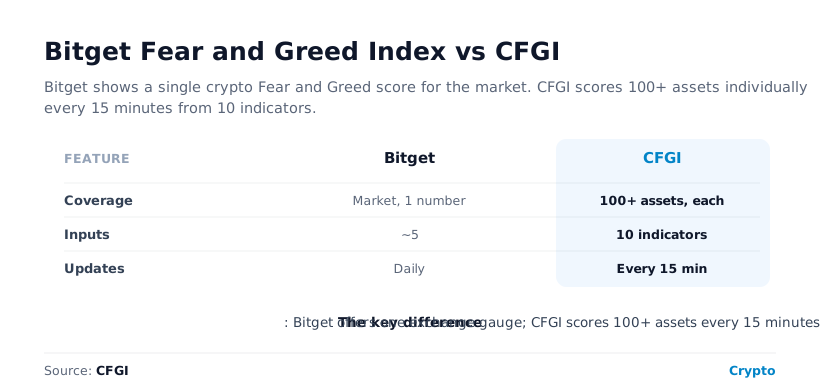
Bitget displays a crypto Fear and Greed score, from 0 to 100, for the market as a whole, built largely from its own exchange data and shown alongside its trading tools. CFGI scores hundreds of assets individually from 10 indicators and refreshes every 15 minutes across 4 timeframes, so it shows the mood of each coin rather than one blended market reading. This is education, not financial advice.
CFGI data
Exchange Fear and Greed widgets like Bitget show one market number. CFGI has scored hundreds of assets individually, every 15 minutes, across 4 timeframes since March 2022, which is what reveals divergence: on 23 May 2024 the most fearful and most greedy major coins were 61 points apart.
Source: CFGI dataset, March 2022 to June 2026.
Key takeaways
- Bitget shows one market-wide crypto score, built largely from exchange data.
- It blends volatility, volume, social, survey, dominance and search.
- CFGI scores hundreds of assets individually, every 15 minutes, across 4 timeframes.
- Both use the 0 to 100 scale; CFGI reads from 10 indicators.
- CFGI also scores the stock market on the same scale.
What Is the Difference?
Bitget surfaces a crypto Fear and Greed number alongside its market data, a convenient single gauge for the whole market. Like most exchange widgets, it reads the market as one figure. CFGI runs the same 0 to 100 idea but scores each asset on its own, from 10 indicators, every 15 minutes. So instead of one number for all of crypto, you see Bitcoin, Ethereum and hundreds of assets separately, and you can compare them. Both sit on the same familiar 0 to 100 scale, where under 20 is Extreme Fear and 80 or above is Extreme Greed, so the readings are directly comparable, the difference is not the scale they use but how much each one actually shows you beneath that single headline figure.
What the Bitget Index Measures
As you would expect from a major exchange, Bitget’s index leans heavily on its own trading data. Its methodology has been described as a weighted blend of around six sources designed to avoid leaning on any single metric: market volatility and trading volume carry the most weight (roughly a quarter each), with social-media sentiment and survey data adding a behavioural layer, and Bitcoin dominance and Google search trends rounding it out. Being exchange-native, it can also draw on signals like funding rates and liquidations across the many coins it lists, the kind of derivatives data an exchange sees directly. The result is a solid, market-wide read on crypto mood, but, like other exchange widgets, it is a single blended number for the whole market rather than a per-coin view. There is also a subtle point worth noting about exchange-provided indices in general: because they are built and displayed by a trading venue, they are designed first and foremost to serve traders already on that platform, sitting beside the charts and order book as one more piece of context while you trade. That is genuinely convenient, but it also means the gauge is a feature of the exchange rather than a standalone analytical product, and its scope tends to match what the exchange offers rather than the whole of crypto.
Bitget vs CFGI, Side by Side
| Bitget | CFGI | |
|---|---|---|
| Scope | Whole market, one number | hundreds of assets, scored individually |
| Inputs | Composite, exchange-led | 10 indicators |
| Update frequency | Periodic | Every 15 minutes |
| Timeframes | One | 4 |
| Per-asset scores | No | Yes |
| Stocks too | No | Yes, on the same scale |
The two crypto Fear and Greed readings compared.
The methodologies overlap on the basics, volatility, volume, dominance and social all feature in each. The structural difference is scope: one market number versus hundreds of assets, each scored on its own.
Which Is More Useful?
A single exchange number is handy for a quick market read while you trade, and if you are already on Bitget’s platform, having it beside the order book is convenient. But if you watch more than one coin, or you act on sentiment as the market moves, per-asset scoring and a 15-minute refresh are the difference: they show one coin fearful while another runs greedy, in real time. That divergence is real and large, on 23 May 2024 the most fearful and most greedy major coins were 61 points apart, a gulf a single market number simply cannot express. CFGI also reads the stock market on the same scale, so the same tool covers both crowds, which an exchange-specific crypto widget does not attempt. None of this means an exchange gauge is bad, for a quick gut-check of overall market mood it does the job perfectly well. The point is simply that the two are built for different purposes: Bitget’s index is a convenient at-a-glance feature for traders on its platform, while a per-asset, cross-market index is a dedicated tool for reading sentiment in fine detail, across many coins and both asset classes, wherever you happen to trade.
Frequently asked questions
What does the Bitget Fear and Greed Index measure?
A single market-wide crypto sentiment score from 0 to 100, built largely from exchange data: a weighted blend of volatility and volume (the largest weights), social and survey sentiment, Bitcoin dominance and search trends, plus derivatives signals an exchange sees directly.
How is CFGI different from the Bitget Fear and Greed Index?
CFGI scores hundreds of assets individually from 10 indicators and refreshes every 15 minutes across 4 timeframes, where Bitget shows one market-wide number. Both use the 0 to 100 scale, and CFGI also covers stocks.
Do exchange Fear and Greed widgets differ from each other?
They are usually variations on the same single-market format, with small differences in inputs and refresh timing. The bigger difference is per-asset scoring, which CFGI provides and most exchange widgets do not.
Is one more accurate?
Each reads current sentiment reasonably from standard signals. None predicts price reliably. The practical edge of CFGI is detail: per-asset scores and a faster refresh, not a claim to forecast. This is education, not financial advice.
CFGI.io, Market sentiment research
The CFGI research team builds and maintains the CFGI Fear and Greed Index: a 0 to 100 sentiment score from 10 sub-indicators across hundreds of crypto assets and the equity market, refreshed every 15 minutes. We have tracked market emotion through multiple full crypto and equity cycles.
Think we missed something?
Spotted a gap, disagree with a take, or think we should cover a new topic? Message us and we'll act on your input.
Message us on TelegramKeep reading
This article is educational and is not financial advice. Crypto and equities are volatile and you can lose money. See our disclaimer.