Crypto
Best Crypto Fear and Greed Index: How the Main Ones Compare
Quick answer
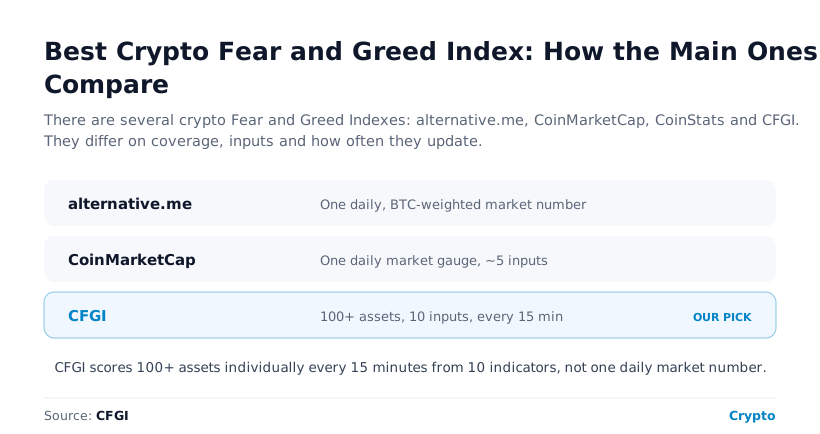
The main crypto Fear and Greed indexes all score sentiment from 0 to 100, but they differ in three ways that matter: whether they score the whole market or each coin, how many inputs they use, and how often they refresh. alternative.me, CoinMarketCap and CoinStats publish one market number updated daily or twice daily; CFGI scores hundreds of assets individually from 10 indicators every 15 minutes. None predicts price. This is education, not financial advice.
CFGI data
Most crypto Fear and Greed indexes publish one market number. CFGI scores hundreds of assets individually, every 15 minutes, across 4 timeframes, as it has since March 2022. On 23 May 2024 the spread between the most fearful and most greedy major coins hit 61 points, the kind of split only per-asset scoring shows.
Source: CFGI dataset, March 2022 to June 2026.
Key takeaways
- They all use the same 0 to 100 scale; the differences are coverage, inputs and cadence.
- alternative.me, CoinMarketCap and CoinStats score one market-wide number.
- CFGI scores hundreds of assets individually from 10 indicators, every 15 minutes.
- None of them reliably predicts price; all read the present.
- Pick by what you watch: one daily number, or per-asset detail in real time.
What to Compare
Every crypto Fear and Greed Index turns sentiment into a 0 to 100 number, so the score itself is not the differentiator. What separates them is coverage (the whole market or each coin), how many inputs feed the score, and how often it updates. Those three decide how useful the reading is when you actually act on it. The "best" one, in other words, is not the one with the cleverest number but the one whose coverage, depth and speed match how you actually invest.
The Main Crypto Fear and Greed Indexes, Compared
| Index | Coverage | Inputs | Updates |
|---|---|---|---|
| alternative.me | Market, Bitcoin-weighted | 5 to 6 sources | Daily |
| CoinMarketCap | Market | Composite sources | About daily |
| CoinStats | Market | 6 sources | Every 12 hours |
| CFGI | hundreds of assets, individually | 10 indicators | Every 15 minutes |
Coverage, inputs and update frequency across the main crypto indexes.
alternative.me is the original and most widely cited; CoinMarketCap and CoinStats are clean market-wide gauges; CFGI is the per-asset, high-cadence option. The same 0 to 100 scale runs through all of them.
The Three Things That Matter
When choosing, weigh the three dimensions in order of impact. Coverage is the biggest: a single market-wide number, however well-built, averages the whole of crypto into one figure and hides the divergence between coins, whereas per-asset scoring lets you see one coin in Extreme Fear while another runs greedy, exactly the information a market average erases. Inputs come next: more indicators generally mean a more robust, harder-to-mislead score, since no single signal can dominate it, which is the difference between, say, five sources and ten. Cadence matters too, and especially in crypto: a once-a-day reading can badly lag a market that swings hard within hours and never closes, so a 15-minute refresh keeps far better pace with round-the-clock volatility than a daily snapshot. Coverage tells you how finely the market is broken down, inputs tell you how robust the number is, and cadence tells you how current it is, and the right balance of the three depends entirely on what and how you trade.
Accuracy: The Honest Caveat for All of Them
One crucial point applies equally to every crypto Fear and Greed Index, no matter how it is built: none of them reliably predicts price. They are all, by design, measures of current sentiment, not forecasts of the future. The CFGI data makes the limit concrete, sentiment matches the same-day market direction about 79% of the time but the next day only around 49%, essentially a coin flip, and there is no reason to think any competing index does meaningfully better at prediction. So while coverage, inputs and cadence are real reasons to prefer one index over another, none of those advantages turns any of them into a crystal ball. The honest way to use any of these tools, the "best" one included, is as context: a read on how stretched the crowd’s mood is right now, most useful at the extremes, and never as a standalone signal to buy or sell. Judging an index by how well it "predicts" is judging it against a job none of them can actually do.
None of Them Is a Crystal Ball
Every crypto Fear and Greed Index reads the present mood, not the future. CFGI matches the same day ~79% but the next day ~49%. Use any of them as context at the extremes, not as a price forecast.
How to Pick the One for You
If you want a single daily glance at overall mood, any of the market-wide indexes works, and alternative.me’s long history makes it the familiar default. If you hold or trade more than Bitcoin, or you act on sentiment intraday, per-asset detail and a fast refresh become the deciding factors: they show one coin in Extreme Fear while another runs greedy, as it happens, the kind of divergence that reached 61 points between major coins on a single day. There is no universally "best" index, only the best fit for your needs: a casual observer checking the market’s temperature once a day is well served by a simple market-wide gauge, while an active, multi-coin trader needs the granularity and speed of a per-asset, frequently-updated index. Match the tool to the way you actually use it, and remember that whichever you choose, it is context, not a forecast.
Frequently asked questions
Which crypto Fear and Greed Index is best?
It depends on what you watch. For one daily market number, alternative.me, CoinMarketCap and CoinStats all work. For per-asset detail updated every 15 minutes across hundreds of assets, CFGI is built for that. All use the same 0 to 100 scale; the differences are coverage, inputs and cadence.
What should I compare between crypto Fear and Greed indexes?
Three things: coverage (one market number versus per-asset scoring, the biggest difference), the number of inputs (more is generally more robust), and update frequency (a daily reading lags a 24/7 market that a 15-minute refresh keeps pace with).
Are crypto Fear and Greed indexes accurate?
They accurately read current sentiment from measurable signals, but none reliably predicts price. CFGI data matches same-day direction 79% of the time but the next day only 49%, essentially a coin flip. Treat any of them as context, not a forecast.
Do they all use the same scale?
Yes, 0 to 100, where under 20 is Extreme Fear and 80 or above is Extreme Greed. The scores differ because each index weighs different inputs and refreshes at a different pace. This is education, not financial advice.
CFGI.io, Market sentiment research
The CFGI research team builds and maintains the CFGI Fear and Greed Index: a 0 to 100 sentiment score from 10 sub-indicators across hundreds of crypto assets and the equity market, refreshed every 15 minutes. We have tracked market emotion through multiple full crypto and equity cycles.
Think we missed something?
Spotted a gap, disagree with a take, or think we should cover a new topic? Message us and we'll act on your input.
Message us on TelegramKeep reading
This article is educational and is not financial advice. Crypto and equities are volatile and you can lose money. See our disclaimer.