Stocks
What Is an Institutional Investor?
Quick answer
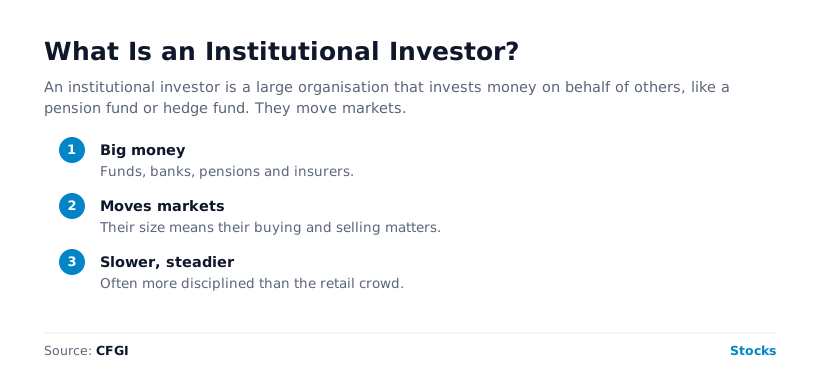
An institutional investor is a large organisation that invests pooled money on behalf of others, such as a pension fund, mutual fund, insurance company or hedge fund. Because they manage enormous sums, institutions account for the great majority of trading volume and can move prices when they buy or sell. They are "the big money", in contrast to retail investors trading their own savings, and they own most of the stock market between them.
CFGI data
Where the big money leans is a sentiment signal in its own right, not a footnote. Because institutions drive most of the volume, their positioning is part of what tips the Stock Fear and Greed Index between greed and fear on its 0 to 100 scale, which CFGI refreshes daily for equities.
Source: CFGI methodology, 10-input 0 to 100 model.
Key takeaways
- An institutional investor invests pooled money for others, at scale.
- Types include pension funds, mutual funds, insurers and hedge funds.
- Institutions own around 80% of the S&P 500 and most daily volume.
- Quarterly 13F filings reveal what the biggest managers hold.
- They are called "smart money", but they are not always right.
The Big Money
Institutional investors pool and manage money for large groups: workers’ pensions, fund shareholders, insurance policyholders, university endowments. Because each one controls vast sums, a single decision to buy or sell can be large enough to move a stock, and together they make up the overwhelming majority of activity on exchanges. They are often called "smart money", a label that reflects their resources and access, not a guarantee that they are right.
The Main Types
- Pension funds. Invest retirement savings for millions of workers; among the largest pools of capital on earth.
- Mutual funds and ETFs. Pool money from ordinary investors into diversified portfolios, including the huge index funds.
- Hedge funds. Run flexible, often aggressive strategies for wealthy and institutional clients.
- Insurance companies. Invest the premiums they collect to pay future claims.
- Endowments and sovereign wealth funds. Manage the long-term wealth of universities, charities and entire nations.
How Much of the Market They Own
The numbers are startling. Institutions own roughly 80% of the large-cap S&P 500 and around 78% of the broader Russell 3000, and they account for somewhere between 70% and 90% of daily trading volume, depending on the period. In other words, the stock market is, to a first approximation, an institutional market with individuals around the edges. This is why the phrase "the market did X today" usually means "large institutions did X today". When a pension fund rebalances or an index fund takes in a wave of new money, the resulting flows ripple across thousands of stocks at once.
Following the Smart Money: 13F Filings
Curious what the big money owns? In the US, any institutional manager with at least 100 million dollars in qualifying assets must file a quarterly report called a 13F, listing its long stock holdings. These filings are how analysts and individual investors track the moves of famous funds, and a fresh 13F from a well-known investor can itself move a stock.
Read 13Fs With Care
A 13F shows only long US equity positions, and arrives up to 45 days after quarter-end. It hides short bets, derivatives and foreign holdings, and shows where a fund was, not where it is now. It is a rear-view mirror, not a live feed.
Institutions Versus Retail
The counterpart is the retail investor, an individual trading their own money. Institutions bring more resources, data, research and access to deals an individual will never see. But the gap has narrowed in one respect: in liquid, high-profile names, coordinated retail flows now genuinely move momentum and pricing, as the meme-stock era made clear. Retail still accounts for only around a fifth of volume, but its influence on the most-watched stocks is larger than that share suggests.
Are They Really "Smart Money"?
Not reliably. Institutions are run by people and machines that feel the same fear and greed as everyone else, and they herd, chase performance and blow up too. They can be forced to sell at the worst moment by redemptions or risk limits, which amplifies a sell-off rather than steadying it. The collapse of giant funds over the years is proof that size and sophistication are not the same as being right. "Smart money" is a useful shorthand, not a description of infallibility. The 1998 implosion of the hedge fund Long-Term Capital Management, run by Nobel laureates and so large its failure threatened the financial system, is the classic reminder that brilliance and leverage can be a dangerous mix.
Institutions and Market Sentiment
Because institutions move most of the volume, their positioning is one of the forces a Stock Fear and Greed Index ultimately reflects on its 0 to 100 scale. When the big money piles into risk, momentum and breadth strengthen and the gauge leans greedy; when it rushes to safety, the same signals turn fearful. Watching how the largest players are leaning, and reading it against the crowd’s overall mood, is a more complete picture than following either institutions or retail alone.
Frequently asked questions
What is an institutional investor?
A large organisation that invests pooled money on behalf of others, such as a pension fund, mutual fund, insurance company, endowment or hedge fund. They manage huge sums and dominate trading.
How much of the stock market do institutions own?
A great deal: roughly 80% of the S&P 500 and around 78% of the Russell 3000, and they account for an estimated 70% to 90% of daily trading volume.
What is a 13F filing?
A quarterly report that US managers with at least 100 million dollars in assets must file with the SEC, listing their long stock holdings. It is widely used to track "smart money", but it shows only long US equities and arrives with a delay.
Are institutional investors always right?
No. They have more resources and access, but they feel the same fear and greed, herd, and can be forced to sell at the worst time. Size and sophistication do not guarantee good calls. This is education, not financial advice.
CFGI.io, Market sentiment research
The CFGI research team builds and maintains the CFGI Fear and Greed Index: a 0 to 100 sentiment score from 10 sub-indicators across hundreds of crypto assets and the equity market, refreshed every 15 minutes. We have tracked market emotion through multiple full crypto and equity cycles.
Think we missed something?
Spotted a gap, disagree with a take, or think we should cover a new topic? Message us and we'll act on your input.
Message us on TelegramKeep reading
This article is educational and is not financial advice. Crypto and equities are volatile and you can lose money. See our disclaimer.