Stocks
What Is a Hedge Fund?
Quick answer
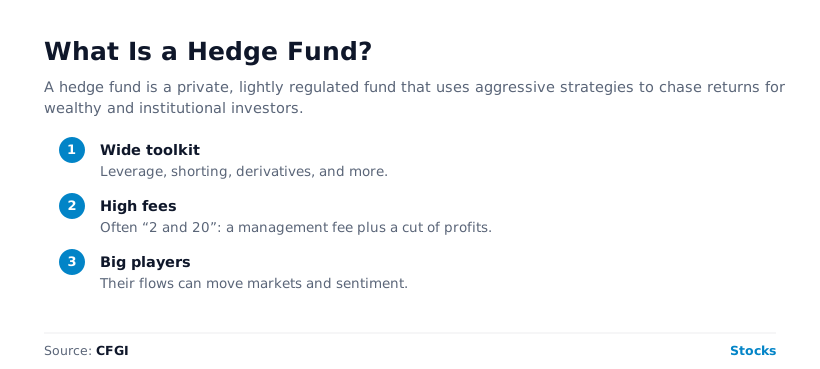
A hedge fund is a private investment fund, open mostly to wealthy and institutional investors, that uses flexible and often aggressive strategies to chase returns. Unlike a mutual fund, it can sell short, use heavy leverage and trade complex instruments, and it aims for "absolute" returns rather than just beating an index. The name comes from hedging, but today hedge funds pursue almost any strategy in search of profit, with much higher fees and, often, much higher risk.
CFGI data
Leveraged funds amplify the swings a Fear and Greed Index measures. When sentiment turns and crowded positions unwind at once, the forced selling deepens the drop toward Extreme Fear, below 20 on CFGI’s 0 to 100 scale, which is part of why the sharpest falls so often coincide with the most one-sided positioning.
Source: CFGI methodology, 10-input 0 to 100 model.
Key takeaways
- A hedge fund is a private, lightly regulated investment fund for large investors.
- It can short, use leverage and trade complex instruments a mutual fund cannot.
- The classic fee is "2 and 20": 2% of assets plus 20% of profits.
- Access is limited to accredited investors and qualified purchasers.
- After fees, most hedge funds underperform a simple index portfolio.
Flexible Strategies, Restricted Access
A hedge fund pools money like a mutual fund, but with far fewer rules constraining it. It can short sell to profit when prices fall, borrow heavily to amplify its bets, and trade derivatives most funds cannot touch. In exchange for that freedom, it is lightly regulated and therefore restricted to large, qualified investors who are assumed able to bear the risk, and it charges fees that are far steeper than anything in the mainstream fund world.
The "2 and 20" Fee
The classic hedge-fund fee is known as "2 and 20": a 2% annual management fee on the assets, plus a 20% performance fee on the profits, often only above a certain hurdle. The 2% pays the bills and the salaries whether the fund does well or not; the 20%, sometimes called carried interest, is the incentive to "beat the market". It is a wildly lucrative structure for managers, and a heavy drag for investors: even a fund that matches the market gross can deliver below-market returns net of those fees. Years of mixed performance have pushed the industry’s headline fees down from that 2-and-20 benchmark, but the basic shape persists.
Who Can Invest
Hedge funds are not for everyone, by law as well as by price. Because they are lightly regulated, access is generally limited to "accredited investors", broadly those with a net worth over 1 million dollars excluding their home, or income above 200,000 dollars a year, and for some funds "qualified purchasers" with at least 5 million dollars in investments. The logic is that wealthier, more sophisticated investors can absorb the higher risk and the long lock-up periods that hedge funds often impose. For ordinary investors, a hedge fund is usually something to understand rather than something to buy.
What They Actually Do
Hedge funds are defined more by their freedom than by any single approach, and the strategies vary enormously.
- Long/short equity. Buy stocks expected to rise and short those expected to fall, the original "hedged" strategy.
- Global macro. Bet on big-picture moves in currencies, rates and commodities.
- Event-driven. Trade around mergers, bankruptcies and other corporate events.
- Arbitrage and quant. Exploit small price differences or run systematic, model-driven strategies.
What unites them is the goal of "absolute return", making money in any market, rather than simply beating a benchmark the way a mutual fund tries to.
Hedge Fund Versus Mutual Fund
| Hedge fund | Mutual fund | |
|---|---|---|
| Open to | Wealthy and institutional only | The general public |
| Strategies | Short, leverage, derivatives | Mostly buy and hold |
| Fees | High (around 2 and 20) | Low to moderate |
| Goal | Absolute return | Beat a benchmark index |
| Regulation | Light | Heavy |
Two very different kinds of fund.
Do They Actually Beat the Market?
Surprisingly often, no. The premium fee structure eats a large share of returns, and study after study finds that, after fees, the average hedge fund underperforms a simple mix of stocks and bonds. A handful of legendary funds have produced extraordinary, durable returns, and they dominate the headlines, but they are the rare exceptions, not the rule, and survivorship bias flatters the industry’s record because the funds that blow up quietly disappear from the averages. The promise of hedge funds is genuine diversification and "alpha"; the reality, for most, is high fees in search of a market-beating edge that proves elusive.
The Reframe
A hedge fund is not automatically "smarter money". It is a fee structure attached to a strategy. Judge it on net returns and real diversification, not on the mystique.
Hedge Funds and Market Sentiment
Hedge funds are big, fast-moving and frequently leveraged, so their collective behaviour shapes the market’s extremes. When many funds crowd into the same trade and sentiment turns, their positions can unwind all at once, and the forced selling amplifies the fall, exactly the froth and panic a Fear and Greed Index is built to read. Watching where the crowd is leaning, including the leveraged professionals, helps explain why markets can swing so violently at the moments sentiment flips.
Frequently asked questions
What is a hedge fund?
A private, lightly regulated fund open mainly to wealthy and institutional investors that uses flexible, often aggressive strategies, including shorting and leverage, to chase absolute returns.
What is the "2 and 20" fee?
The classic hedge-fund fee structure: a 2% annual management fee on assets plus a 20% performance fee on profits, often above a hurdle. It is lucrative for managers and a significant drag on investor returns.
Can anyone invest in a hedge fund?
Generally no. Access is usually limited to accredited investors (over 1 million dollars net worth excluding a home, or income above 200,000 dollars) and qualified purchasers, because of the higher risk and lighter regulation.
Do hedge funds beat the market?
Most do not, after fees. A few legendary funds have produced exceptional returns, but on average hedge funds have underperformed a simple stock and bond portfolio once their high fees are counted. This is education, not financial advice.
CFGI.io, Market sentiment research
The CFGI research team builds and maintains the CFGI Fear and Greed Index: a 0 to 100 sentiment score from 10 sub-indicators across hundreds of crypto assets and the equity market, refreshed every 15 minutes. We have tracked market emotion through multiple full crypto and equity cycles.
Think we missed something?
Spotted a gap, disagree with a take, or think we should cover a new topic? Message us and we'll act on your input.
Message us on TelegramKeep reading
This article is educational and is not financial advice. Crypto and equities are volatile and you can lose money. See our disclaimer.