Stocks
What Is a Short Squeeze?
Quick answer
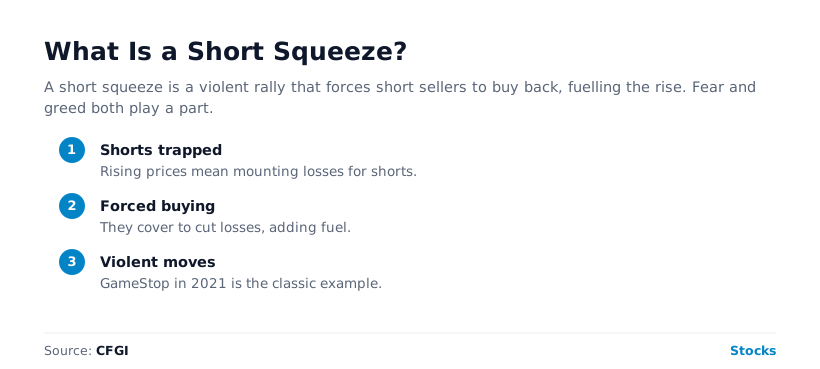
A short squeeze is a sharp, fast rise in a stock’s price that forces short sellers, who profit when prices fall, to buy back shares to limit their losses. That forced buying pushes the price even higher, triggering more buy-backs in a self-reinforcing spiral. Because a short seller’s losses are theoretically unlimited, the panic can be extreme, as the 2021 GameStop saga showed. A short squeeze is a vivid mix of emotions: panic among the shorts and greed among the buyers piling in. This is education, not financial advice.
CFGI data
A short squeeze is fear and greed colliding. Shorts panic-buy while momentum traders greedily chase, a feedback loop that can pin a single stock in Extreme Greed while the market is calm, exactly the kind of isolated extreme per-asset sentiment reveals.
Source: CFGI dataset, 2021 to June 2026.
Key takeaways
- A short squeeze forces short sellers to buy back as prices rise.
- That forced buying pushes the price even higher, a spiral.
- A short’s losses are unlimited, which makes the panic extreme.
- GameStop in 2021 rose over 2,700% in weeks on a squeeze.
- It mixes panic among shorts with greed among buyers.
When the Shorts Are Trapped
A short seller borrows shares and sells them, hoping to buy them back cheaper. But if the price rises instead, their losses grow, and they may be forced to buy back to cut the damage. When many shorts are forced to buy at once, their buying drives the price up further, forcing still more buy-backs, a squeeze. The result can be a spectacular, short-lived spike, far beyond what fundamentals justify, before the move exhausts itself and often reverses just as sharply.
Why Short Sellers Are So Vulnerable
The squeeze is so violent because of a brutal asymmetry in short selling. When you buy a stock, the most you can lose is 100%, if it goes to zero. When you short a stock, your loss is theoretically unlimited, because there is no ceiling on how high a price can rise. A stock that triples inflicts a 200% loss on a short seller, and it can keep going. As losses mount, brokers issue margin calls forcing the short to buy back, and the more shorts are crowded into a stock, measured by its "short interest", the percentage of shares sold short, the more forced buying is waiting to ignite. High short interest is the dry tinder; a rising price is the spark.
Unlimited Downside
A buyer can lose 100%; a short seller can lose far more, because a price has no upper limit. That uncapped risk is what turns a rising stock into a stampede of forced buying.
The GameStop Squeeze
The most famous short squeeze in history struck GameStop in January 2021. The struggling retailer had been shorted so heavily that around 140% of its available shares were sold short, more than actually existed in free float. When traders coordinating on the Reddit forum r/WallStreetBets began aggressively buying the stock and its call options, the trapped short sellers were forced to cover, and the price exploded from around 17 dollars early in the month to an intraday high of 483 dollars on 28 January, a gain of over 2,700% in weeks. Several hedge funds that were short the stock lost billions. It became a cultural moment, retail traders versus Wall Street, and the textbook illustration of how ferocious a squeeze can be.
Gamma Squeezes and the Fuel
Squeezes are often supercharged by a related effect in the options market, the "gamma squeeze". When traders buy large numbers of call options on a rising stock, the dealers who sold them those calls must buy the underlying shares to hedge their own risk, and they have to buy more as the price climbs. That hedging adds another wave of forced buying on top of the short-covering, pouring fuel on the fire, which was a key part of the GameStop move. The two together, heavy short interest providing the trapped sellers and call-buying triggering dealer hedging, are the classic ingredients of an explosive squeeze, and watching short interest and options activity is how traders try to spot one brewing.
A Collision of Fear and Greed
A short squeeze is emotion at its most concentrated: fear among trapped shorts scrambling to cover, and greed among traders chasing the vertical move. On per-asset sentiment, a squeezed stock can pin in extreme greed while the broader market is unmoved, an isolated, manufactured extreme rather than a market-wide one. A Stock Fear and Greed Index reading at the extreme is a cue that a move may be running on emotion, not value, which matters enormously here, because squeezes almost always reverse hard once the forced buying exhausts. The crowd chasing a squeeze at its peak is buying pure greed, and the gravity that follows can be every bit as violent as the spike.
Frequently asked questions
What is a short squeeze?
A sharp, fast rise in a stock’s price that forces short sellers to buy back shares to limit losses. That forced buying pushes the price higher, triggering more buy-backs in a self-reinforcing spiral.
Why are short sellers so vulnerable to a squeeze?
Because a short seller’s loss is theoretically unlimited, there is no ceiling on how high a price can rise, while a buyer can only lose 100%. As losses mount, margin calls force shorts to buy back, and high short interest means lots of forced buying waiting to ignite.
What happened with GameStop?
In January 2021, GameStop, with around 140% of its float sold short, was bought aggressively by r/WallStreetBets traders, forcing shorts to cover. The price rocketed from about 17 dollars to an intraday 483 in weeks, over 2,700%, and several hedge funds lost billions.
How does a short squeeze relate to fear and greed?
It collides the two: panic among trapped shorts and greed among chasing buyers. A stock can pin in extreme greed while the market is calm, a move running on emotion that almost always reverses hard. This is education, not financial advice.
CFGI.io, Market sentiment research
The CFGI research team builds and maintains the CFGI Fear and Greed Index: a 0 to 100 sentiment score from 10 sub-indicators across hundreds of crypto assets and the equity market, refreshed every 15 minutes. We have tracked market emotion through multiple full crypto and equity cycles.
Think we missed something?
Spotted a gap, disagree with a take, or think we should cover a new topic? Message us and we'll act on your input.
Message us on TelegramKeep reading
This article is educational and is not financial advice. Crypto and equities are volatile and you can lose money. See our disclaimer.