Stocks
What Is a Private Company?
Quick answer
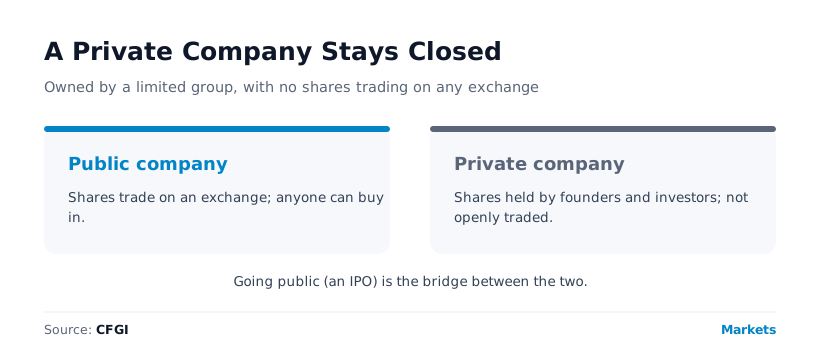
A private company is owned by a limited group, founders, employees or private investors, and its shares are not traded on a public exchange. It raises money privately, often through venture-capital funding rounds, and does not have to report its finances to the public. The trade-off is control and privacy in exchange for harder access to capital. Without a daily traded price, a private company has no live market mood to read. This is education, not financial advice.
CFGI data
Sentiment needs a live market price, and private companies do not have one. CFGI scores the public market instead: a 0 to 100 Stock Fear and Greed reading updated daily since 2021 across major indices and leading stocks, where the crowd reprices mood every trading day.
Source: CFGI dataset, 2021 to June 2026.
Key takeaways
- A private company’s shares are not publicly traded.
- It is owned by founders, staff or private investors.
- It raises money privately, often through VC funding rounds.
- It keeps control and privacy but has harder access to capital.
- With no daily price, it has no live market mood to measure.
What Is a Private Company?
A private company is one whose ownership is held by a small group and not offered to the general public. Its shares do not trade on a stock exchange. Many of the world’s companies, from corner shops to giant startups worth tens of billions, are private. They raise money from founders, venture capital or private equity rather than public markets, and in exchange for staying out of the public eye, they keep their finances confidential and their control concentrated.
Private Versus Public
| Private | Public | |
|---|---|---|
| Ownership | A small group | Anyone can buy shares |
| Shares trade | Rarely, privately | Daily, on an exchange |
| Disclosure | Limited | Extensive and public |
| Daily price | None | Set by the market |
| Raising capital | Private rounds | Public markets, at scale |
The core differences.
A private company can become public through an IPO, crossing from one column of this table to the other in a single, transformative event.
How Private Companies Raise Money
Without public markets to tap, growing private companies raise capital through a ladder of private "funding rounds", selling equity to investors at each step. It usually begins with a "seed" round from angel investors or early funds to prove the idea, followed by Series A, B, C and beyond from venture-capital and private-equity firms, each round larger and at a higher valuation as the company matures. Investors hand over money in exchange for an ownership stake, betting on a future "exit". Crucially, these valuations are negotiated privately at each round, a snapshot agreed between the company and a handful of investors, rather than set continuously by an open market the way a public company’s is. This is why a private startup can be labelled a "unicorn" worth a billion dollars on the strength of a single funding round, even though no open market has ever tested that number. The valuation is real to the people who agreed it, but it is a negotiated estimate, not a live, crowd-set price, which is a meaningful difference when conditions change.
Why Stay Private?
Plenty of successful companies choose to remain private, sometimes indefinitely, because the trade-offs favour it. Staying private means keeping decision-making concentrated and nimble, avoiding the heavy cost and scrutiny of public reporting, escaping the relentless pressure to hit quarterly targets, and keeping financials confidential from competitors. The cost is that raising large amounts of capital is harder and slower, and early shareholders cannot easily sell their stakes. Companies typically go public only when the need for big capital or a way for early backers to "exit" outweighs the freedoms of staying private. For venture investors, that exit, an IPO or an acquisition, is the whole point: it is how they finally turn an ownership stake into cash.
The Exit
Private investors make their return at an "exit": the company going public via IPO, or being acquired. Until then, their stake is illiquid, valued only at the next funding round.
Why Is There No Mood to Measure?
Sentiment is read from a live, traded price: the crowd repricing an asset in real time. A private company has no such price, so there is no daily signal of fear or greed to capture. Its value is estimated only occasionally, during funding rounds, not voted on continuously by thousands of buyers and sellers. That is the deep reason a Fear and Greed reading exists for public companies but not private ones: the public market generates a fresh, emotional price every trading day, which CFGI reads into the Stock Fear and Greed Index, while a private company’s worth simply sits, unchanged on paper, between rounds. In a sense, the absence of a Fear and Greed score for private companies is the clearest illustration of what the index actually measures: not the value of a business, which exists whether it is public or private, but the live, shifting emotion of a crowd actively pricing it. No crowd, no mood, no score.
Frequently asked questions
What is a private company?
A company owned by a limited group, founders, employees or private investors, whose shares are not traded on a public exchange. It raises money privately and does not have to report its finances publicly.
How do private companies raise money?
Through private funding rounds, selling equity to investors at each step: a seed round, then Series A, B, C and beyond from venture-capital and private-equity firms, each larger and at a higher valuation as the company matures.
Why do some companies stay private?
To keep control concentrated and nimble, avoid the cost and scrutiny of public reporting, escape short-term quarterly pressure, and keep finances confidential. The trade-off is harder access to large-scale capital and illiquid shares for early owners.
Does a private company have a Fear and Greed score?
No. Without a daily traded price there is no live mood to measure, its value is only estimated occasionally at funding rounds. CFGI scores public stocks, which the market reprices in the open every day. This is education, not financial advice.
CFGI.io, Market sentiment research
The CFGI research team builds and maintains the CFGI Fear and Greed Index: a 0 to 100 sentiment score from 10 sub-indicators across hundreds of crypto assets and the equity market, refreshed every 15 minutes. We have tracked market emotion through multiple full crypto and equity cycles.
Think we missed something?
Spotted a gap, disagree with a take, or think we should cover a new topic? Message us and we'll act on your input.
Message us on TelegramKeep reading
This article is educational and is not financial advice. Crypto and equities are volatile and you can lose money. See our disclaimer.