Stocks
What Is a Good VIX Level?
Quick answer
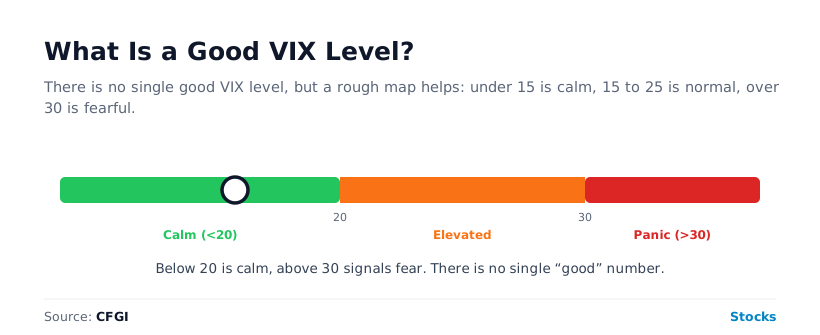
There is no single good VIX level, because what counts as high or low depends on context. As a rough map, under about 15 signals calm, 15 to 25 is normal, and over 30 signals fear and stress, with readings above 40 marking outright panic. Crucially, a very low VIX is not automatically good: deep calm can mean complacency, the kind of greed that often precedes a shock. The level is context for expected volatility, not a verdict on whether to buy or sell. This is education, not financial advice.
CFGI data
A VIX level only tells you about expected volatility; a Fear and Greed Index puts it in context. CFGI blends volatility with price, momentum and breadth into a 0 to 100 score, so a low VIX paired with Extreme Greed, 80 or above, reads as complacency rather than safety, a nuance the VIX number alone cannot give you.
Source: CFGI methodology; VIX bands are rough historical guides.
Key takeaways
- There is no single good VIX level; context decides.
- Rough guide: under 15 calm, 15 to 25 normal, over 30 fearful, over 40 panic.
- The VIX has averaged around 17 to 20, hitting a record near 83 in 2020.
- A very low VIX can signal complacency, not safety.
- Read the level alongside broader sentiment, not alone.
A Rough Map of Levels
| VIX | What it suggests |
|---|---|
| Under ~12 | Very calm, often complacency |
| ~12 to 20 | Normal conditions |
| ~20 to 30 | Elevated, rising caution |
| ~30 to 40 | Fear and stress |
| Over ~40 | Panic and crisis |
Rough VIX bands.
These bands are historical rules of thumb, not hard lines. The VIX measures the volatility the market expects over the next 30 days, so a higher level simply means bigger moves are anticipated, in either direction.
What the VIX Is Actually Measuring
It helps to be clear about what the number is. The VIX is derived from the prices investors pay for S&P 500 options, and it expresses how much the market expects the index to swing over the coming month. Because people pay up for protection when they are nervous, the VIX rises with fear and falls with calm, earning its nickname, the "fear gauge". One subtlety: it is symmetric, measuring the expected size of moves, not their direction, though in practice it spikes far more on the way down than up, because crashes are what scare people into buying options.
The Historical Context
Knowing the long-run record makes any reading easier to judge. Over its history the VIX has had a median around 17 to 18 and spends most of its time roughly between 11 and 26. The extremes are dramatic: it fell as low as about 9 in the calmest stretches, and spiked to an all-time high near 83 during the COVID crash of March 2020, narrowly above its previous peak around 80 in the 2008 financial crisis. So a reading of 30 is genuinely elevated, while a reading of 50 or more is the signature of a real crisis, the kind that appears only a handful of times in a generation.
Why Low Is Not Always Good
It is tempting to call a low VIX good news, but deep calm often reflects complacency rather than genuine safety. When the VIX is very low, it usually means everyone is relaxed and fully invested, which paradoxically makes the market fragile: there is little fear left to fade and plenty of positioning that can unwind if something goes wrong. Some of history’s nastiest shocks have erupted out of unusually quiet markets. That is why a very low VIX sitting alongside Extreme Greed is a yellow flag, not an all-clear, the so-called volatility paradox in action.
The Paradox
A calm market is not the same as a safe one. The lowest VIX readings come right when complacency is highest, which is often when the risk of a surprise is greatest.
Why Context Beats the Number
The same VIX level can mean opposite things in different climates. A reading of 20 looks high during a sleepy bull market but low in the middle of a crisis, so the number only makes sense relative to where it has been. Two other habits help. First, watch the trend: a VIX grinding higher signals building unease even below the "fear" bands. Second, remember that the VIX is strongly mean-reverting, extreme spikes tend to collapse back toward the average within weeks, which is why a VIX above 40 has, historically, often coincided with the kind of capitulation that later looked like an opportunity rather than a moment to sell.
How to Use the VIX Level
Treat the VIX as context, not a trigger. A spiking VIX confirms that fear is real and widespread, which for a contrarian is information, not a reason to panic; a persistently low VIX is a nudge to check whether the market has grown complacent. What it is not is a precise buy or sell signal on its own. The level tells you how stormy the weather is expected to be, but not which way to sail. Used to gauge the emotional temperature of the market alongside other tools, rather than as a standalone timing device, it earns its place.
The VIX In Context: Pair It With Sentiment
The VIX captures one dimension, expected volatility, while a Fear and Greed Index blends volatility together with price action, momentum and market breadth into a single 0 to 100 read. That is why the two work so well together: a low VIX next to a gauge reading Extreme Greed tells a fuller story, calm prices and a euphoric crowd, than the VIX could alone. Reading the level beside broader sentiment turns a single volatility number into a much richer picture of where the market really stands.
Frequently asked questions
What is a good VIX level?
There is no single good level. Roughly, under 12 is very calm, 12 to 20 is normal, 20 to 30 is elevated, 30 to 40 is fearful, and over 40 is panic. What is good depends on context, not the number alone.
What is the average VIX level?
Its long-run median is around 17 to 18, and it spends most of its time between about 11 and 26. It has spiked as high as roughly 83, during the March 2020 COVID crash, and fallen as low as about 9.
Is a low VIX always good?
No. A very low VIX can signal complacency, the kind of greed that often precedes a shock. Deep calm is not the same as safety, which is the volatility paradox.
How should I use the VIX level?
As context for expected volatility, read alongside broader sentiment rather than as a buy or sell signal on its own. Watch the trend, and remember the VIX is strongly mean-reverting. This is education, not financial advice.
CFGI.io, Market sentiment research
The CFGI research team builds and maintains the CFGI Fear and Greed Index: a 0 to 100 sentiment score from 10 sub-indicators across hundreds of crypto assets and the equity market, refreshed every 15 minutes. We have tracked market emotion through multiple full crypto and equity cycles.
Think we missed something?
Spotted a gap, disagree with a take, or think we should cover a new topic? Message us and we'll act on your input.
Message us on TelegramKeep reading
This article is educational and is not financial advice. Crypto and equities are volatile and you can lose money. See our disclaimer.