Stocks
What Does the VIX Tell You?
Quick answer
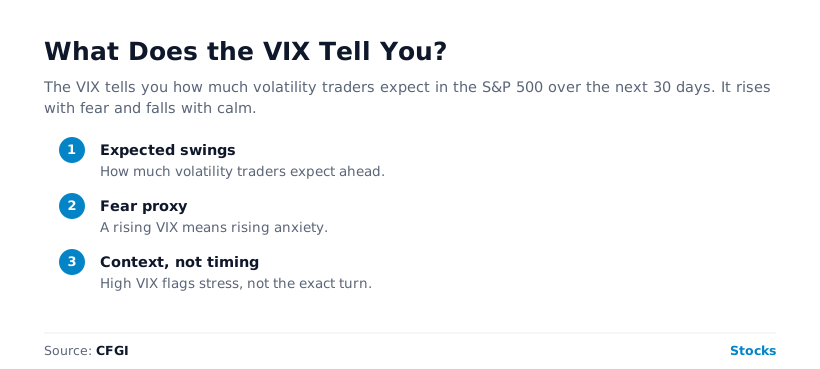
The VIX tells you how much volatility the market expects in the S&P 500 over the next 30 days, derived from options prices. A high VIX means traders are paying up for protection because they expect big swings, which is why it is called the "fear gauge". A low VIX means calm, and often complacency. Crucially, the VIX measures expected turbulence, not direction: it tells you how big the moves might be, not which way they will go. This is education, not financial advice.
CFGI data
The VIX is one signal; a Fear and Greed Index blends many. CFGI uses volatility as one of its inputs alongside price, momentum and breadth, so it captures what the VIX says about fear and adds the rest of the picture in a single 0 to 100 score, daily for equities since 2021.
Source: CFGI methodology; VIX measures 30-day expected S&P 500 volatility.
Key takeaways
- The VIX measures expected S&P 500 volatility over 30 days.
- It rises with fear and falls with calm, the "fear gauge".
- It tells you expected turbulence, not market direction.
- A very low VIX can signal complacency before a shock.
- Traders use it to size risk, hedge, and spot fear extremes.
Expected Turbulence, Not Direction
The VIX is built from S&P 500 options prices. When traders expect big moves, they pay more for options as protection, and the VIX rises; when they expect calm, it falls. The single most important thing to understand is that it says nothing about which way the market will go, only how much it is expected to move. A spike in the VIX means fear and stress and the expectation of large swings; it does not, by itself, mean the market is heading down, even though in practice fear and falling prices usually arrive together.
How the VIX Is Built
Under the hood, the VIX is a measure of "implied volatility", the amount of movement that options prices are pricing in for the next 30 days. Options are essentially insurance against price moves, so when investors are nervous they bid up the cost of that insurance, and the VIX reflects it. This is why the VIX is forward-looking, unlike most measures that describe what already happened, it captures what the market collectively expects to happen next, expressed through what people are willing to pay to protect themselves. In effect, it reads the market’s anxiety straight from its insurance bill.
What a Rising VIX Tells You
When the VIX climbs, it is telling you that fear and uncertainty are rising and that the market expects a bumpier ride. Demand for protection is up, conviction is down, and participants are bracing for larger swings. A sharply spiking VIX is the signature of stress, a sell-off, a shock, a crisis, and it tends to move much faster on the way up than on the way down, because fear strikes quickly. But remember the caveat: "bigger moves expected" is not the same as "lower prices coming". The VIX is shouting that the seas are getting rough, not which direction the ship will be pushed.
What a Low VIX Tells You
A low VIX tells you the market is calm, and that is not always reassuring. Deep calm usually means investors are relaxed and fully invested, with little fear priced in, which paradoxically makes the market fragile: there is little protection in place and plenty of positioning that can unwind if something goes wrong. Some of history’s worst shocks have erupted out of unusually quiet markets, the "calm before the storm". So an extremely low VIX is worth noting not as an all-clear but as a sign of complacency, the same euphoria a Fear and Greed Index would flag as greed.
The Paradox
A high VIX feels dangerous but often comes near bottoms; a low VIX feels safe but can precede shocks. The "fear gauge" is most useful read against the grain of how it feels.
What the VIX Does Not Tell You
For all its usefulness, the VIX has clear blind spots. It does not tell you direction, only expected magnitude. It does not tell you when a move will happen, only that volatility is expected over the coming month. And it is not a precise timing tool: a high VIX can stay high, and a low one can stay low, for longer than seems reasonable. The VIX is a weather forecast for turbulence, valuable for knowing whether to brace, but it cannot tell you exactly when the storm hits or where the wind will blow. Treating it as a precise buy or sell signal is asking it to do a job it was never built for.
How Traders Use It
In practice, the VIX is used less as a crystal ball and more as a dial for risk. When it is high, traders often reduce position sizes and pay for hedges, knowing swings will be large; when it is low, they may take on more exposure but stay alert to complacency. Because the VIX is strongly mean-reverting, extreme spikes tend to collapse back toward the average within weeks, contrarians treat a soaring VIX as a sign that fear, and the selling that comes with it, may be near exhaustion. There are even VIX-linked products that let investors trade volatility directly, usually as a hedge. Across all of these, the VIX is a tool for managing turbulence, not predicting price.
The VIX Versus a Fear and Greed Index
The VIX measures one thing, expected volatility, brilliantly, but it is a single dimension. A Fear and Greed Index folds volatility together with price momentum, market breadth, safe-haven demand and more into one 0 to 100 score. That makes the two natural partners: the VIX gives you a clean read on how much fear is priced into options, while the broader gauge adds the rest of the sentiment picture. CFGI uses volatility as just one of its inputs, so it captures what the VIX is telling you and surrounds it with context, which is why reading the two together is more revealing than either alone.
Frequently asked questions
What does the VIX tell you?
How much volatility the market expects in the S&P 500 over the next 30 days, derived from options prices. It rises with fear, falls with calm, and measures expected turbulence, not direction.
Does a high VIX mean the market will fall?
No. It means big moves are expected, in either direction. A high VIX signals fear and stress, and in practice often accompanies falling prices, but it does not predict which way price goes.
Is a low VIX good?
Not necessarily. A low VIX signals calm, but deep calm can mean complacency, with little protection priced in. Some shocks have erupted out of unusually quiet markets, so a very low VIX is worth treating with caution, not comfort.
How is the VIX different from a Fear and Greed Index?
The VIX measures one thing, expected volatility. A Fear and Greed Index blends volatility with price momentum, breadth and safe-haven demand into a single sentiment score, giving the fuller picture. This is education, not financial advice.
CFGI.io, Market sentiment research
The CFGI research team builds and maintains the CFGI Fear and Greed Index: a 0 to 100 sentiment score from 10 sub-indicators across hundreds of crypto assets and the equity market, refreshed every 15 minutes. We have tracked market emotion through multiple full crypto and equity cycles.
Think we missed something?
Spotted a gap, disagree with a take, or think we should cover a new topic? Message us and we'll act on your input.
Message us on TelegramKeep reading
This article is educational and is not financial advice. Crypto and equities are volatile and you can lose money. See our disclaimer.