Crypto
What Affects the Crypto Fear and Greed Index?
Quick answer
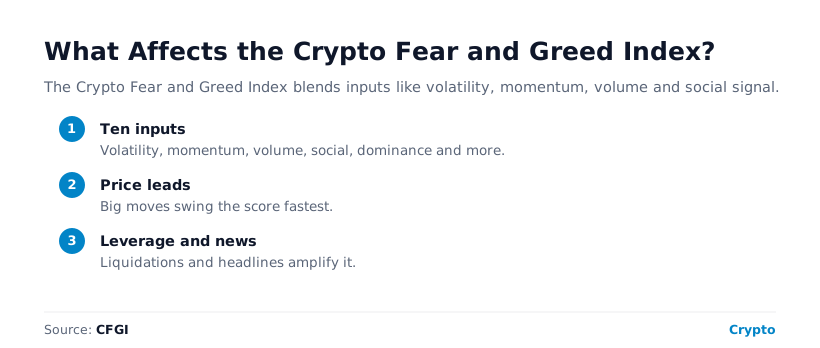
The Crypto Fear and Greed Index moves because its underlying inputs move. It blends signals such as price volatility, momentum, trading volume, social activity and market dominance into one 0 to 100 score. When those point to confidence, the score rises toward greed; when they point to stress, it falls toward fear. Real-world events, from a Bitcoin halving to an exchange failure, affect the index indirectly, by moving those underlying signals. Because it blends ten indicator groups, no single input, not even social hype, can swing it alone. This is education, not financial advice.
CFGI data
CFGI builds the crypto score from 10 indicator groups across hundreds of assets, refreshed every 15 minutes since March 2022. That breadth is why a burst of social hype alone does not move the reading, and why a coin can trend on social yet still score fearful if price, volume and volatility disagree.
Source: CFGI dataset, March 2022 to June 2026.
Key takeaways
- The score moves because its underlying inputs move.
- Inputs include volatility, momentum, volume, social signal and dominance.
- Real-world events affect it indirectly, by moving those signals.
- No single input, even social hype, can dominate the blend.
- Each coin is scored on its own inputs, so per-asset readings differ.
What Feeds the Crypto Score
A Fear and Greed Index is a synthesis, so what affects it is the basket of signals beneath it. The crypto score responds to several families of input working together.
| Input | Pushes toward greed when... |
|---|---|
| Volatility | Price swings calm down |
| Momentum | Prices trend higher |
| Volume | Buying demand is strong |
| Social signal | Chatter turns bullish |
| Market dominance | Risk appetite broadens into altcoins |
What pushes the crypto score toward greed.
The Input Families, One by One
Each family reads a different facet of the crowd’s mood. Volatility treats sudden, sharp swings, especially downward, as fear, and calm as confidence. Momentum and volume read the strength and conviction of buying: rising prices on heavy volume are greedy, fading prices on thin volume are fearful. Social signals gauge how excited and engaged the crowd is online. And market dominance, Bitcoin’s share of the total market, hints at risk appetite: when money rotates out of Bitcoin into riskier altcoins, that broadening is a sign of greed. CFGI blends ten such groups, so the final number reflects agreement, or disagreement, across all of them.
The Real-World Catalysts Behind It
It is worth being clear about cause and effect. News events do not feed into the index directly; they move the underlying signals, which then move the score. A Bitcoin halving, an ETF approval or a wave of positive regulation tends to lift momentum, volume and social chatter, dragging the score toward greed. An exchange collapse, a major hack, a hawkish central bank or a sudden crash spikes volatility and crushes momentum, pulling it toward fear. So when you ask "what moved the index today?", the honest answer is usually an event that moved its inputs, the index is the messenger, not the cause.
Why No Single Input Dominates
Because social is just one of ten inputs, a wave of hype on its own will not dominate the score. It takes broad agreement, across volatility, momentum, volume and the rest, to drive a deep reading at either extreme. That is precisely what makes the index steadier and harder to game than a social-only sentiment tool, which a single viral post or a coordinated bot campaign can distort. The blend is a feature: it filters out the noise of any one channel and requires real, multi-signal conviction before it commits to fear or greed.
The Practical Upshot
A coin can be trending number one on social media and still score fearful, if its price is falling, its volume is thin and its volatility is high. The blend keeps the gauge honest.
What Affects One Coin’s Score
Because CFGI scores hundreds of assets individually, what affects a single coin’s reading is that coin’s own inputs, not the market’s. A legal ruling moves XRP’s score, a network upgrade moves Ethereum’s, an outage moves Solana’s, and none of these necessarily touch Bitcoin. This is why a per-asset gauge is so useful: the same market-wide event can be irrelevant to one coin and decisive for another, and only by scoring each on its own signals can the index capture that. The market reading and a single coin’s reading answer genuinely different questions.
What Does Not Move It
Just as telling is what the index ignores. Your personal opinion, a single tweet in isolation, or a price level with no supporting move in volume and volatility will not shift it. It does not run on narrative alone, nor on any one person’s view of where the market "should" go. The score is a reflection of measured, collective behaviour, which means it can stubbornly disagree with the loudest voices online, and that disagreement is often exactly when it is most worth listening to.
Reading the Blend
Put together, the lesson is that the Crypto Fear and Greed Index is a weighted blend of measurable signals, moved by real events that ripple through those signals, and deliberately resistant to any single source of noise. That is what makes one number a fair summary of a chaotic market. To see the blend in action across the whole market and individual coins, the live gauge below is the place to start.
Frequently asked questions
What affects the Crypto Fear and Greed Index?
Its underlying inputs: volatility, momentum, trading volume, social activity and market dominance, among ten indicator groups. Confidence lifts the score; stress lowers it. Real-world events move it by moving those signals.
Does social hype move the score?
Only partly. Social is one of ten inputs, so a wave of hype alone will not dominate. A coin can trend number one on social yet still score fearful if its price, volume and volatility disagree.
Do news events move the index directly?
Not directly. Events like a halving, an ETF approval or an exchange collapse move the underlying signals, momentum, volume, volatility, which then move the score. The index reflects the market’s reaction, it is not the cause.
Why does the blend matter?
It keeps the score balanced and far harder to manipulate than a social-only tool, which a single viral post can distort. It takes broad agreement across signals to drive a deep reading. This is education, not financial advice.
CFGI.io, Market sentiment research
The CFGI research team builds and maintains the CFGI Fear and Greed Index: a 0 to 100 sentiment score from 10 sub-indicators across hundreds of crypto assets and the equity market, refreshed every 15 minutes. We have tracked market emotion through multiple full crypto and equity cycles.
Think we missed something?
Spotted a gap, disagree with a take, or think we should cover a new topic? Message us and we'll act on your input.
Message us on TelegramKeep reading
This article is educational and is not financial advice. Crypto and equities are volatile and you can lose money. See our disclaimer.