Markets
What Is Loss Aversion?
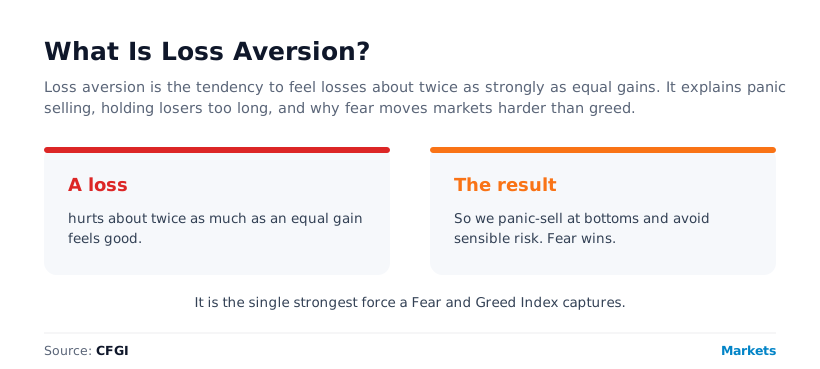
Quick answer
Loss aversion is the tendency to feel the pain of a loss about twice as strongly as the pleasure of an equal gain. It is one of the best-documented findings in behavioural finance, identified by Kahneman and Tversky, and it shapes how investors act: it drives panic selling, makes people hold losing positions too long hoping to break even, and helps explain why fear moves markets faster and deeper than greed. Recognising it is the first step to building rules that resist it. This is education, not financial advice.
CFGI data
Loss aversion is visible in the data: in CFGI history, fear arrives fast and deep while greed builds slowly, the equity score plunged to an extreme-fear 3 on 8 April 2025 but rarely sits near 100. Pain felt more sharply than gain is exactly why the fear side of the scale is reached more often.
Source: CFGI dataset, 2021 to June 2026.
Key takeaways
- Losses feel about twice as painful as equal gains feel good.
- It is a cornerstone of prospect theory.
- It drives panic selling and holding losers too long.
- The disposition effect, selling winners early, holding losers, follows from it.
- It helps explain why fear moves markets harder than greed.
The Asymmetry of Pain and Gain
Loss aversion, identified by psychologists Daniel Kahneman and Amos Tversky, says we do not weigh gains and losses equally. Losing 100 dollars hurts more than gaining 100 dollars pleases, by roughly two to one. That asymmetry quietly distorts almost every investment decision. It shows up two ways. When prices fall, the pain of further loss can trigger panic selling at the worst moment. And when a position is down, the desire to avoid locking in the loss makes people hold losers far too long, hoping to get back to even.
Where It Comes From: Prospect Theory
Loss aversion is the cornerstone of prospect theory, the 1979 framework that helped found behavioural finance and later won Kahneman a Nobel Prize. Prospect theory showed that people judge outcomes not in absolute terms but as gains and losses relative to a reference point, usually what they paid or what they had, and that the pain of a loss is far steeper than the pleasure of an equal gain. The asymmetry is thought to have deep evolutionary roots: for our ancestors, avoiding a loss, of food, of shelter, of safety, was often a matter of survival, while an equivalent gain was merely nice to have. That ancient wiring, useful on the savannah, quietly sabotages us in markets, where it pushes us to act on the fear of loss rather than on cool calculation.
How It Hurts Investors
Loss aversion damages returns in several specific ways. It triggers panic selling near the bottom, as the mounting pain of loss overwhelms judgement at exactly the wrong moment. It makes people hold losing positions far too long, refusing to "realise" a loss and tying up money in failing investments in the vain hope of breaking even, the "break-even disease". It can also make investors too cautious in general, shunning sensible risk because the fear of any loss looms so large, which can mean missing out on long-run gains. In each case the underlying mistake is the same: letting the lopsided fear of loss, rather than a clear view of value and probability, drive the decision.
The Disposition Effect
The clearest market symptom of loss aversion is the "disposition effect": the tendency to sell winners too early and hold losers too long, which is almost exactly backwards. The logic is loss aversion at work. With a winning position, the pleasure of locking in a sure gain is tempting, so people sell to "bank" it, even when the winner has further to run. With a losing position, realising the loss is so painful that they hold on, hoping it recovers, even when the case for it has collapsed. The net result, cutting your flowers and watering your weeds, is a well-documented drag on returns, and it stems directly from feeling losses more sharply than gains.
Cut Your Flowers, Water Your Weeds
Loss aversion makes investors sell winners early and cling to losers, the opposite of the old advice to "let winners run and cut losers". Naming the bias is the first step to reversing it.
How to Resist It
You cannot switch off loss aversion, it is wired in, but you can build structures that blunt it. The most powerful is to set rules in advance, when you are calm: predefined stop-losses, a written plan, and a regular rebalancing schedule all remove the in-the-moment decision that loss aversion would hijack. Reframing helps too: judge your portfolio as a long-run process rather than agonising over each position, and ask of any holding, "knowing nothing about what I paid, would I buy this today?" to strip out the anchor to your entry price. And a neutral, external signal can serve as a calm second opinion when the pain of a loss is screaming at you to sell. The goal is not to feel less, but to decide less from feeling.
Loss Aversion and Fear
Loss aversion is the engine behind market fear. Because losses sting twice as much, falling prices generate more emotional pressure than rising prices, which is why crashes are sharp and the fear side of a sentiment index is reached more often and more deeply than the greed side. CFGI’s own history shows the imprint clearly: the equity score has plunged to a panicked 3 but topped out at only 83, fear runs to greater extremes than greed because the pain that drives it is felt more keenly. In a sense, a Fear and Greed Index is loss aversion made visible: the lopsided pull toward the fear end of the scale is the collective signature of millions of people each feeling their losses twice as hard as their gains.
Frequently asked questions
What is loss aversion?
The tendency to feel losses about twice as strongly as equal gains. It is a core finding of behavioural finance, identified by Kahneman and Tversky, and the cornerstone of prospect theory.
How does loss aversion affect investing?
It drives panic selling when prices fall, makes people hold losing positions too long to avoid locking in a loss, and can make investors overly cautious. It also helps explain why fear moves markets harder than greed.
What is the disposition effect?
The tendency, driven by loss aversion, to sell winners too early to bank a sure gain and hold losers too long to avoid realising a loss, almost exactly backwards. It is a documented drag on returns.
Can you overcome loss aversion?
Not entirely, it is wired in, but you can blunt it by setting rules in advance like stop-losses and rebalancing, reframing your portfolio as a long-run process, and using a neutral signal as a calm second opinion. The aim is to decide less from feeling. This is education, not financial advice.
CFGI.io, Market sentiment research
The CFGI research team builds and maintains the CFGI Fear and Greed Index: a 0 to 100 sentiment score from 10 sub-indicators across hundreds of crypto assets and the equity market, refreshed every 15 minutes. We have tracked market emotion through multiple full crypto and equity cycles.
Think we missed something?
Spotted a gap, disagree with a take, or think we should cover a new topic? Message us and we'll act on your input.
Message us on TelegramKeep reading
This article is educational and is not financial advice. Crypto and equities are volatile and you can lose money. See our disclaimer.