Stocks
Fear and Greed Index for Dividend Investors
Quick answer
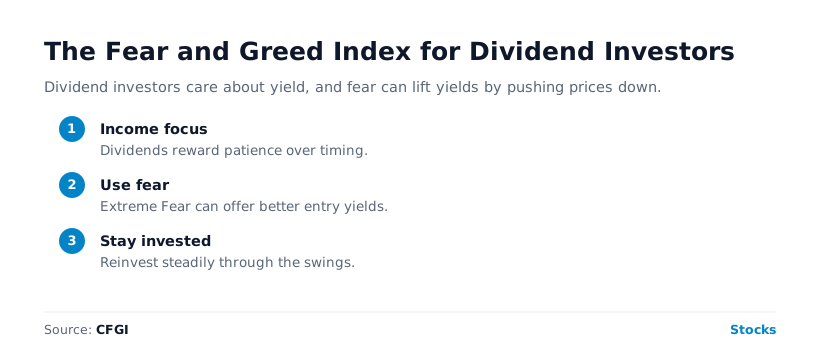
Dividend investors buy stocks for the income they pay, and that income matters relative to price: when a share price falls, its dividend yield rises. Because fear pushes prices down, periods of Extreme Fear can be exactly when quality dividend payers offer their most attractive yields. The Fear and Greed Index helps a dividend investor spot those moments, while keeping the focus on the durability of the dividend itself, not just the headline yield. This is education, not financial advice.
CFGI data
Fear lifts yields. When CFGI sits in Extreme Fear and prices fall, the dividend on a steady payer becomes a larger share of a lower price. The equity 3 on 8 April 2025 is the kind of reading that historically coincided with richer yields on quality names, though the dividend’s safety always comes first.
Source: CFGI dataset, 2021 to June 2026.
Key takeaways
- Dividend yield rises when the share price falls.
- Dividend investing buys stocks for reliable income.
- Fear pushes prices down, lifting yields.
- Beware the yield trap: a high yield can warn of a cut.
- The dividend’s durability matters more than the headline yield.
How Fear Helps a Dividend Investor
A dividend yield is the annual payout divided by the share price. So when fear drives a quality company’s price down, its yield goes up, you get more income per dollar invested. For a long-term dividend investor, broad fear can be an opportunity to buy reliable income more cheaply. The caution is crucial: a very high yield can also be a warning that the market expects the dividend to be cut. Fear is an opportunity only when the payout itself is durable, which is the central tension a dividend investor must navigate.
What Dividend Investing Is
Dividend investing is the strategy of buying shares chiefly for the regular income they pay out, rather than purely for price appreciation. Many established, profitable companies return a slice of their earnings to shareholders as a cash dividend, typically each quarter, and dividend investors prize the companies that pay reliably and, ideally, raise their payouts year after year, the most consistent of which are nicknamed "dividend aristocrats" for decades of unbroken increases. The appeal is twofold: a steady, relatively predictable income stream, and the power of compounding when those dividends are reinvested to buy more shares, which themselves pay dividends. It is generally a patient, income-focused approach that favours stable, mature businesses over speculative growth, and it tends to attract investors who value a dependable cash return and a degree of resilience over the chase for the biggest possible capital gain.
Yield, Price and the Yield Trap
The relationship between yield and price is the key thing a dividend investor must understand, because it cuts both ways. Since yield is the payout divided by the price, a falling price mechanically lifts the yield, which can be a gift (a quality company on sale, paying you more income per dollar) or a trap. The "yield trap" is the danger: sometimes a yield is high not because the stock is cheap, but because the market has correctly judged that the dividend is about to be cut, the price has fallen in anticipation of the bad news. Chasing that headline yield means buying a deteriorating business right before its income, the whole reason you bought it, gets slashed. Telling the two apart requires looking past the yield to the health of the underlying business: is the payout comfortably covered by earnings (a sustainable "payout ratio"), is the company financially sound, is the high yield driven by broad market fear or by a problem specific to that company? Fear-driven cheapness is the opportunity; company-specific trouble is the trap.
A High Yield Is a Question, Not an Answer
A falling price lifts the yield, but ask why it fell. Broad market fear on a healthy payer is an opportunity; a price falling because a cut is coming is a yield trap. Check the payout’s safety, not just its size.
How to Use Sentiment for Income
- Build a watchlist of quality dividend payers in calm times.
- When the index reads Extreme Fear, check whether their yields have become attractive.
- Always verify the dividend looks sustainable, not a yield trap from a falling business.
- Favour adding income steadily over trying to call the exact bottom.
- Keep the focus on the durability of the payout, not just the headline number.
Safety First
A high yield born of fear is only useful if the dividend is safe. The index flags cheapness; your own analysis must confirm the payout can last. This is education, not financial advice.
Durability Over the Headline Number
The throughline for a dividend investor using sentiment is that the Fear and Greed Index can help with the timing question but never with the quality question. When the index sits deep in Extreme Fear, it is a useful prompt to look harder at your watchlist, because broad panic often pushes the prices of good, durable dividend payers down alongside everything else, lifting their yields to genuinely attractive levels for no fault of their own. That is the kind of fear-driven opportunity income investors prize. But the index can only tell you the crowd is fearful and prices are depressed; it cannot tell you whether a given company’s dividend is safe. That second, more important question is answered by your own analysis of the business, not by sentiment. Used together, the index flags when to look, and your fundamental work confirms what is actually worth buying, with the durability of the payout always taking precedence over the temptation of a fat headline yield.
Frequently asked questions
How does the Fear and Greed Index help dividend investors?
Fear pushes prices down, which lifts dividend yields. Extreme Fear can be when quality payers offer their most attractive yields, so the index helps spot those entry points, while your own analysis confirms the dividend is safe.
What is dividend investing?
Buying shares chiefly for the regular income they pay, favouring established companies that pay reliably and ideally raise their payouts (the "dividend aristocrats"). The appeal is steady income plus compounding when dividends are reinvested.
Is a high dividend yield always good?
No. A very high yield can be a "yield trap", high because the market expects a dividend cut, with the price falling in anticipation. Telling opportunity from trap means checking whether the payout is covered by earnings and the business is sound.
Should I time dividend buys with sentiment?
Use it as context, not a trigger. The index flags when broad fear has made quality yields attractive; your own analysis must confirm the dividend is durable. Favour adding income steadily over calling the bottom. This is education, not financial advice.
CFGI.io, Market sentiment research
The CFGI research team builds and maintains the CFGI Fear and Greed Index: a 0 to 100 sentiment score from 10 sub-indicators across hundreds of crypto assets and the equity market, refreshed every 15 minutes. We have tracked market emotion through multiple full crypto and equity cycles.
Think we missed something?
Spotted a gap, disagree with a take, or think we should cover a new topic? Message us and we'll act on your input.
Message us on TelegramKeep reading
This article is educational and is not financial advice. Crypto and equities are volatile and you can lose money. See our disclaimer.