Stocks
What Is a Trading Halt?
Quick answer
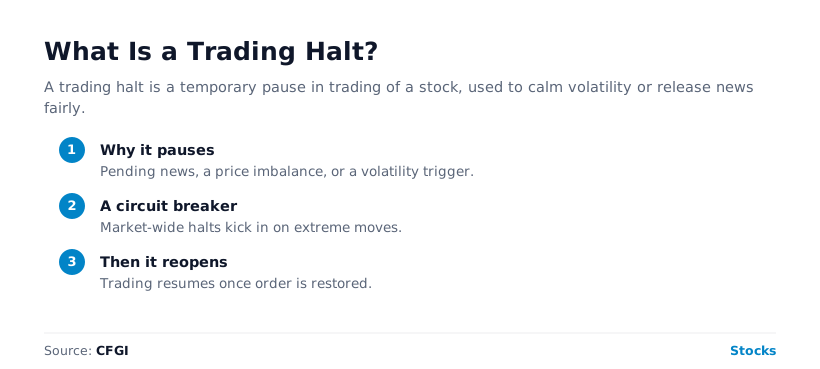
A trading halt is a temporary pause in the trading of a stock or the whole market, ordered by an exchange or regulator. Halts happen for two main reasons: to give everyone time to absorb major news, so nobody trades on it before it is public, or to cool extreme volatility when prices move too far too fast. A halt is essentially a circuit breaker, a pause, not a verdict on whether a stock is good or bad.
CFGI data
A volatility halt is fear made official, the single-stock cousin of the panic a Fear and Greed Index reads market-wide. Both interrupt the one-sided selling that drives CFGI’s Stock score toward Extreme Fear, below 20 on its 0 to 100 scale, by forcing a pause when emotion is running hottest.
Source: CFGI methodology, 10-input 0 to 100 model.
Key takeaways
- A trading halt temporarily pauses trading in a stock or the whole market.
- Halts are called for major news, extreme volatility or regulatory reasons.
- Single-stock halts use limit up-limit down (LULD) price bands.
- Market-wide circuit breakers trigger at S&P 500 drops of 7%, 13% and 20%.
- In March 2020, market circuit breakers fired four times in two weeks.
Pressing Pause On a Stock
When a stock is halted, no one can buy or sell it until trading resumes. The pause buys time, either so that everyone can learn a piece of news at once, or so that a frantic market can catch its breath. It is one of the market’s most basic safety features, and although a halt can feel alarming, it is usually the system working as designed, not a sign that something has gone irreparably wrong.
The Types of Halt
- News halts. Called around a major announcement, earnings, a merger, an investigation, so the information reaches everyone before trading restarts.
- Volatility halts. Triggered automatically when a single stock moves too far too fast, using preset price bands.
- Regulatory halts. Imposed by a regulator over a compliance or disclosure concern, and often longer.
- Market-wide circuit breakers. Pause the entire market when a broad index falls sharply in a day.
Single-Stock Volatility Halts
The most common automatic halt uses a mechanism called limit up-limit down, or LULD. Each stock has a price band around its recent average, and trades are not allowed to happen outside it. If a stock’s price runs up to the edge of the band and does not come back within about 15 seconds, trading pauses for around five minutes. The aim is to stop the kind of sudden, exaggerated swing, a "flash crash" in a single name, that can be caused by a fat-finger order or a runaway algorithm, without freezing the stock for any longer than necessary.
Market-Wide Circuit Breakers
When fear grips the whole market, not just one stock, market-wide circuit breakers kick in. Introduced after the 1987 "Black Monday" crash, when the Dow fell 22.6% in a single day, and updated in 2013, they are tied to how far the S&P 500 falls from the previous close.
| Level | S&P 500 drop | What happens |
|---|---|---|
| Level 1 | 7% | Trading halts for 15 minutes (before 3:25pm ET) |
| Level 2 | 13% | Trading halts for 15 minutes (before 3:25pm ET) |
| Level 3 | 20% | Trading halts for the rest of the day |
US market-wide circuit breaker levels.
The design is deliberate: brief pauses for the first two levels to let panic subside, and a full stop only in a genuine, all-day collapse.
March 2020: Circuit Breakers In Action
The clearest modern demonstration came during the COVID-19 crash. In a span of just two weeks in March 2020, the market hit a Level 1 circuit breaker on four separate days, each time after the S&P 500 plunged 7% within minutes of the opening bell. Far from a sign of failure, the repeated halts were the brakes doing their job, forcing a 15-minute pause into some of the most violent selling in history so that humans, not just panic and algorithms, could decide what to do next.
Do Halts Actually Help?
Mostly yes, but it is debated. Supporters argue that a forced pause lets traders digest information, breaks feedback loops of panic selling, and prevents prices from detaching entirely from reality. Critics counter that halts can interrupt genuine price discovery and even add anxiety, as traders rush to act before a halt or fret while frozen out of a position. What everyone agrees on is the key point for an investor: a halt is a timeout, not a verdict. It can precede good news or bad, and it says nothing by itself about whether a stock is worth owning.
Trading Halts and Sentiment
Halts and circuit breakers tend to fire at the emotional extremes, the very moments of peak fear or frenzy that push a Stock Fear and Greed Index toward the ends of its 0 to 100 scale. A market-wide circuit breaker is, in effect, the system formally acknowledging that fear has overwhelmed orderly trading. Reading halts alongside the broader mood helps put a scary headline in context: a pause at a moment of Extreme Fear is the safety valve working, not the market ending.
Frequently asked questions
What is a trading halt?
A temporary pause in trading of a stock or the whole market, ordered by an exchange or regulator, usually for a major news release, to cool extreme volatility, or for a regulatory reason.
What is a circuit breaker?
A market-wide halt triggered when the S&P 500 falls sharply in a day: 7% (Level 1) and 13% (Level 2) pause trading for 15 minutes, while 20% (Level 3) halts trading for the rest of the day.
What is limit up-limit down?
A single-stock safety mechanism that bans trades outside a price band around a stock’s recent average. If the price hits the band and does not return within about 15 seconds, the stock is paused for roughly five minutes.
Is a trading halt bad?
Not necessarily. A halt is a pause, not a judgment, used to keep markets fair or calm volatility. It can precede good or bad news and says nothing by itself about a stock’s value. This is education, not financial advice.
CFGI.io, Market sentiment research
The CFGI research team builds and maintains the CFGI Fear and Greed Index: a 0 to 100 sentiment score from 10 sub-indicators across hundreds of crypto assets and the equity market, refreshed every 15 minutes. We have tracked market emotion through multiple full crypto and equity cycles.
Think we missed something?
Spotted a gap, disagree with a take, or think we should cover a new topic? Message us and we'll act on your input.
Message us on TelegramKeep reading
This article is educational and is not financial advice. Crypto and equities are volatile and you can lose money. See our disclaimer.