Stocks
How Often Does the Stock Fear and Greed Index Update?
Quick answer
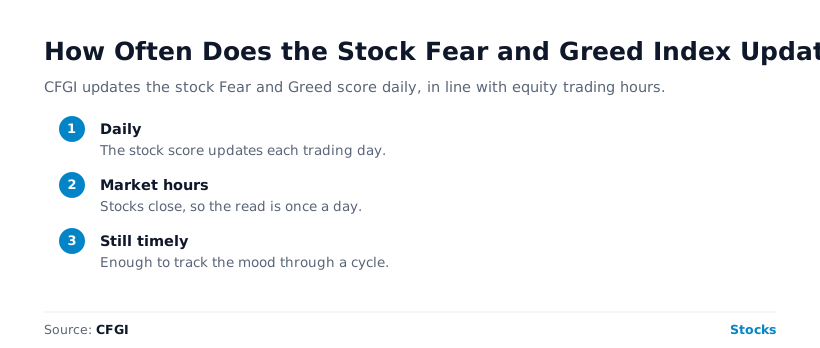
CFGI updates the stock Fear and Greed score once a day, in line with the fact that equity markets trade on set hours and close overnight. That is different from the crypto score, which refreshes every 15 minutes because crypto trades around the clock. For stocks, a daily reading captures where the equity crowd ended the session without drowning the signal in intraday noise. This is education, not financial advice.
CFGI data
CFGI has scored stock sentiment daily since 2021, across major indices and leading names, on a 0 to 100 scale. A daily cadence suits equities because exchanges close overnight; the crypto score, by contrast, refreshes every 15 minutes across 4 timeframes, matching a market that never closes.
Source: CFGI dataset, 2021 to June 2026.
Key takeaways
- The stock score updates once a day, set by equity trading hours.
- The crypto score updates every 15 minutes, because crypto trades 24/7.
- A daily reading captures the session cleanly, without intraday noise.
- The stock score holds steady over weekends and market holidays.
- CFGI has daily stock history back to 2021 and 15-minute crypto history to 2022.
Why Daily for Stocks
Stock exchanges trade on set hours and close overnight, so a sentiment score updated every minute would mostly track intraday noise rather than a meaningful shift in mood. CFGI updates the Stock Fear and Greed Index daily, which captures where the equity crowd actually ended the session and lines the score up neatly with the way equity data itself is reported.
| Market | Trades | CFGI updates |
|---|---|---|
| Crypto | 24 hours, 7 days | Every 15 minutes |
| Stocks | Set exchange hours | Once a day |
Update frequency, crypto versus stocks.
What "Daily" Actually Means
A daily cadence means the stock score is refreshed each trading day to reflect the latest completed session, then holds until the next one. On a weekend or a market holiday, when exchanges are shut, the number stays put, because there is no new trading to measure. That is a feature, not a gap: the score is meant to summarise a session, so it changes when a session does. If you check it on a Saturday, you are seeing Friday’s close, which is exactly the most recent real reading there is.
The score is built from several market inputs, things like momentum, volatility, breadth and demand for safe havens, each measured over the latest data and blended into one figure on a 0 to 100 scale. Updating that blend once a session keeps every component aligned to the same point in time, rather than mixing a fresh tick of one input with a stale reading of another.
How That Compares to Other Indices
Different fear and greed gauges make different choices. CNN’s well-known stock version recalculates throughout the trading day as its component data arrives, then stores one end-of-day value as the historical point for each session. CFGI takes the daily reading as the headline cadence and draws on 10 market inputs rather than seven. Both land on the same 0 to 100 scale and tell the same kind of story, fear near the bottom, greed near the top, so the practical difference is less about the number and more about how often it moves and what feeds it.
Why Crypto Updates Every 15 Minutes Instead
Crypto never closes. With trading running 24 hours a day, seven days a week, an overnight gap simply does not exist, and a once-a-day snapshot would miss the sharp swings that happen at 3am on a Sunday. So the Crypto Fear and Greed Index refreshes every 15 minutes, across four timeframes, to keep pace with a market that is always live. The contrast is a neat illustration of the rule behind both: the update frequency should match how often the underlying market actually trades.
What the Cadence Means for Using the Score
Knowing the rhythm changes how you should read the gauge. A daily stock score is a tool for context and positioning, not for scalping the next ten minutes. Checking it once a day, ideally after the close, tells you whether the crowd is leaning fearful or greedy as you think about the days ahead. Watching for a daily number to flick around tick by tick would be a misuse of it, because by design it does not.
The Simple Rule
Use the daily stock score as a once-a-day mood check, and the 15-minute crypto score when you need a live read on a market that never sleeps.
Does a Daily Score React Fast Enough?
For its purpose, yes. The worry people have is that a once-a-day number might miss a dramatic move, but a sharp sell-off or a powerful rally still shows up clearly in the very next reading, because the inputs that feed the score, momentum, volatility and the rest, all reflect that session’s trading. What a daily score deliberately filters out is the minute-to-minute chop that rarely means anything: a brief wobble at lunchtime that fully reverses by the close was never a real change in sentiment, and a daily reading is right to ignore it.
If you genuinely need an intraday pulse, the live gauge on the stock page reflects the most recent data CFGI holds, while the historical record is anchored to one clean value per session. That split, a current reading for now and a stable daily point for the archive, is the same approach most serious sentiment indices take, and it is what makes the history comparable from one day to the next.
Read the Latest
Frequently asked questions
How often does the Stock Fear and Greed Index update?
CFGI updates the stock score once a day, in line with equity trading hours. The crypto score updates every 15 minutes because crypto trades around the clock.
Why not update it every minute?
Stock exchanges close overnight and trade on set hours, so a minute-by-minute equity score would mostly track intraday noise. A daily reading captures the session cleanly and keeps every input aligned to the same moment.
Does the stock score change on weekends?
No. With exchanges closed, there is no new trading to measure, so the score holds at the last session’s value until markets reopen. Checking it on a Saturday shows you Friday’s close.
How far back does the data go?
CFGI has scored stocks daily since 2021 and crypto every 15 minutes since 2022. This is education, not financial advice.
CFGI.io, Market sentiment research
The CFGI research team builds and maintains the CFGI Fear and Greed Index: a 0 to 100 sentiment score from 10 sub-indicators across hundreds of crypto assets and the equity market, refreshed every 15 minutes. We have tracked market emotion through multiple full crypto and equity cycles.
Think we missed something?
Spotted a gap, disagree with a take, or think we should cover a new topic? Message us and we'll act on your input.
Message us on TelegramKeep reading
This article is educational and is not financial advice. Crypto and equities are volatile and you can lose money. See our disclaimer.