Markets
Why Is the Fear and Greed Index Showing Fear When Price Is Up?
Quick answer
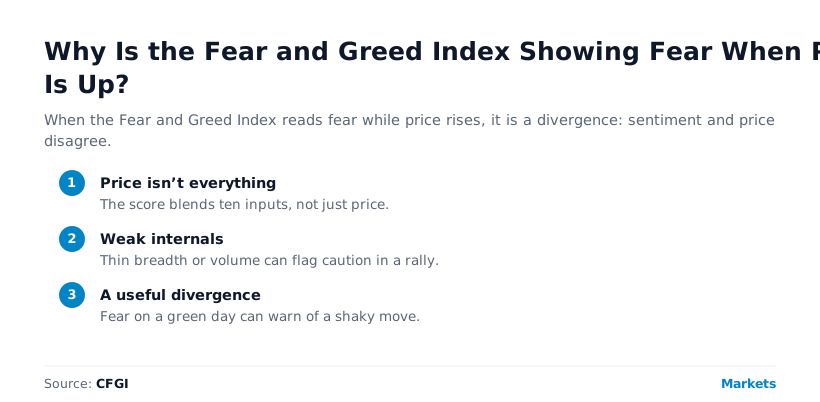
The Fear and Greed Index can show fear while price rises because it reads more than price. A rally on low volume, high volatility or weak breadth can leave the index cautious even as price climbs, a divergence. It often means the crowd does not trust the move, which can be bullish, a "wall of worry" the market climbs, or bearish, a fragile rally that fades. The divergence itself is the information; it is a flag to watch, not a verdict. This is education, not financial advice.
CFGI data
CFGI builds each score from 10 indicators, not price alone, so price and sentiment can diverge. That is the point: a rising price with a fearful reading tells you the move lacks the volume, breadth or momentum that usually accompanies conviction, which a price chart alone would hide.
Source: CFGI dataset, March 2022 to June 2026.
Key takeaways
- The index reads 10 signals, not just price.
- A rally on weak volume, breadth or momentum can read fearful.
- A divergence means the crowd does not fully trust the move.
- It can be bullish (a wall of worry) or bearish (a fragile rally).
- It is a flag to watch, not a prediction.
Why Sentiment and Price Can Disagree
The Fear and Greed Index is built from many signals: volatility, volume, breadth, momentum and more. Price is only one of them. So a price rise that is not backed by the others, a thin rally, a bounce on high volatility, a move led by only a few names, can leave the overall reading in fear. This is a feature, not a bug. A single price line cannot tell you whether a move has conviction behind it. A divergence between price and sentiment is exactly the information a composite index adds.
The Signals Beyond Price
To see why, it helps to know what the index reads besides price. Volume asks whether real conviction is behind a move or whether it is drifting up on thin trading. Market breadth checks how many assets are participating, a rally carried by just a handful of names is narrower and weaker than it looks. Volatility gauges how nervous the market is, since a price can rise even as fear and big swings persist. Momentum and safe-haven demand add further angles. When price climbs but these underlying signals stay weak or nervous, the blended score can sit in fear, because the move lacks the broad, calm, high-conviction participation that usually accompanies genuine greed. The index is telling you the rally is not as healthy as the price alone suggests.
Climbing a Wall of Worry
A fearful reading during a rising market is not necessarily bad, and can even be a bullish sign. Markets are often said to "climb a wall of worry": the most durable rallies frequently begin in disbelief and fear, while the crowd is still scarred from a recent decline and refuses to trust the recovery. As price keeps rising, those doubters are gradually forced to convert, and their delayed buying provides fresh fuel that pushes the market higher still. In this reading, persistent fear during an advance means there is still skepticism left to win over, and therefore still buying power in reserve. A rally that everyone already loves, by contrast, has no doubters left to convert.
The Wall of Worry
Fear during a rise can be fuel: as long as doubters remain, there are still buyers waiting to be converted. The most dangerous rallies are often the ones everyone already trusts.
Or a Fragile Rally
The same divergence can carry the opposite message, though, which is why it is a flag rather than a verdict. A price rising on weak volume and narrow breadth, with the crowd unconvinced, can simply be a fragile rally running on little real support, the kind that fades and rolls over once the thin buying is exhausted. In a downtrend, exactly this pattern describes a bull trap or a dead cat bounce: price pops, but the underlying sentiment never recovers, and the move proves false. So the fearful reading during a rise is the market warning you that the move lacks conviction, which can resolve either way. It tells you to watch closely, not which side will win.
How to Read the Divergence
The practical approach is to treat the divergence as a question, not an answer.
- Climbing a wall of worry: price rises while fear lingers, sometimes a sign the move has room as doubters convert.
- A fragile rally: the move lacks volume or breadth, and may fade.
- Either way, watch: the divergence flags that price and the crowd disagree, not which one wins.
Watch which side resolves the disagreement, does the rally pull sentiment up out of fear, or does it fail and confirm the caution?, and combine the reading with the trend and your own plan rather than acting on the divergence alone.
Frequently asked questions
Why does Fear and Greed show fear when price is rising?
Because the index reads more than price, volume, volatility, breadth and momentum among them. A rally not backed by those signals can leave the reading fearful. It is a divergence between price and sentiment, which a price chart alone would hide.
Is a divergence bullish or bearish?
Neither by itself. Fear during a rise can mean a "wall of worry" the market climbs, with doubters still to convert, or a fragile rally on weak volume and breadth that fades. It is a flag to watch, not a verdict.
What does the index read besides price?
Volume, volatility, market breadth, momentum and safe-haven demand, among ten signals. When price rises but these stay weak or nervous, the blended score can sit in fear, signalling the move lacks broad, high-conviction participation.
Should I trust price or the index?
Use both. The divergence itself is the signal: it tells you price and the crowd disagree, so watch which side resolves it and combine with the trend and a plan. This is education, not financial advice.
CFGI.io, Market sentiment research
The CFGI research team builds and maintains the CFGI Fear and Greed Index: a 0 to 100 sentiment score from 10 sub-indicators across hundreds of crypto assets and the equity market, refreshed every 15 minutes. We have tracked market emotion through multiple full crypto and equity cycles.
Think we missed something?
Spotted a gap, disagree with a take, or think we should cover a new topic? Message us and we'll act on your input.
Message us on TelegramKeep reading
This article is educational and is not financial advice. Crypto and equities are volatile and you can lose money. See our disclaimer.