Crypto
What Is a Bull Trap?
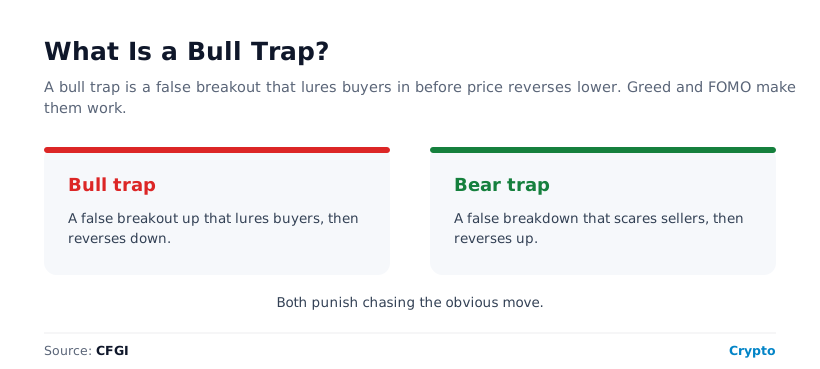
Quick answer
A bull trap is a false signal that a downtrend has ended: price breaks higher, lures buyers in expecting a rally, then reverses and falls, trapping them at a loss. They are dangerous because they spring at technical breakout points, where traders place their most confident bets and their stop-losses. They feed on greed and the fear of missing out, which is why they often appear when a Fear and Greed Index is rising into greed during a still-weak market. This is education, not financial advice.
CFGI data
Bull traps thrive on greed returning too early. CFGI per-asset scoring helps here: a coin pushing into Greed while the broader market stays fearful is the kind of divergence that flags a move running on emotion rather than broad support, and CFGI has scored hundreds of assets individually on its 0 to 100 scale since March 2022 to show it.
Source: CFGI dataset, March 2022 to June 2026.
Key takeaways
- A bull trap is a false breakout that traps buyers before price reverses.
- It springs at breakout points, capturing stop-losses.
- Weak volume and RSI divergence are warning signs.
- Waiting for a confirmed close beyond the level helps avoid one.
- Greed returning too early often powers them.
How a Bull Trap Works
In a downtrend, price sometimes breaks above a level that looks like a turning point. Buyers rush in, convinced the bottom is in. Then the breakout fails, price falls back below the level, and those buyers are trapped, holding at a loss as the downtrend resumes. The same idea in reverse is a bear trap. Bull traps work because of emotion: greed and FOMO make a breakout irresistible, so buyers act before the move has real support behind it.
Why Bull Traps Are So Dangerous
What makes a bull trap especially costly is where it strikes. Breakouts above a key level are precisely the moments traders feel most confident, so they buy aggressively and cluster their protective stop-loss orders just below the breakout level. When the move fails and price falls back through that level, it triggers all those stops at once, a wave of automatic selling that accelerates the reversal and deepens the losses. The trap thus turns the market’s own risk management against it: the very level that lured buyers in becomes the trigger for a cascade of selling. This is why a failed breakout often reverses far harder than a normal dip, it is selling its own trapped buyers.
How to Spot a Bull Trap
Bull traps leave clues for those who look beyond the price itself.
- Weak volume: a real breakout surges on heavy volume; a trap breaks out on thin, declining volume.
- RSI divergence: if price makes a higher high but the RSI makes a lower high, momentum is fading beneath the move.
- A sharp rejection: a strong reversal candle right after the breakout signals the buyers have already been overwhelmed.
- No broad support: the move is isolated, not confirmed by the wider market or related assets.
The common thread is that a genuine breakout is backed by conviction, volume, momentum, breadth, while a trap is a hollow move running on hope alone.
How to Avoid One
The single most effective defence is patience: wait for the breakout to confirm before acting on it. Rather than buying the first spike above a level, experienced traders wait for a full candle, often a four-hour or daily one, to actually close beyond it, since brief spikes that leave long wicks above a level frequently reverse. Many wait further still for a successful "retest", where price dips back to the broken level and holds it as support, proving the breakout was real. Demanding above-average volume on the move is part of the same discipline. None of this guarantees you avoid every trap, but insisting on confirmation filters out a great many false breakouts that pure FOMO would have you chase.
Wait for the Close
A wick above a level is not a breakout; a candle closing above it, on real volume, is closer to one. Patience for confirmation is the cheapest protection against a bull trap.
Sentiment and Bull Traps
A Fear and Greed Index can add context that price alone cannot. A breakout where sentiment is jumping into greed but volume and breadth are thin is more likely to be a trap, the move is running on emotion rather than broad participation. Per-asset scoring is especially telling: a single coin running hot into Greed while the broader market stays fearful is a classic divergence, a sign that the enthusiasm is local and unsupported rather than part of a genuine, market-wide turn. When greed returns too early and too narrowly, the conditions for a bull trap are exactly in place, which is why pairing the chart with a sentiment read can keep you from chasing a breakout that was never real.
Frequently asked questions
What is a bull trap?
A false breakout that lures buyers in expecting a rally, then reverses lower and traps them at a loss. It is common in downtrends and feeds on greed and the fear of missing out.
Why are bull traps so dangerous?
Because they spring at breakout points where traders bet most confidently and place their stop-losses. When the move fails, those stops trigger a wave of automatic selling that accelerates the reversal, so a failed breakout often falls harder than a normal dip.
How do you spot a bull trap?
Look beyond price: weak or declining volume on the breakout, RSI divergence (price higher highs but RSI lower highs), a sharp reversal candle, and a lack of broad support all warn that a breakout may be false.
How do you avoid a bull trap?
Wait for confirmation: a full candle closing beyond the level on above-average volume, and ideally a successful retest, rather than buying the first spike. Pairing the chart with a sentiment read also helps spot moves running on thin greed. This is education, not financial advice.
CFGI.io, Market sentiment research
The CFGI research team builds and maintains the CFGI Fear and Greed Index: a 0 to 100 sentiment score from 10 sub-indicators across hundreds of crypto assets and the equity market, refreshed every 15 minutes. We have tracked market emotion through multiple full crypto and equity cycles.
Think we missed something?
Spotted a gap, disagree with a take, or think we should cover a new topic? Message us and we'll act on your input.
Message us on TelegramKeep reading
This article is educational and is not financial advice. Crypto and equities are volatile and you can lose money. See our disclaimer.