Markets
Can the Fear and Greed Index Be Wrong?
Quick answer
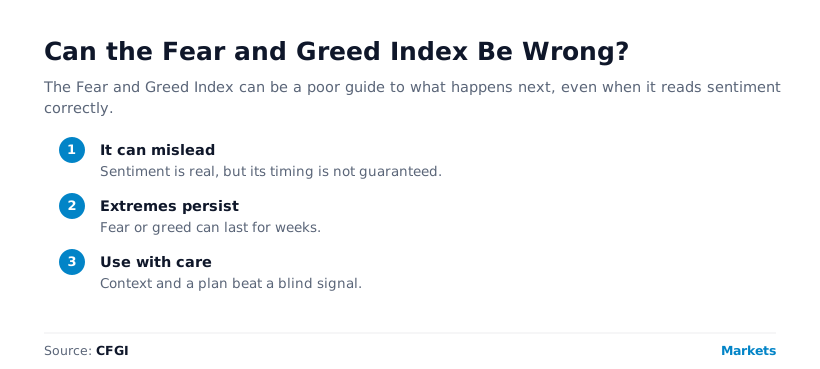
The Fear and Greed Index is rarely wrong about current sentiment, since it reads measurable signals, but it is often "wrong" as a forecast. The market can stay fearful or greedy far longer than seems reasonable, so an extreme reading can be perfectly accurate and still be early. The honest answer is that the index describes the present accurately and predicts the future poorly, and most of the times it "feels wrong" are really times it was used as a crystal ball it was never meant to be. This is education, not financial advice.
CFGI data
There are two questions hiding in this one. CFGI reads current sentiment accurately, but as a forecast it matches the next day only 49% of the time, against 79% for the same day, on data since March 2022. So it is usually right about now and close to a coin flip about tomorrow, which is the heart of what "wrong" really means here.
Source: CFGI dataset, March 2022 to June 2026.
Key takeaways
- It is rarely wrong about current sentiment, which it reads directly.
- It is often "wrong" as a forecast of what happens next.
- Sentiment can stay extreme far longer than seems reasonable.
- In edge cases, thin data or manipulation can make a reading noisier.
- Used as context rather than a forecast, it is hard to be misled by it.
Accurate Versus Right
When people ask whether the Fear and Greed Index can be wrong, they usually mean whether it can mislead them about price. The answer is yes, but almost never because it misreads sentiment. It reads the crowd accurately, from real, measurable signals. It can still mislead you, because it can be early: sentiment can sit at an extreme while price keeps going in the same direction. Separating "wrong about the mood" from "wrong about the next move" resolves most of the confusion.
What the Data Shows
| Question | CFGI agreement |
|---|---|
| Does it read sentiment now? | Yes, by construction |
| Same-day direction | 79% |
| Next-day direction | 49% |
Accurate now, weak as a forecast.
The Honest Read
An Extreme Fear or Extreme Greed reading can be correct about the crowd and still precede more of the same move. Treat the index as context, not a forecast, and combine it with trend and a plan. This is education, not financial advice.
Wrong As a Forecast: The Main Way It "Fails"
The most common way the index appears to be wrong is that the market refuses to turn when it "should". A reading of Extreme Greed can persist for months as a bull market climbs, and Extreme Fear can linger as a downtrend grinds on. In both cases the gauge is accurate, the crowd really is greedy, or really is fearful, but the expected reversal does not arrive on schedule. This is the famous warning that "markets can stay irrational longer than you can stay solvent". The reading was not wrong; the assumption that an extreme must reverse immediately was. That assumption, not the index, is the real source of the error.
When the Reading Itself Can Be Off
There are narrower cases where the reading itself can be noisier, and an honest answer has to acknowledge them. On a very thin, lightly traded coin, the underlying data is jumpier, so a per-asset score can swing on relatively little activity. Social-media inputs can be targeted by bots and coordinated hype, although blending many signals together is precisely what limits any one channel’s ability to distort the result. And like any data product, an input feed can briefly glitch. None of these make the index "wrong" in the usual sense, but they are reasons to lean on the extremes and the trend rather than over-interpreting every small wiggle, especially on smaller assets.
The Safeguard
The blend of many inputs is the main defence against a single bad signal. It is much harder to mislead a ten-input gauge than a one-input one, which is exactly why a synthesised index is steadier than any raw signal.
Different Providers, Different Answers
Another reason the index can seem "wrong" is that not all Fear and Greed indices agree. Different providers use different inputs, weightings and update frequencies, so on the same day one might read 35 and another 45. Neither is wrong; they are answering with slightly different recipes. CFGI, for instance, draws on ten inputs and scores assets individually, where a classic market index might use fewer signals and produce a single blended number. If two gauges disagree, the question is not which is "right" but what each one is actually measuring, and a per-asset reading will naturally differ from a market-wide one.
How to Use It Without Being Misled
The way to avoid being "fooled" by the index is to set the right expectations for it. Use it as context, never as a forecast. Weight the extremes, where it carries information, over the neutral middle, where it does not. Combine it with price action, trend, fundamentals and your own plan rather than acting on the number alone. And remember the asymmetry: it is better at flagging when to be brave in fear than at calling the exact top in greed. Held to those standards, the index is very hard to be misled by, because you are asking it only the question it can actually answer: how does the crowd feel right now?
Frequently asked questions
Can the Fear and Greed Index be wrong?
Rarely about current sentiment, often as a forecast. It reads the crowd accurately but predicts the next day only about half the time, so an extreme reading can be accurate and still be early.
Why does it feel wrong sometimes?
Usually because people use it as a forecast. Sentiment can stay extreme for a long time while price keeps moving, so the reading is correct about the crowd but does not predict the turn. The error is in the expectation, not the index.
Can the reading itself ever be off?
In edge cases, yes: a thin, lightly traded asset gives noisier data, and social inputs can be targeted by manipulation, though blending many signals limits the impact of any one. These are reasons to lean on the extremes and the trend, not single wiggles.
So is it useful?
Yes, as context. It describes the present accurately, which is valuable, as long as you do not treat it as a prediction and you weight the extremes over the middle. This is education, not financial advice.
CFGI.io, Market sentiment research
The CFGI research team builds and maintains the CFGI Fear and Greed Index: a 0 to 100 sentiment score from 10 sub-indicators across hundreds of crypto assets and the equity market, refreshed every 15 minutes. We have tracked market emotion through multiple full crypto and equity cycles.
Think we missed something?
Spotted a gap, disagree with a take, or think we should cover a new topic? Message us and we'll act on your input.
Message us on TelegramKeep reading
This article is educational and is not financial advice. Crypto and equities are volatile and you can lose money. See our disclaimer.