Markets
What Is Behavioural Finance?
Quick answer
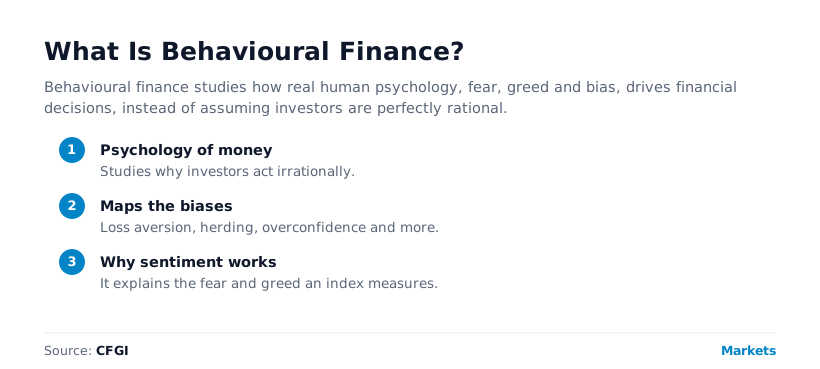
Behavioural finance is the study of how psychology shapes financial decisions. It rejects the old assumption that investors are perfectly rational, and instead looks at how emotions like fear and greed, and biases like herding and loss aversion, lead people to buy high and sell low. Founded in 1979 by psychologists Daniel Kahneman and Amos Tversky, it has produced multiple Nobel Prizes and explains the market anomalies that pure logic cannot, and it is the field that explains why a Fear and Greed Index works at all. This is education, not financial advice.
CFGI data
A Fear and Greed Index is behavioural finance made measurable. CFGI turns crowd emotion into a 0 to 100 score from 10 indicators, refreshed every 15 minutes since March 2022, putting a number on the very biases behavioural finance describes.
Source: CFGI dataset, March 2022 to June 2026.
Key takeaways
- It studies how psychology, not pure logic, drives financial decisions.
- It was founded in 1979 by Kahneman and Tversky with prospect theory.
- Emotions and biases lead people to buy high and sell low.
- It explains the market anomalies efficient-market theory cannot.
- It is the foundation a Fear and Greed Index is built on.
People Are Not Perfectly Rational
Traditional finance assumed investors are rational machines who weigh every fact and act in their own best interest. Behavioural finance starts from how people actually behave: they panic, they chase, they follow the crowd, and they let recent events loom too large. It draws on psychology to explain the patterns that pure logic cannot. This matters because those patterns move markets: why emotions move markets is the short answer to why prices overshoot in both directions, and behavioural finance is the field that studies it in detail.
Where the Field Came From
Behavioural finance was born in 1979, not from economists but from two psychologists, Daniel Kahneman and Amos Tversky, who published "prospect theory", a description of how people really make decisions under risk. Their work showed, with experiments, that humans systematically break the rules that classical economics assumed they followed. The field grew through the 1980s and earned serious recognition: Kahneman won the Nobel Memorial Prize in Economics in 2002, and Richard Thaler, another founder, who developed the idea of mental accounting, won it in 2017. What began as a fringe challenge is now mainstream, decorated economics.
Prospect Theory: The Cornerstone
At the heart of behavioural finance sits prospect theory, which describes how people actually weigh gains and losses. Two findings stand out. First, we judge outcomes against a reference point, usually what we paid or what we had, rather than in absolute terms. Second, losses loom larger than gains: the pain of losing is felt about twice as intensely as the pleasure of an equivalent gain, a pattern called loss aversion. Prospect theory also showed that simply changing how a choice is "framed" can flip people’s decisions. These insights overturned the tidy assumption that investors coolly maximise expected value, and explain a great deal of real market behaviour.
Why It Changed Everything
Classical theory assumed people maximise expected value. Prospect theory showed they actually react to gains, losses and framing in predictable, irrational ways, which is exactly what moves markets to extremes.
The Biases It Studies
From that foundation, behavioural finance catalogues the specific biases that distort investor decisions.
- [Herd behaviour](/learn/markets/what-is-herd-behaviour-in-markets/): following the crowd rather than your own analysis.
- [Loss aversion](/learn/markets/what-is-loss-aversion/): feeling losses far more painfully than equal gains.
- [Recency bias](/learn/markets/what-is-recency-bias-in-investing/): assuming the recent past will simply continue.
- [Overconfidence](/learn/markets/what-is-overconfidence-bias/): overrating your own knowledge and skill, leading to overtrading.
- [Confirmation bias](/learn/markets/what-is-confirmation-bias/): seeking only the information that agrees with you.
- Fear and greed: the two emotions that swing the crowd between extremes.
No one is immune. The value of naming these biases is that a named enemy is far easier to resist than an invisible one.
The Challenge to Efficient Markets
Behavioural finance grew up as a direct challenge to the "efficient market hypothesis", the dominant 1960s and 1970s idea that prices always reflect all available information and that investors are rational, so markets cannot be systematically "wrong". If that were fully true, bubbles, crashes, manias and panics should not happen, yet they plainly do. Behavioural finance explains these anomalies, excess volatility, momentum, and the tendency of prices to overshoot, as the predictable result of human bias. The debate is not settled; both Eugene Fama, the father of efficient markets, and Robert Shiller, a leading behavioural economist, shared the Nobel Prize in 2013. The honest synthesis is that markets are mostly efficient but periodically, and importantly, driven to extremes by emotion.
Why It Matters for You
Behavioural finance is not just academic; it is intensely practical, because its biases are the very ones that lead people to buy high and sell low. The lesson is not that you can switch off your own psychology, you cannot, but that you can build systems to outwit it. Writing down a plan in advance, sizing positions sensibly, automating regular investments, and using a neutral signal to check your emotions all turn the field’s findings into defences. Knowing that you will feel loss aversion at the bottom and overconfidence at the top is the first step to not acting on either. Self-awareness, structured into rules, is the practical payoff of the whole discipline.
Behavioural Finance, Measured
A Fear and Greed Index is, in a sense, behavioural finance made measurable. The field describes how crowd emotion swings between fear and greed; the index turns that swing into a single 0 to 100 number you can actually read. By quantifying the very biases the discipline catalogues, herding, loss aversion, euphoria, panic, it gives you a concrete tool for the abstract insight that markets are moved by psychology. CFGI builds that score from ten indicators, refreshed continuously, so the human emotions behavioural finance studies become something you can watch in real time rather than only recognise in hindsight.
Frequently asked questions
What is behavioural finance?
The study of how psychology, emotions like fear and greed and biases like herding, shapes financial decisions, instead of assuming investors are perfectly rational. It explains why markets overshoot in both directions.
Who founded behavioural finance?
Psychologists Daniel Kahneman and Amos Tversky, who introduced prospect theory in 1979. Kahneman won the Nobel Prize in 2002 and Richard Thaler, another founder, won it in 2017, marking the field’s move into the mainstream.
How does it challenge efficient markets?
The efficient market hypothesis assumes prices are always rational. Behavioural finance explains the anomalies it cannot, like bubbles, crashes and excess volatility, as the predictable result of human bias. Both views shared the 2013 Nobel Prize.
How does it relate to the Fear and Greed Index?
A Fear and Greed Index is behavioural finance made measurable: it turns the crowd emotion the field describes into a single 0 to 100 score, so the biases become something you can watch in real time. This is education, not financial advice.
CFGI.io, Market sentiment research
The CFGI research team builds and maintains the CFGI Fear and Greed Index: a 0 to 100 sentiment score from 10 sub-indicators across hundreds of crypto assets and the equity market, refreshed every 15 minutes. We have tracked market emotion through multiple full crypto and equity cycles.
Think we missed something?
Spotted a gap, disagree with a take, or think we should cover a new topic? Message us and we'll act on your input.
Message us on TelegramKeep reading
This article is educational and is not financial advice. Crypto and equities are volatile and you can lose money. See our disclaimer.